
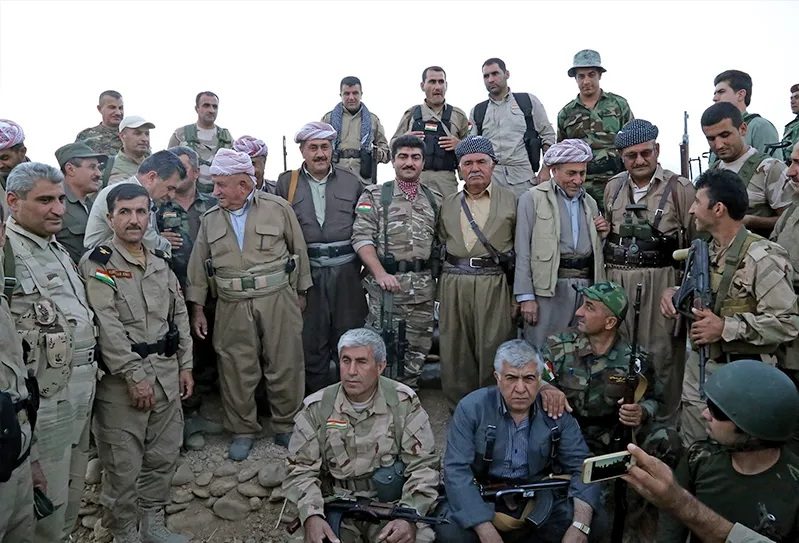
US withdrawal: An opportunity to redefine the role and capabilities of the Peshmerga forces
According to KurdPress, Niad Carnegie, in an analysis of the consequences of the end of the US-led coalition mission in Iraq, considers the withdrawal of foreign forces for the Kurdistan Region the beginning of a stage in which the Peshmerga forces and the regional government must rely more than ever on their domestic capabilities and at the same time strengthen their security relationship with Baghdad.A Carnegie Endowment analysis by Dutch journalist and Kurdish writer Vladimir van Wilgenburgh emphasizes that the end of the coalition’s presence, while raising concerns about security threats, could also be a test of the Kurdistan Region’s readiness to stand on its own two feet in the defense sector.
While Iraq has celebrated the end of the coalition’s mission, the atmosphere in the Kurdistan Region has been described as different. Banyar Faiq Karim, a Kurdish researcher at the London-based think tank Dialogue, said that the Kurds see this development as more worthy of mourning than celebration.
However, in an important part of the Carnegie analysis, the main issue is not just the concern about the US withdrawal, but also the question of whether the Peshmerga forces, after years of training, arming, and support from the coalition, can now take on more responsibility for defending the region.Sirwan Barzani, the commander of the Kurdish Peshmerga and Bazargan forces, said of the end of the coalition’s presence: “It’s not good. But this is Iraq’s decision. They invited the coalition forces and now they say we don’t need them anymore.”
He added that Kurdish and Iraqi forces have identified four or five ISIS cells near the town of Makhmur in Nineveh province in recent days, an issue that he sees as alarming after months of the group’s decline in activity.
Barzani, referring to the experience of 2014, said: “This is a warning. We know what happened in 2014. Now, the activity of terrorist cells will definitely increase and we can see this.”
Despite these concerns, he stressed that Iraqi and Kurdish forces today are better trained and prepared than in 2014.ISIS seized large swathes of Iraq and Syria in 2014, but local forces backed by the coalition have driven the group out of areas it controlled in the years since. Under the agreement between Baghdad and Washington, the coalition forces are scheduled to withdraw from Iraq by September 30, 2026.
The Carnegie analysis goes on to examine the threats facing the region, emphasizing that the most significant current threat to Iraqi Kurds is not necessarily ISIS, but rather the continued use of drone and missile attacks.
Since the start of the US-Israeli war against Iran on February 28, the Kurdistan Region has suffered about a thousand drone and missile attacks, killing at least 32 people.
Miles B.Retired U.S. Army Colonel and former coalition spokesman Coggins said of the threat from armed groups: “The main internal threat to Iraq is from armed groups that have attacked the Kurdistan Region of Iraq more than 800 times this year. The central Iraqi government is facing a major challenge.”
In such circumstances, Sirwan Barzani has emphasized the need to strengthen the region’s defense capabilities, but his argument is based on the fact that this responsibility must be pursued within the framework of Iraqi security. “Ultimately, this is Iraqi airspace. Even Iraq itself does not have adequate air defense; it is very weak in this regard. So we hope that when they provide these systems, they will also consider the Kurdistan Region.”
Joey Hood, a former U.S. ambassador to the region and former assistant secretary of state for Near Eastern affairs, also considered it unlikely that attacks in the region would stop.He said that not only American forces but also targets that are dependent on American interests are being targeted.
Hood added: “The federal government in Baghdad and the regional government in Erbil must immediately work with partners like the United States to acquire and deploy the air defense systems needed to defend against these attacks.”
But the crux of the Carnegie analysis lies in its final section, which examines the capabilities of the Peshmerga forces after the coalition leaves.
On September 30, CENTCOM commander Brad Cooper declared that Iraqi security forces, including the Peshmerga, now have the “capacity, leadership, and operational independence” to unilaterally manage security threats on their own soil.
Carnegie, however, contrasted this assessment with a different perspective.“Unfortunately, I think the government in Baghdad is not very concerned about infiltration and attacks into Kurdish areas,” said a former CENTCOM planner who was not named in the analysis.
In this light, the US withdrawal highlights two realities for the region: first, the need to increase reliance on the capabilities of the Peshmerga forces themselves, and second, the need to maintain and strengthen the security relationship with Baghdad.
On September 30, Masrour Barzani, the prime minister of the Kurdistan Region, said that the region should not be perceived as more vulnerable after the coalition’s withdrawal. “We assure you that the Iraqi forces are now more capable than they were in the past, while the Peshmerga forces are a strong and ready force that can confront any threat that affects the Kurdistan Region.A coalition official who has advised the Peshmerga forces described the coalition withdrawal as regrettable, but stressed that the region can no longer rely on a foreign presence for its security.
“It’s always good to have a military presence to monitor the efforts to counter ISIS and to continue military assistance,” he said. “The Kurdistan Region is in a very strategic geographic location.”
“The Peshmerga Ministry now has to do it itself. In that sense, the Peshmerga have had enough time. The autonomous region should and can remain strong enough to defend itself and set aside individual interests. It’s time for it to stand on its own two feet. There are enough revenues.»
In this way, the US withdrawal is not only presented as a security vacuum for the Kurdistan Region, but also as a point of reference for measuring the maturity and independence of the region’s security structure. This view places the main responsibility for the future on the Peshmerga forces and regional institutions themselves, who must now assume a greater part of the mission of protecting the region, relying on their own resources and capacities.
However, the Carnegie analysis also warns that greater reliance on domestic capabilities does not mean no need for Baghdad. Nechirvan Barzani, the president of the Kurdistan Region, attended the Baghdad ceremony to end the coalition mission and emphasized the importance of Iraq relying on its own capabilities.From Carnegie's perspective, this development shows that in the period after the US withdrawal, the region will be forced to cooperate more than ever with the central Iraqi government and define some of its security arrangements within the framework of the Iraqi government's structure.
The conclusion of the analysis published by the Carnegie Foundation is that the coalition's withdrawal could mark the end of a period of extensive reliance by the Peshmerga forces on foreign military support and mark the beginning of a period in which the Peshmerga must increase its independent defense capabilities. At the same time, the Kurdistan Region will continue to need security cooperation with Baghdad and foreign partners to confront regional threats.
User comments