
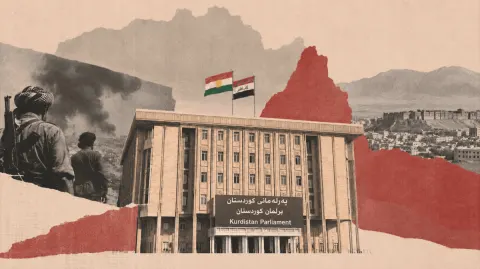
Kurdistan Regional Parliament; An institution that holds elections but has no power
Kurdistan Region Parliament, a new research report titled "Elections without Parliamentary Power; The Democratic Experience of the Kurdistan Region" by Goran Azad, a former member of the Kurdistan Regional Parliament, examining more than three decades of the institution's activity, shows that the competition and political agreements of the Kurdistan Democratic Party and the Patriotic Union, the monopoly of power, and the weakening of independent institutions have been the main obstacles to the formation of an efficient parliamentary system in the Kurdistan Region.
This research, published in November 2026 by the "Statistics" project, examines the history of the Kurdistan Regional Parliament from the first elections on May 19, 1992 to the sixth term and argues that although the formation of the parliament was one of the most important political achievements of the Iraqi Kurds after the 1991 uprising, this institution gradually lost its independence and real position in the power structure.
According to Goran Azad, one of the main roots of this crisis has been the Democratic Party and the Patriotic Union's view of elections and parliament as a means of maintaining and dividing power, instead of accepting democratic competition and the real transfer of authority to legal institutions.
This study considers the weakness of parliamentary oversight of the government, the influence of parties in the security and judicial systems, the dependence of independent institutions on political currents, the weakening of the opposition, and the decline in the quality of representatives as other factors in the region's democratic crisis.
In the final section, the report presents a set of proposals for overcoming the crisis, including drafting and approving the Kurdistan Regional Government's constitution, amending the electoral law and replacing the semi-open list system with a hybrid system consisting of 50 percent closed list and 50 percent open list, activating independent oversight and electoral institutions, implementing the party law, and ending the dependence of the armed forces on parties. It also emphasizes the need for legal and financial support for the opposition, independent media, and civil society.
The author finally suggests holding a comprehensive conference with the participation of politicians, academics, and experts to examine the reasons for the failure of the Kurdistan Region’s democratic experience since 1992 and to develop practical solutions to transform the parliament into an independent institution with real power. From the perspective of this research, without ending party monopoly and transferring power from political structures to legal institutions, holding elections alone cannot guarantee democracy and accountable governance in the Kurdistan Region.





User comments