Kurdish Lobby Network in America
According to KurdPress, documents from the US Department of Justice show that Kurdish political activity in Washington relies on a set of professional lobbying firms, representative offices, civil society organizations, research institutions, and direct connections with members of Congress, White House officials, and US ministries.
A review of contracts, financial reports, and documents filed with the US Department of Justice shows that Kurdish lobbying is not limited to holding diplomatic meetings or trying to gain political support, but is an organized activity with specific costs, hiring specialized companies, contacting congressional committees, attending think tanks, media activity, and trying to turn political demands into legal proposals.
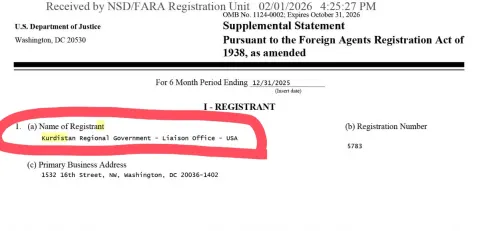
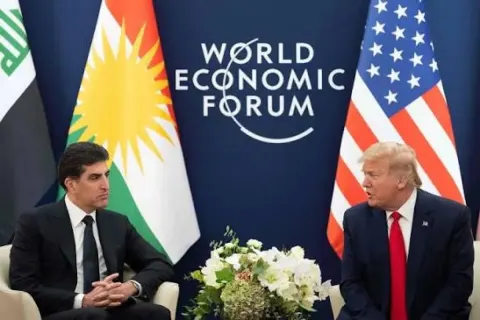
One of the most important documents for identifying this network is the file of the Kurdistan Regional Government's representative office in the United States, with registration number 5783 in the US Department of Justice's Foreign Agents Registration Act. Based in Washington, this office is responsible for pursuing the regional government's relations with Congress, the White House, the State Department, the Department of Defense, the media, and research institutions, in addition to diplomatic duties and official communications.
One of the Kurdistan Regional Government's most important new contracts in 2026 has been signed with Continental Strategy. The Washington-based company signed its contract with the regional government's representative office on July 1, 2026.
The importance of these companies' activities becomes clearer when reports on visits to the regional govern. The office's official report for the first half of 2026 shows that regional representatives have had contact with a range of members of parliament, senators, staff of specialized congressional committees, and officials from the National Security Council and the State Department during this periodment's representative office are reviewed.
Alongside the official network of the regional government, the Patriotic Union of Kurdistan has also created an independent path for lobbying in the United States. The most important example of this is the party's contract with Ballard Partners. A review of the company's records filed with the Department of Justice shows that its activities were not limited to public contacts but also included coordinating direct meetings with senior American officials.
In addition to the regional government and the Patriotic Union, Syrian Kurdish political representatives have also used the services of professional lobbying firms. One of the most important cases is the contract of the American mission of the Syrian Democratic Council with Brownstein Haight Faber Shrek. The company's mission included developing the Syrian Democratic Council's relations with the US government, informing policymakers about the role of the Syrian Democratic Forces in the fight against ISIS, introducing the structure of the autonomous administration in northern and eastern Syria, increasing political and media awareness of it, and pursuing economic and financial opportunities.
In addition to official contracts and lobbying firms, Kurdish civil society organizations and formations also play a role in shaping public support and conveying Kurdish demands to the American political structure. The civil society organization "American Kurdish Advocates" also focuses specifically on the issues of the Syrian Kurds. The organization defines its activities in three areas: political advocacy, civic engagement, and public education. It works through such means as training community leaders, encouraging electoral participation, holding public events, and communicating with representatives of Congress.
One of the most important political and institutional tools used by Kurds in Washington is the Kurdish-American Congressional Caucus, which was formed with the aim of strengthening US-Kurdish relations and keeping issues related to Kurdistan on the House agenda. The importance of this group is that it provides the opportunity to raise Kurdish issues within the framework of an inter-party structure.
The sum of these activities shows that Kurdish lobbying in the United States proceeds along several parallel paths. Hiring professional firms, meeting with representatives and staff of congressional committees, communicating with the National Security Council and the State Department, pursuing defense issues through the Defense Department and Armed Forces committees, cooperating with think tanks, media activity, organizing the Kurdish community, and trying to present and approve legal proposals are the most important tools of this network. In the economic sphere, communication with American companies, chambers of commerce, and institutions active in the energy sector is pursued with the aim of linking climate stability to American economic interests.



User comments