
The shadow of ethnic tension over the future of northeastern Syria; What do Arabs and Kurds want?
According to KurdPress, the simultaneous protests by Arabs and Kurds in the Syrian province of Hasakah show that the process of integrating northeastern Syria into the central government structure is still facing conflicting demands from local communities; Arabs want to accelerate the implementation of Damascus' sovereignty and end parallel structures, and Kurds warn of the loss of their linguistic and cultural rights following the return of state institutions.
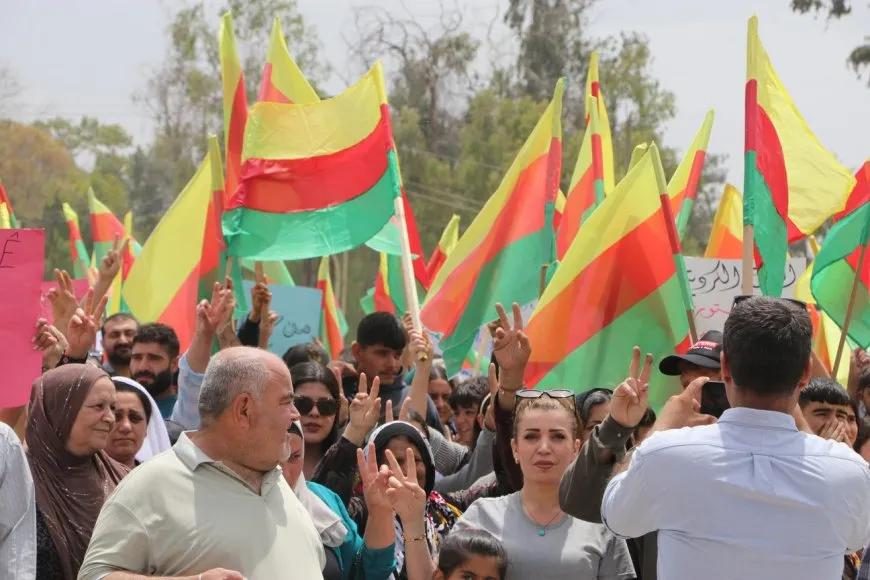
According to the "New Arab" magazine, hundreds of people took to the streets in the city of Hasakah on Friday in a demonstration titled "Friday to Restore Sovereignty" and demanded the Syrian government exercise full sovereignty over the province.The rally began after Friday prayers at the Abu Bakr al-Siddeeq Mosque in the Ghuwayran neighborhood and continued toward the Governorate Square. A rally in support of the protests was also held in the city of Serikani.
The protesters called for an end to the parallel security and administrative structures that remain in place as efforts are underway to integrate the Syrian Democratic Forces and the self-governing institutions into the Syrian government. The rallies were organized by the Hasakah Freedmen’s Association, which also called for the appointment of government officials based on merit rather than political or regional quotas, and for fair representation of the Arab, Kurdish, and Syriac communities in the governorate’s administration.
Syrian journalist Hassan Abdullah Khalaf told New Arab that Damascus has waited too long to fully exercise its sovereignty in Hasakah.Referring to the continued operation of parallel structures in the region, he asked how it was possible for a province to have two municipalities, two emergency and traffic police units, two armies, two transportation departments, two types of license plates and two driver’s licenses.
The protests came at a time when another wave of protests is underway in Kurdish areas of Hasakah province. Kurdish students and teachers have been protesting and striking in several areas in protest of the Syrian Ministry of Education’s decision to limit Kurdish language instruction to three sessions per week.
On Thursday, the schools of Ma’badeh and Rmeylan witnessed student strikes, and similar protests were held in Qamishlo and other predominantly Kurdish areas. The protesters are demanding the right to education in their mother tongue and recognition of Kurdish as an official language in the Syrian constitution.According to New Arab, Kurdish protests have grown in recent weeks, with students arguing that the three-session Kurdish language teaching schedule is not enough to preserve and expand the language. The dispute stems from a directive issued by the Syrian Ministry of Education in August that Kurdish will be taught as a “national language” in public and private schools in areas with significant Kurdish populations, with three sessions a week.
Kurdish activists contrast the decision with the education system in the autonomous regions, where Kurdish has been the main language of instruction for more than a decade. Syrian lawyer Bashir Jamal al-Din called for the Kurdish language rights to be guaranteed in the Syrian constitution, insisting that all lessons should be taught in Kurdish.He told Hawar News Agency that three sessions are not enough to teach the mother tongue.
The simultaneous nature of these two waves of protests has made the social and political challenges of implementing this year’s agreements between Damascus and the Syrian Democratic Forces more apparent. These agreements foresee the integration of the military and civilian institutions of northeastern Syria into the central government structure, and Syrian government security forces have begun deploying in Hasakah as part of this process.
However, the implementation of the agreement has faced criticism from two different perspectives. Some Arab residents of the region believe that the integration process is proceeding too slowly and that the continued operation of parallel structures has created a complex and inefficient situation in the field of security and public services.In contrast, the Kurds fear that a full return to central government institutions would undermine the political and cultural rights that have been built up over the years of self-rule in northeastern Syria.
Samer al-Ahmad, a political analyst, told New Arab that the pro-government protests are not necessarily against the integration agreements, but rather are aimed at pressuring Syrian authorities to fully implement them.
In such circumstances, Damascus is faced with two different demands in northeastern Syria: on the one hand, a section of society wants to accelerate the full return of state sovereignty and end parallel structures, and on the other hand, the Kurds want integration into the central government not to come at the cost of losing their linguistic and cultural rights.This situation shows that the main issue in the new phase is not only the integration of the Syrian Democratic Forces and the self-governing institutions, but also how to define the relationship between the central government and the various communities in northeastern Syria, which has also become one of the main challenges for Damascus.
User comments