
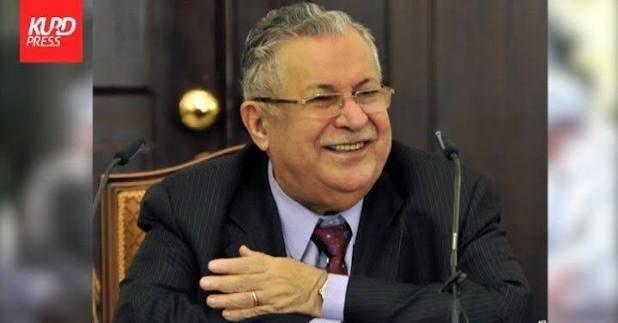
Jalal Talabani; The Story of a Politician Amid War, Peace, and Power
KurdPress- The ninth anniversary of Jalal Talabani's death once again brings up the name of a politician who experienced more than six decades of political developments in Iraq and Kurdistan. Talabani was born on November 12, 1933, in the village of Kalakan, near Dukan in the Sulaymaniyah region, and died on October 3, 2017, in Berlin. He was 83 years old at the time of his death.
But to understand his place, a simple biography is not enough.Talabani must be seen in a larger historical context; a history in which the Iraqi monarchy fell, a republic and military governments were formed, the Baath Party came to power, Saddam Hussein ruled Iraq, the Iran-Iraq War occurred, the Iraqi Kurds faced the Anfal campaign and the Halabja chemical attack, a Kurdish autonomous region was formed after the Persian Gulf War, and finally the Baath government fell in 2003. Throughout all these stages, Talabani's name was somehow tied to the political developments in Iraq.
From a political teenager to joining the Kurdistan movement
Mam Jalal entered political activity as a teenager and worked in the Kurdistan Democratic Party led by Mustafa Barzani. He later continued his education in Iraq and became one of the well-known figures of the new generation of Kurdish politicians in the 1950s and 1960s.Historical sources consider him to be a politician who, in addition to his political activity, was also associated with intellectual circles and leftist and socialist movements.
This intellectual difference was important. The Iraqi Kurdish movement in those years was not just a homogeneous political movement. Alongside the mainstream of the Kurdistan Democratic Party, groups of intellectuals and urban activists were looking for different models for organizing the Kurdish movement. It was in this political atmosphere that Talabani gradually transformed from one of the young figures of the Kurdish movement into an independent leader.
1975; The Year of Defeat and the Beginning of a New Path
The year 1975 was a turning point in the history of the Iraqi Kurdish movement and Talabani's political life. With the signing of the Algiers Agreement between Iran and Iraq in March 1975, Iran's support for the armed movement of the Iraqi Kurds ceased and the armed rebellion led by Mustafa Barzani collapsed. This defeat created a huge vacuum in the Kurdish movement.In such circumstances, Talabani and a group of Kurdish political activists sought to create a new organization; one that would both learn from the experience of the 1975 defeat and pursue a different form of political organization.
A historical document in the University of Exeter archives records the founding declaration of the Patriotic Union of Kurdistan, dated June 1, 1975, and also preserves a copy of Talabani’s handwritten text. The Patriotic Union of Kurdistan was not the product of the work of a single individual. The University of Exeter archives mention a series of early founders and activists, including Jalal Talabani, Fuad Masum, Noshirwan Mustafa, Adel Murad, and other Kurdish political figures.
Thus, although Talabani was the leader and central figure of the Patriotic Union of Kurdistan, the formation of this party must be seen as part of the broader developments in the political movement in Iraqi Kurdistan.Return to armed struggle
After its establishment, the Patriotic Union of Kurdistan pursued a struggle against the Baghdad government and resumed its armed activity inside Iraqi Kurdistan in 1976. This phase was the beginning of several decades of political and military struggle that made Talabani one of the most well-known Iraqi Kurdish leaders.
However, Talabani's policy was not limited to the military field from the beginning. He also attached importance to negotiations, relations with regional governments, and the creation of a network of foreign relations. The relationship with Iran was one of the most important examples of this policy; a relationship that became even more important during the years of the Iran-Iraq war.
These relations later always remained part of the discussions and disagreements about Talabani's career. To understand it, the geopolitical conditions of that period must also be taken into account.The Iraqi Kurds were at war with the Baghdad government, while Iran and Iraq were engaged in one of the longest regional wars of the 20th century.
The 1980s; Iraqi Kurdistan’s Dark Years
In the 1980s, the conflict between Saddam Hussein’s government and Kurdish groups became one of the most violent chapters in Iraq’s contemporary history.
The Anfal campaign in 1988 and the chemical attack on Halabja in the same year are among the best-known events of this period. The Patriotic Union of Kurdistan was one of the main forces opposing the Baath regime during those years, and Talabani continued his political and military activities both inside and outside Iraq.
It was during this period that the Patriotic Union of Kurdistan’s relations with Iran gained particular importance. Examining these relations without taking into account the Iran-Iraq War and the rivalries within the Kurdish movement would provide an incomplete picture of Talabani’s politics.On the other hand, the widespread repression of the Kurds during this period made the issue of Iraqi Kurdistan more of an international issue than ever before.
1991; A window opened after the Gulf War
The 1991 Gulf War changed the political order of Iraq. After Iraq’s defeat, uprisings broke out in the north and south of the country. In the north, Kurdish forces were able to take control of a large part of the Kurdish areas. The creation of a safe zone and a no-fly zone in northern Iraq effectively created a new political space for the Kurds.
In 1992, elections were held in the Kurdish areas, and the Kurdistan Democratic Party and the Patriotic Union of Kurdistan participated in the formation of new political institutions. This process eventually led to the formation of the Kurdistan Regional Government.
But this victory was not the end of the differences. In fact, a new phase had begun. The competition between the two main parties in Kurdistan over power, income, and areas under control.A war that pitted two Kurdish parties against each other
In 1994, the rivalry between the Kurdistan Democratic Party and the Patriotic Union of Kurdistan (PUK) turned into an armed conflict. This war is one of the most complex and controversial chapters in the Taliban’s political career. The two sides fought over political power, customs revenues, economic resources, and spheres of influence. During the war, alliances changed, and both sides received foreign support at various times.
In 1996, KDP forces, supported by Saddam Hussein’s government, entered Erbil and drove the PUK out of the city, an event that demonstrated the extent to which Kurdish internal rivalry was intertwined with regional politics and Baghdad. The war was finally settled by Washington in 1998.On September 17, 1998, Jalal Talabani and Massoud Barzani reached an agreement in Washington to end the fighting and share power and resources. The US State Department described the agreement at the time as a step towards opening a new chapter in cooperation between the two main currents in Kurdistan.
This point in Talabani’s career is of particular importance. A rival who had once faced Barzani on the battlefield finally sat down with him at the negotiating table.
2003; Baghdad was no longer the same Baghdad
The fall of Saddam Hussein in 2003 changed the course of Talabani’s political life forever. For years, he had been an opponent of the Baghdad government, but now he entered the new political structure of Iraq. Talabani became a member of the Iraqi Governing Council and participated in negotiations to shape the country’s interim political structure.
This development was one of the most important turning points in his life.Talabani went from being an opponent of the central government to being one of the builders of the new Iraqi government. The future of Kurdistan was no longer the only issue. Now the future of Iraq as a whole had to be decided.
April 6, 2005; A Kurd at the head of the Iraqi government
On April 6, 2005, the Iraqi parliament elected Jalal Talabani as president. He was the first non-Arab president of Iraq, and his election was considered one of the important symbols of the change in the country's political structure after the fall of Saddam Hussein. In his speech after the election, Talabani spoke of a united, democratic, and federal Iraq. This position is a key point in understanding his politics.
During his presidency, Talabani defended the framework of a federal Iraq; that is, preserving the state of Iraq while recognizing the extensive powers of the Kurdistan Region. In this way, a politician who had been involved in the struggle against the central governments in Baghdad for decades was now at the head of the same government.“Mam Jalal” and the Politics of Mediation
Among the Kurds, Talabani is known as “Mam Jalal.” This name became part of his political identity over the years.
In Iraq after 2003, Talabani tried to establish communication between different political groups. This role was of particular importance to him, because on the one hand, the president was the leader of one of the largest Kurdish parties, and on the other hand, as the head of state, he had to work with Shiite Arab groups, Sunni Arab groups, and other political movements.
Of course, this role should not be seen as a solution to all of Iraq’s disputes. Iraq’s new political structure was still facing deep ethnic, religious, and partisan crises. But the ability to create a channel for dialogue between different groups was one of the characteristics that has been repeatedly mentioned in various narratives about Talabani.Second term and a tense Iraq
Talabani was elected president for a second term in 2010 and remained in office until 2014. This period coincided with increasing political differences between Baghdad and the Kurdistan Region. Issues such as the region's budget, oil exports, the powers of the central government, and the status of disputed territories, including Kirkuk, complicated relations between Baghdad and Erbil.
In the post-2003 Iraqi political system, the president did not have the executive powers of the prime minister; therefore, Talabani's role should be understood primarily in terms of presidency, political mediation, and coalition-building.
Illness; the beginning of the end of political presence
In December 2012, Talabani suffered a stroke and was transferred to Germany for treatment. After that, his active role in Iraqi politics was greatly reduced.
He returned to Iraq in 2014, but was unable to fully resume his former political role.That same year, Iraq faced a major crisis caused by the rise of ISIS. From here on, a new generation of politicians gradually replaced the leaders of the Talabani generation on the political scene in Iraq and the Kurdistan Region.
In such a tense atmosphere, news of Talabani’s death broke on October 3, 2017. He died in Berlin, where he was receiving medical treatment.
Death of “Mam Jalal”; the end of a generation
Talabani’s death was not the only news of the death of a former president. He was one of the last figures of a generation of politicians who began their history from the era of armed struggle and the mountains and eventually reached the formal structure of the Iraqi state. His body was transferred to Sulaymaniyah and his funeral was held at a time when Iraqi Kurdistan was experiencing one of its most sensitive political periods after the independence referendum.
The timing of his death therefore had a special symbolic meaning.While the question of the future of Kurdistan had once again become a major issue in regional politics, one of the most important architects of Kurdistan's contemporary political history was no longer present.

User comments