
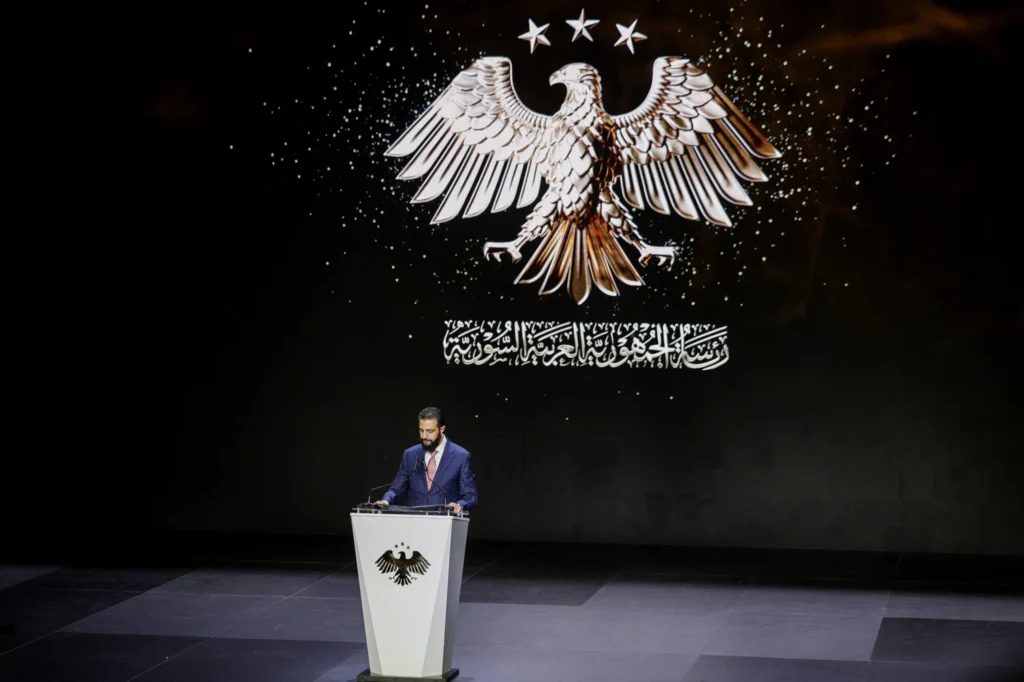
America's Misguided Policies Towards Syria / Atlantic Council
According to Kurdistan Press, Wael Al-Zayat, a non-resident fellow at the Syria Project in the Atlantic Council’s Middle East programs and director of the US-Syria Business Council, in an analysis referring to recent developments in Syria emphasizes that Washington’s policy towards the country during the years of war lacked a coherent strategy and that excessive focus on tactical goals, especially the fight against ISIS, has distanced the United States from its primary political goal towards Syria.
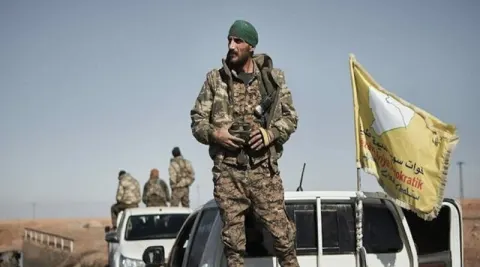
Al-Zayat writes that last month, the Syrian Democratic Forces announced that they would disband their military structure and integrate into the Syrian army. A day earlier, the United States officially removed Syria from the list of state sponsors of terrorism and removed Hayat Tahrir al-Sham from the list of terrorist groups.These developments, he said, along with the lifting of major US sanctions on Syria, including those imposed by Congress under the Caesar Act, have ended nearly five decades of US economic isolation of Syria.
He describes the moment as “bittersweet” for advocates of a more coherent US policy toward Syria, because he believes much of this could have happened years ago, potentially preventing thousands of deaths.
Al-Zayyat, who worked in the US government during the early years of the Syrian war, says Washington was pursuing two goals that appeared to be complementary: defeating ISIS and defending the Syrian people against the government. However, in practice, the two goals diverged and at times even conflicted.The result was that the United States succeeded in the first goal, but failed in the second, a failure that, according to the author, came at a very high human cost.
During the Obama administration, the CIA supported parts of the Syrian opposition, including the Free Syrian Army, to support a political transition and end the rule of Bashar al-Assad. At the same time, the US Department of Defense supported the People's Protection Units, a force that later continued to operate as the Syrian Democratic Forces, and whose main mission was to confront ISIS in northeastern Syria.
This approach initially seemed logical, writes Al-Zayyat, but Washington was never able to formulate a unified political and military strategy for the two paths.The problem, he believes, was compounded by the fact that the YPG, which the US supported as the main ground force in the fight against ISIS, was linked to the Kurdistan Workers’ Party, a terrorist organization that the US has designated as such and has been at war with NATO member Turkey.
The situation was further complicated when the Syrian Democratic Forces clashed with elements of the Syrian opposition, which the US also supported. In the author’s words, Washington was effectively supporting two forces that had different goals, both for each other and for the future of the Syrian war. He sees this situation not as a sustainable grand strategy but as an example of “serious policy incoherence” on the part of the US.Al-Zayyat says that at the same time, he warned that if the US decided to support the Syrian Democratic Forces, it would have to have a broader political and military strategy to determine the fate of the Assad regime. Otherwise, Washington would risk creating a new powerful actor in Syria, while abandoning the initial political goal that had brought the US into the war.
According to him, American officials gradually focused on the tactical issue of defeating ISIS, marginalizing the political issue of the continuation of the regime and ignoring the concerns of the Syrian people. Russia subsequently entered the war in support of the Assad regime. The author considers these interventions to be the main factors in the increase in casualties, the destruction of infrastructure and the massive displacement of Syrians.Al-Zayyat also points to growing Turkish discontent with US cooperation with the YPG and the gradual weakening and dispersion of the Syrian opposition, writing that during the war, about a million Syrians lost their lives and 12 million were displaced inside and outside the country. According to him, far-right parties close to the Kremlin in Europe have also used the Syrian refugee crisis for their political goals.
The author directs another part of his criticism to Idlib. In his opinion, the Obama administration considered the groups that dominate northwestern Syria to be largely unworkable, because Hayat Tahrir al-Sham, which previously operated under the name Jabhat al-Nusra, was still on the list of terrorist groups.He writes, citing former senior US officials, that Washington saw Idlib as so entangled with al-Qaeda-linked movements that any contact or engagement with the armed groups ruling the region was considered politically costly. In Al-Zayyat’s view, this became one of America’s most important mistakes.
He emphasizes that Washington did not necessarily have to trust HTS, but it could have accepted that the Syrian issue was not simply a counterterrorism case, but a political conflict in which millions of Syrians were competing for the future of their country.
According to him, the US could have maintained its contact with opposition groups in Idlib to gain a more accurate understanding of developments in the region and even indirectly, through parties such as Turkey, had contact with HTS.In the author’s view, such an approach could have helped Washington better understand the true nature and potential of the group that would later topple the Assad regime.
Al-Zayyat sees the current situation in Syria as a striking paradox: Washington once considered Hayat Tahrir al-Sham too dangerous to engage with, but it now holds power in Damascus. The United States has spent years trying to manage, contain, or marginalize the opposition, but in the end, these same forces have prevailed. On the other hand, the force that the United States had strengthened as its most important field player in Syria is now being dissolved and integrated into the structure of the Syrian government.In his view, Washington should not evaluate foreign policy solely on the basis of whether a decision was rational at the time it was made; it should also consider the ultimate outcome of the set of decisions and the trajectory that those decisions create.
Al-Zayyat writes that support for the Syrian Democratic Forces was instrumental in defeating ISIS, and this real success should not be ignored. Nor should the sacrifices of Kurdish forces in the fight against ISIS be underestimated. However, tactical success in the fight against ISIS cannot be equated with a grand strategy for the future of Syria.
He also believes that the US’s reluctance to engage meaningfully with Hayat Tahrir al-Sham was understandable at the time, given the group’s history and its inclusion on the terrorist list, but foreign policy should not be halted simply because a group is on such a list.In his view, the lack of a coherent strategy for Syria has limited and ineffective US influence on the country’s development path, with grave humanitarian consequences for Syria and the region.
The author emphasizes that Syria is no longer the Syria of Bashar al-Assad; at the same time, the Syria that has emerged today is neither the Syria that Washington had counted on in 2015 nor the country that Russia and Iran wanted to preserve.
In Al-Zayyat’s view, Syria is now emerging from a devastating war and, despite extensive challenges, has a significant opportunity for reconstruction. He calls on the US to help build effective institutions, revive the economy, integrate the armed forces, protect the rights of Kurds and other minorities, prevent the return of terrorism, and reduce the space for Iran and other destabilizing actors.He sees the most important change needed in Washington’s approach to Syrian society, stressing that the United States must see Syrians as “political actors,” not simply as proxies, partners, terrorists, refugees, or victims.
In conclusion, Al-Zayat writes that Syria has shown what happens when tactical goals replace strategic goals. The most important lesson from the current developments, he believes, is that it is not too late to reform America’s strategy toward Syria.
Source: Atlantic Council
Wael Al-Zayat* is the director of the US-Syria Business Council in addition to his work at the Atlantic Council and previously served for a decade at the US State Department.
User comments