
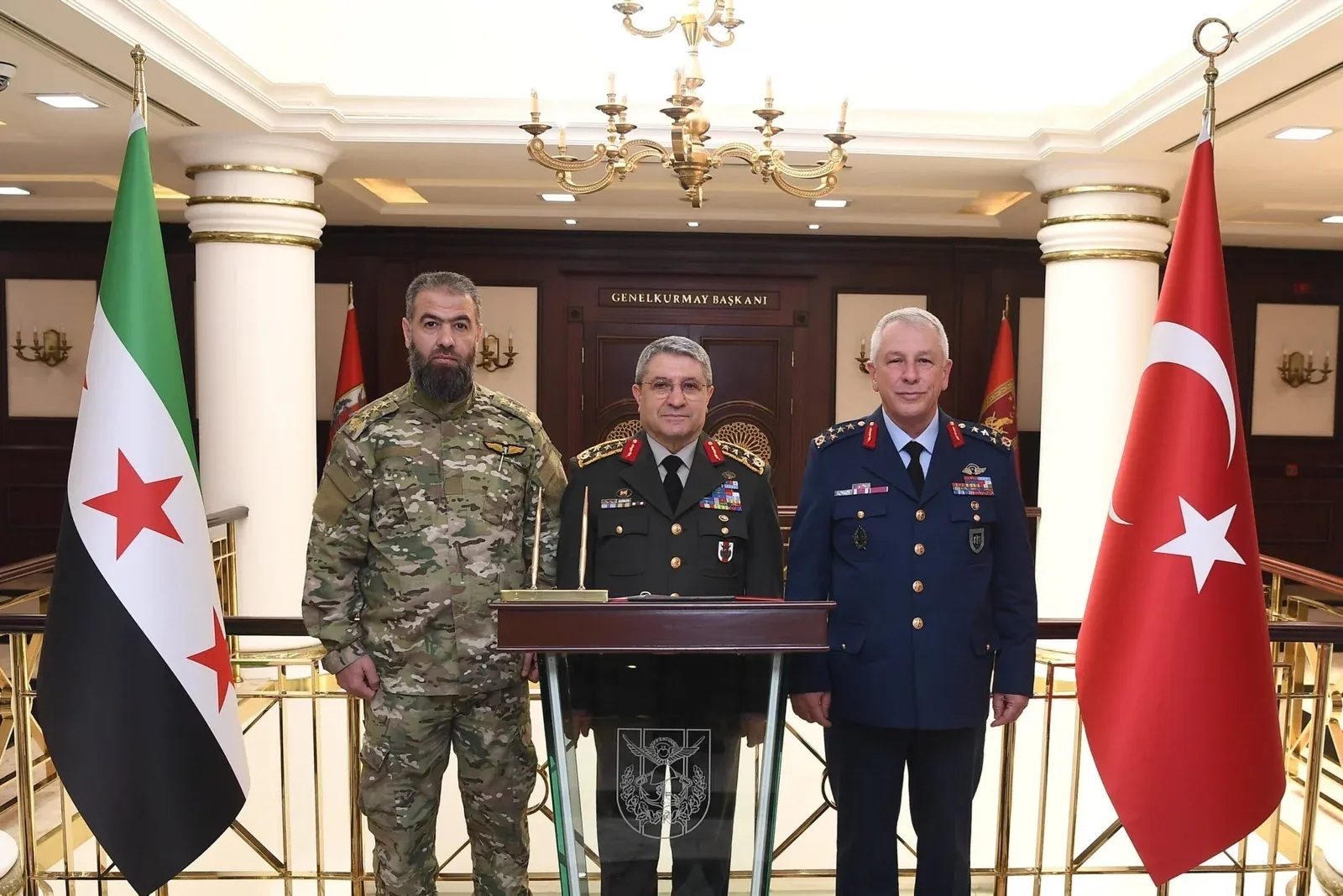
Turkey’s Role in Rebuilding the Syrian Army
According to Kurdistan Press, according to a new analysis by National Context, Turkey is no longer just seeking to maintain a military presence or sell weapons in Syria.Ankara is now on a path that could lead to a deeper involvement in the reconstruction of the Syrian army, from training officers and holding joint exercises to providing weapons, communications, command systems, ammunition, and equipment maintenance. If this trend is consolidated, Turkey’s influence in Syria will no longer be limited to military forces or armed groups aligned with Ankara, but could also become entrenched in the formal structure of the Syrian army.
This development comes at a time when Israel has become sensitive to Turkey’s expanding military role in Syria. Israel’s concerns are not limited to the presence of Turkish forces, but also include the possibility of establishing new bases and deploying advanced systems that could limit the freedom of action of its air force in Syria.Israeli attacks on some Syrian military installations that were said to be used by Turkey are also a sign of this concern.
But Damascus has a different view. Syrian President Ahmed al-Sharaa wants to turn a country that has been largely depleted of its military capacity by years of war into a regional power again. To achieve this goal, rebuilding the army is inevitable. However, Damascus does not seem to want to replace its old dependence on Russia with a new one on Turkey. For this reason, in addition to its close relationship with Ankara, it has maintained its relations with Saudi Arabia and other Arab countries, resumed military relations with Russia, and has not abandoned its ties with the United States and Europe.
But the issue is not just a choice between a few countries.Rebuilding the army, unlike buying a few tanks or planes, requires an interconnected network of capabilities. Aircraft must be compatible with radar and air defense; troops need a communications network and command system; ammunition must be compatible with weapons, and all of this depends on training, maintenance, and the supply chain. With a damaged economy and destroyed infrastructure, Syria cannot easily buy unrelated equipment from several different countries and put it together into a coherent structure.
This is where Turkey becomes important to Damascus. On the one hand, Ankara shares a border with Syria and has been involved in the country’s military developments for years, and on the other hand, its defense industry has expanded significantly in recent years.Turkey can now offer a range of military equipment and services, from armored vehicles and drones to communications, radar, ammunition and air defense. Moreover, Turkish products are a more practical option for a country with limited financial resources, in terms of price and availability, than many Western manufacturers.
That is why National Context emphasizes the concept of a “defense ecosystem.” Turkey wants to transform from an arms seller to a country that provides its foreign partner with a range of military capabilities, from design and production to software, ammunition, training, maintenance and support. Haluk Gürgün, the head of Turkey’s defense procurement agency, also emphasized the same shift in approach, saying that countries are gradually seeing Turkey not as a seller of a product, but as a defense ecosystem.This model is not entirely new for Turkey. Ankara has been involved in training military forces in Somalia for years and has been building, training and equipping the country’s navy under a 10-year agreement. In Azerbaijan, training cooperation and joint exercises have also reached a high level of operational coordination between the two sides. But Syria is a much bigger experience for Turkey, because this time it is not about rebuilding a specific capability; almost all components of a national army must be rebuilt at the same time.
In such a situation, Turkey’s advantage is not only that it can sell weapons. More importantly, Ankara already has access to the institutions that are supposed to form the new Syrian army. During the Syrian war, Turkey had close relations with a number of groups affiliated with the Syrian National Army, and some of these forces later became part of the new Syrian Ministry of Defense.Thus, Ankara did not start from scratch after the fall of Bashar al-Assad; rather, it had connections and networks that were already present within the emerging Syrian military structure.
But more important than this precedent is the change in the direction of cooperation. Turkey is now trying to move from influencing armed groups to directly cooperating with official Syrian military institutions. The August 2025 defense agreement established a framework for the supply of weapons and logistical equipment, training, consulting, transfer of experience, and strategic planning. Thus, Turkey has become involved not only in the sale of equipment, but also in the process of forming the Syrian army itself.
Officer training is perhaps the most obvious example of this trend.Syrian military delegations have visited the Turkish National Defense University, and 49 Syrian military students have entered Turkish military academies for training; 10 in the land sector, 18 in the navy, and 21 in the air force. In numerical terms, this number is not very large, but the importance of the matter lies elsewhere: these individuals could be part of the next generation of Syrian military commanders. Their training in a foreign military structure means that part of their professional experience, organizational methods, and planning style will be formed in the Turkish military environment.
This relationship has continued in 2026. A delegation from the Syrian Ministry of Defense visited the Turkish National Defense University again in June, and Syrian army troops participated in the “Ephesus 2026” exercise, the first appearance of the new Syrian army in a foreign exercise.In the exercise, Syrian forces trained alongside Turkish forces in conditions that encompassed simultaneous ground, naval, and air operations. Such experiences gradually build a kind of operational familiarity, even if Damascus has not officially adopted Turkey’s military doctrine.
Cooperation has not been limited to the ground forces. In July, the commander of the Turkish navy traveled to Latakia and met with Syrian naval officials. For the Syrian navy, which is in need of extensive reconstruction, this type of cooperation could link training, equipment, and future purchases from the outset.
In the area of weapons, it is still not possible to say with certainty how much Turkish equipment has entered the Syrian army.The available information mostly indicates possible packages or areas of negotiation; areas such as armored vehicles, drones, artillery, missiles and air defense. Therefore, it is too early to talk about a “Syrian army equipped with Turkish equipment”. The importance of the matter is that Turkey is already involved in several parts of the Syrian military reconstruction.
The timing of Turkey’s entry is also of great importance. Many of the key decisions about the future Syrian army have not yet been finalized. Damascus must determine how the communication and command networks will be designed, how the air defense will be structured, how the air force will be rebuilt, and on what basis the logistics and maintenance system will operate. Turkey has entered this process at a time when many of these choices are still on the table. As a result, it can also influence the standards and requirements of the future Syrian army.This is where Turkey’s new form of influence becomes important. Influence over an armed group depends largely on commanders, financial resources, and political conditions, and can be lost when these change. But when influence is exercised over officer training, communications software, ammunition, maintenance, and operational standards, it is much harder to change. Once an army chooses a particular communications network and equipment, subsequent decisions are influenced by previous choices.
For Syria, this model has an important advantage. The country’s economy is too weak to support a modern army with the most advanced Western equipment in the short term. The World Bank estimates the cost of physical reconstruction in Syria at about $216 billion, a large part of which is for civilian infrastructure.Damascus must rebuild its electricity, water, roads, and housing, as well as spend on its army. In such circumstances, it would be more attractive to gradually equip an army with systems that are less expensive and can be upgraded over time.
Turkey’s defense industry has found the right capacity for exactly such a market. Today, the country produces everything from light weapons and ammunition to armored vehicles, artillery, drones, electronic warfare, communications systems, command and control, radar, missiles, air defense, helicopters, training aircraft, and naval equipment. Turkey’s defense industry network has grown from 56 companies in 2002 to more than 4,500 companies.
This diversity allows Damascus to start at a level it can afford and gradually move forward.Tactical drones and communications systems could enter the military structure before advanced combat aircraft; ground forces could be equipped with new equipment before air defense is completed, and then, as the economy improves, more sophisticated systems could be added to this structure. In this case, Turkey would not only be a seller of current equipment, but also a supplier of the next generation of equipment.
In areas such as communications, electronic warfare, and command and control, this trend could be even more significant. Companies such as Aselsan and Havlsan are involved in building parts of Turkey’s military electronic architecture, and Roketsan is active in the field of missiles and guided munitions.When multiple parts of an army rely on systems designed to work together, replacing just one of them is not enough, and changing the entire network becomes more costly.
Of course, Turkey is not Damascus’ only option. Russia still has a long experience of working with the Syrian military infrastructure and has not completely lost its footing in the country, but Moscow’s military export capabilities have been severely reduced, and the war in Ukraine has involved a large part of Russia’s defense capacity. Russia’s major arms exports are expected to fall by about 64% between 2016-2020 and 2021-2025.


User comments