
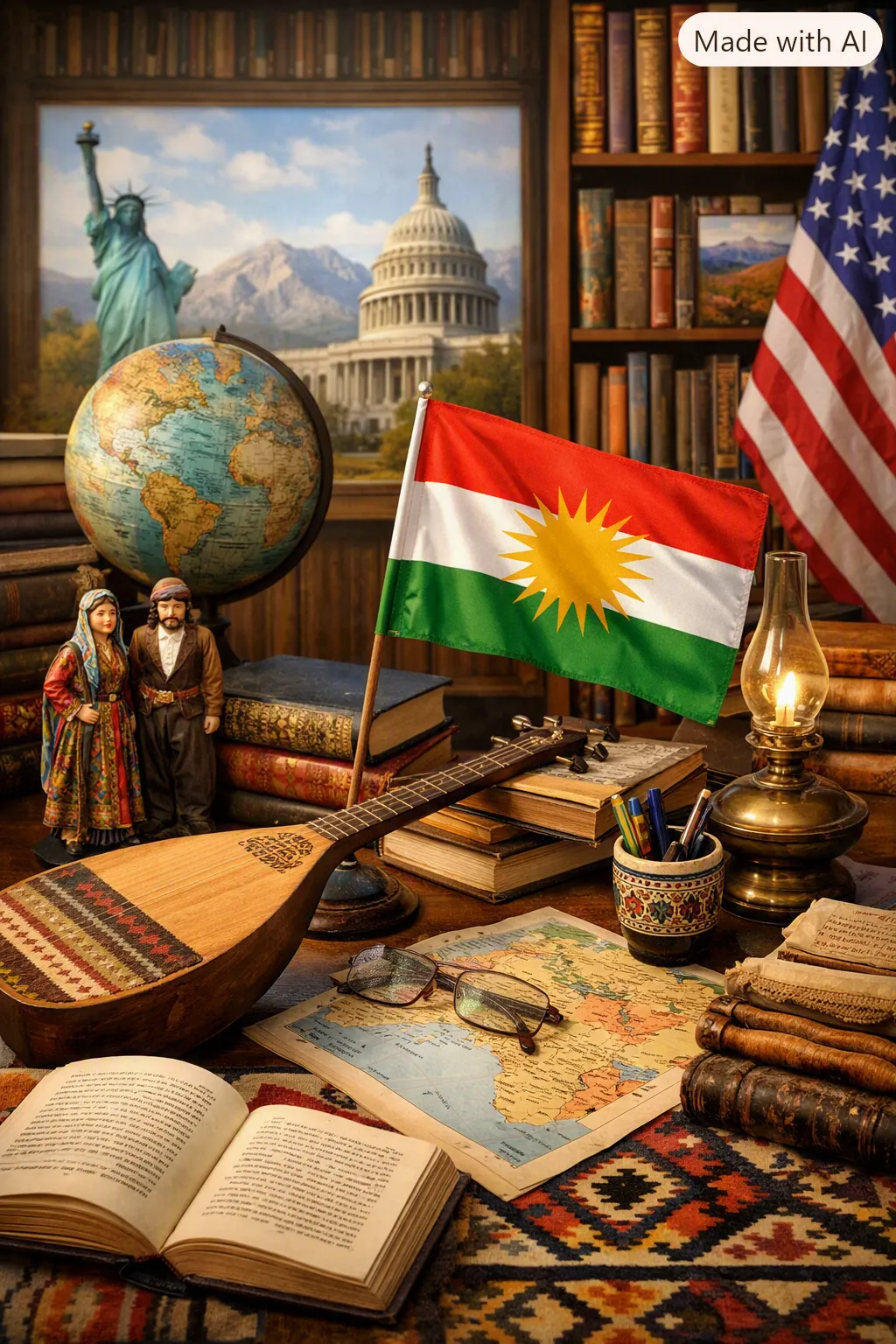
Knowledge Production About Kurds in America
According to KurdPress, the study of Kurdish-American relations is not complete by examining documents from the State Department, the White House, the Defense Department, and the country's Congress.Alongside the formal structure of US foreign policy, over the decades a network of universities, think tanks, Middle East studies centers, Kurdish studies programs, language courses, university chairs, researchers, former diplomats, retired military personnel, and Kurdish institutions has emerged that play a role in producing, transmitting, and reproducing knowledge about the Kurds.
Today, this network has several layers. Some of it is made up of centers whose productions are directly related to foreign policy, security, and decision-making in Washington, including the RAND Corporation, the Council on Foreign Relations, the Washington Institute for Near East Policy, American Enterprise, the Middle East Institute, the Carnegie, the Wilson Center, the Foundation for Defense of Democracies, Brookings, the Center for Strategic and International Studies, and the US Institute of Peace.At the academic level, a number of major American universities study the Kurds from the perspectives of history, politics, sociology, language, literature, culture, Ottoman studies, and Middle Eastern studies. Among these universities, some have gone beyond the stage of sporadic study of the Kurds and have established specific programs, chairs, courses, or research structures for this field.
At the University of Central Florida, a dedicated Kurdish political studies program and the “Najamuddin Karim and Jalal Talabani Chair in Kurdish Political Studies” have been established. American University in Washington runs the “Global Kurdish Initiative for Peace.” Indiana University is pursuing Kurdish language education within the framework of its Center for Central Eurasian Studies, and Harvard has also included an official Sorani Kurdish language course in its curriculum in 2026.The University of Pennsylvania also offers an “Introduction to Sorani Kurdish” course.
Accordingly, what has emerged in the United States is not simply a collection of articles about the Kurds, but rather a set of scientific, linguistic, and policy infrastructures that produce part of the knowledge used by the American academic, media, and policy-making communities about the Kurds.
The University of Central Florida; A Prominent Example of the Institutionalization of Kurdish Studies
One of the clearest examples of the institutionalization of Kurdish studies in the United States is the University of Central Florida. The university’s Kurdish Political Studies program describes itself as “the first and only academic program in the United States focused on Kurdish issues.”The program is located in the School of Politics, Security and International Affairs and pursues activities such as research, teaching, organizing conferences, publishing works and creating academic collaborations related to Kurdish studies. Official page of the Kurdish Political Studies Program at the University of Central Florida
The importance of this program is not limited to its title. The University of Central Florida also hosts the “Najmuddin Karim and Jalal Talabani Chair in Kurdish Political Studies”. According to official information from the university, the chair was established on October 29, 2015 and its mission is to teach, research, support scholarly activities, organize conferences, workshops and other academic programs in the field of Kurdish political studies. The university introduces this chair as the only position of its kind in the United States.Official UCF Kurdish Political Studies Chair and Program Page
The chair was established with a $1 million endowment led by Najmuddin Karim. When the University of Central Florida introduced the chair, Karim was introduced as a neurosurgeon and then-governor of Kirkuk. UCF’s official report on the creation of the Kurdish Political Studies Chair
The inclusion of Jalal Talabani’s name in the title of this chair has a special symbolic and institutional significance. The name of the late Iraqi president in an American academic structure that focuses exclusively on Kurdish politics has thus become part of the official space of American academic education and research.
Talabani Chair; From Academic Title to the Cycle of Knowledge Production
The current holder of the “Najmuddin Karim and Jalal Talabani” Chair at the University of Central Florida is Mehmet Görse, a professor of political science and director of the Kurdish Political Studies Program.The university describes his areas of study as Kurdish politics, ethnic and religious conflicts, peacebuilding, democratization, and issues related to the Middle East. Introducing the Director of the UCF Kurdish Political Studies Program
The structure of the program suggests that the chair is not just an honorary title. In addition to the chair, the UCF Kurdish Political Studies Program offers an award for the best paper in Kurdish studies, research activities, conferences, and educational programs. The university has announced that the paper award will consider works published in peer-reviewed scientific journals. Official UCF Kurdish Studies Program and Award page
The program’s advisory board is also a mix of academic figures and individuals with diplomatic and military backgrounds.The list includes Peter Galbraith, former US ambassador to Croatia, retired General Jay Garner, and Joe Reeder, former US deputy secretary of the Army, among university professors and Kurdish figures. List of members of the advisory board of the UCF Kurdish Political Studies Program
This combination does not in itself prove US government interference in the academic content of the program, but it does indicate the existence of an institutional connection between Kurdish studies and a network of US diplomatic, military, and foreign policy experience.
The Kurdish language; a key link in the production of knowledge
A significant part of the production of knowledge about the Kurds is related to the teaching and understanding of the Kurdish language. A researcher who does not have access to Kurdish languages receives a significant part of Kurdish sources, media, literature, and documents through translation or intermediaries.
Indiana University is an important example in this regard.The University's Center for Central Eurasian Studies includes Kurdish as one of its teaching languages and provides the opportunity to study Kurdish as part of its Less Taught Languages Program. The university also offers Sorani and Kurmanji language instruction and related resources. Indiana University Kurdish Language Program
The official Indiana University website also introduces Hewa Khalid as a Kurdish language instructor. In addition to teaching, the university is also active in developing Kurdish educational resources and teaching the language at various levels. Indiana University Kurdish Language Page
The University of Pennsylvania also offers the course "Introduction to Sorani Kurdish" in its official course catalog. This course follows the basic education of the Sorani language along with cultural and literary components. University of Pennsylvania Kurdish Course Catalog
Harvard has also included Sorani Kurdish in its official language teaching structure.In 2026, the course “Elementary Kurdish I” was included in the curriculum of this university, and advanced courses in Sorani were also included in the course list. Official Harvard Course List
This body of evidence shows the existence of a clear chain: language teaching, student training, more direct access to resources, production of theses and articles, and the formation of a professional force that can later work in the university, the media, think tanks, or other related institutions.
University of Chicago; Language, Resources, and Interdisciplinary Research
The University of Chicago is another example of Kurdish studies being placed within a broader structure of Middle Eastern studies. The university’s Center for Middle Eastern Studies provides resources for the study of the Kurdish language, and activities related to Kurdish language, culture, and resources are also pursued in this environment.
The “Kurdish Circle” has also created a platform for dialogue on Kurdish language and culture at this university.Academic research related to Kurdish language policy, linguistics, education, and language use has also been conducted in this environment. Kurdish Language Resources Center for Middle Eastern Studies, University of Chicago
This type of activity is particularly important because it takes the Kurdish issue beyond the level of a political dispute and brings it into areas such as language policy, education, literature, identity, and social history.
Columbia and Berkeley; Kurdish Studies in Interdisciplinary Networks
At Columbia University, Kurdish studies are pursued across a variety of humanities and social sciences and are not confined to a single department. History, Middle Eastern studies, political science, anthropology, sociology, and linguistics each cover a part of this field.At the University of California, Berkeley, the Center for Middle Eastern Studies has a specific program called “Kurdish Studies” and holds a lecture in this field every year. The university has announced that the speakers for this program are selected from among experts in language, culture, history, and figures related to the Kurdish community. Among the speakers in past courses has been Bayan Sami Abdul Rahman, the representative of the Kurdistan Region in the United States. Kurdish Studies at the Center for Middle Eastern Studies at Berkeley
These examples show that Kurdish studies in the United States is not necessarily formed as an independent department. An important part of this field has developed within Ottoman, Turkish, Middle Eastern studies, linguistics, history, and political science.
Arizona State; Political Research on the Kurds
At Arizona State University, research on the Kurds is part of the field of identity politics, political violence, and regional studies.Güneş Murat Teçkur, a professor of political science at the university, is one of the researchers whose research focuses on Kurds, Turkish politics, and political violence. Güneş Murat Teçkur's profile page at Arizona State University
Teçkur was previously the first holder of the endowed chair of Kurdish political studies at the University of Central Florida. As a result, his transfer between UCF and ASU is also an example of the circulation of Kurdish studies experts in the American university network. Introducing the UCF Kurdish Political Studies Chair
Northwestern; Debating "Kurdish Studies Itself"
At Northwestern, it is not only the study of the Kurds that is the subject of debate, but also "Kurdish Studies" as an academic field.The 2018 Kurdish Studies Conference at Northwestern University focused on three specific areas: the development of Kurdish studies as a field of study, the evolution of the concept of Kurdistan in the face of political and cultural change, and the possibilities and challenges of Kurdish politics in the Middle East. In these sessions, scholars from American and European universities discussed the future of the field. Archive of Kurdish Studies Conferences at Northwestern University
This trend reflects a conceptual shift: the Kurds have become not only a subject of research, but also part of the discussion about the structure and methodology of the field of “Kurdish Studies.”
Stanford and the Issue of Institutionalizing Kurdish Studies
In addition to the expansion of research, one of the important issues at North American universities is the weakness of institutionalizing Kurdish studies as an independent field.In many universities, Kurds are still studied within the framework of Turkish, Ottoman, Middle Eastern, and other regional studies.
From this perspective, Kurdish studies in the United States has a dual situation: on the one hand, scholarly production in the field of Kurdish history, language, politics, and society is developed, and on the other hand, in a significant part of universities, these studies still do not have an independent and stable department or structure.


User comments