
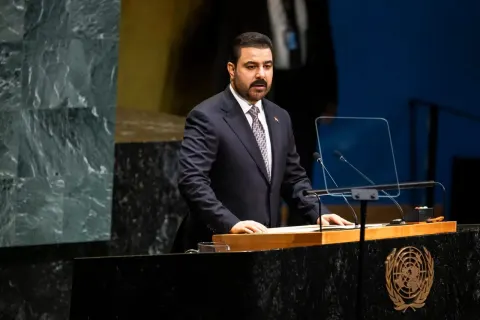
Baghdad seeks to gradually weaken the autonomy of the Kurdistan Region
According to KurdPress, in its report titled "Iraqi Prime Minister Seeks to Expand Baghdad's Authority Over the Kurdistan Region," the American newspaper placed Ali al-Zaidi's actions against the Kurdistan Region in line with his efforts to expand the authority of the central government and limit the power of actors outside of Baghdad's direct control.
The New York Times emphasizes that the success of this strategy will not depend solely on issuing government orders, but on Ali al-Zaidi's ability to translate these orders into real changes on the ground, without dragging the central government into armed confrontation with forces beyond its control.
The American newspaper also emphasizes that Ali al-Zaidi's actions against the Kurdistan Region are evaluated by analysts as a move with political and strategic goals, rather than simply a measure to combat oil smuggling and economic corruption.
The most important analytical part of the New York Times report is about the consequences of Baghdad's recent actions; meaning that limiting the region's autonomy does not necessarily require the formal abolition of its political and legal structures, and can be pursued through the path of weakening economic foundations and making sources of revenue and public spending dependent on the central government.
The New York Times further identifies the decline in Kurdish leaders' bargaining power vis-à-vis Baghdad as one of the important factors driving the Iraqi government's new policies.
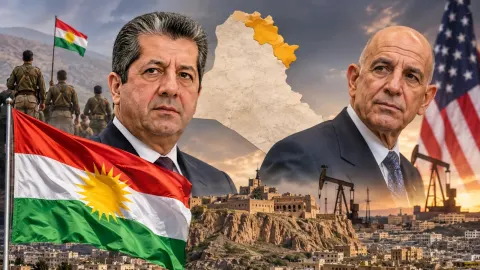
Another important part of the New York Times analysis is dedicated to the role of the United States in the new developments. The newspaper notes that the Kurdistan Region was once considered one of Washington's important regional allies and enjoyed the support of successive US administrations, but it is unclear whether the Donald Trump administration will continue to provide the same level of support.
The New York Times also identifies internal disputes between the Kurdistan Democratic Party and the Patriotic Union of Kurdistan as factors weakening the region's position vis-à-vis Baghdad. According to the newspaper, the power struggle between the two main parties in Iraqi Kurdistan has left the region without an active parliament for two years.
Overall, the New York Times’ assessment is that Ali al-Zaidi’s actions should not be seen as simply a series of administrative decisions to manage border crossings and oil fields; they are part of a broader effort by the central government to reclaim resources and authority that have been held by non-federal actors for the past two decades. However, the realization of this policy depends on Baghdad’s ability to implement its decisions on the ground and manage the response of Kurdish forces and other Iraqi political and armed actors.
User comments