Is the experience of unified governance in the Iraqi Kurdistan Region over?
According to KurdPress, according to the National Context magazine, an informed source in Sulaymaniyah announced that the leadership of the Patriotic Union of Kurdistan decided on November 5 to withdraw from the regional cabinet and pursue the formation of a separate federal region. This decision was made in a situation where political differences between the Patriotic Union and the Kurdistan Democratic Party, after more than two years of deadlock in forming a new regional government, have reached a critical stage. This development could be a turning point in the political structure of the Kurdistan Region, which has been governed, at least formally, as a single federal unit within Iraq since 2006, but in practice has continued to have two centers of political, security, and administrative power.
The Kurdistan Regional Government’s parliamentary elections in October 2024 were the first since 2018 and were expected to pave the way for the formation of a new cabinet and an end to political differences between the main parties. However, more than two years after the elections, disagreements over power-sharing, the parties’ share of the government, and the structure of the region’s administration continue, and the two main parties have failed to reach an agreement on forming a cabinet.
The latest escalation of tensions came after the Kurdistan Democratic Party unilaterally reconstituted the regional parliament. The Kurdistan Parliament has been virtually inactive since its first session on December 2, 2024, and political differences have prevented it from beginning its effective work.
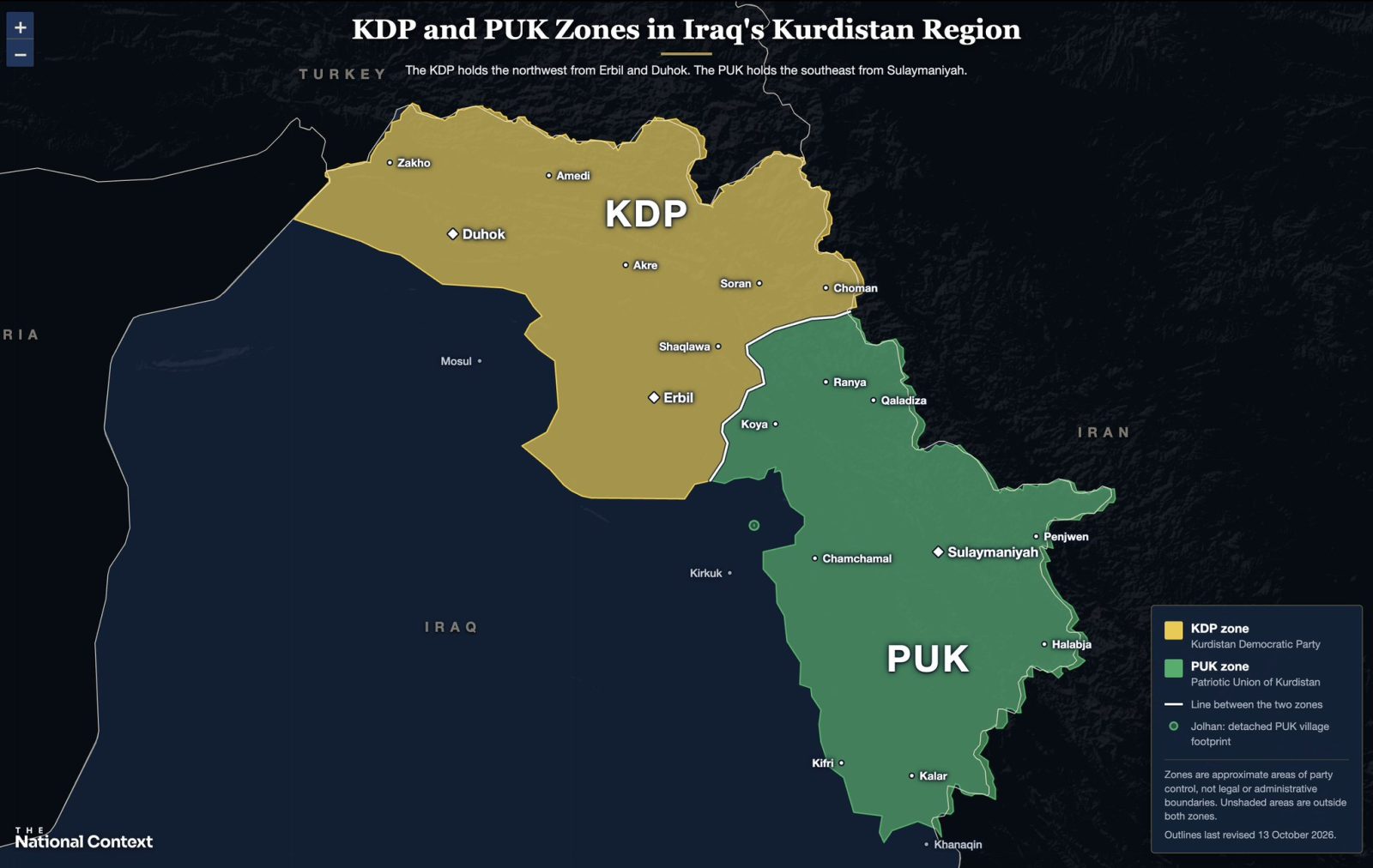
The main problem is that the political and administrative structure of the Kurdistan Region has been based on a geographical division of power between two parties from the beginning. The Kurdistan Democratic Party has greater influence and control in the Erbil and Dohuk regions, while the Patriotic Union of Kurdistan has maintained de facto control of Sulaymaniyah and parts of its surrounding areas since the 1990s. This division of power has its roots in the Iraqi Kurdistan Civil War of the 1990s, which ultimately led to the formation of two separate governments and administrations in the areas under the influence of the two parties.
Although the two parties agreed in 2006 to merge their governing structures into a single Kurdistan Regional Government, this unity has been more formal than practical in many areas.
The possible decision by the Patriotic Union to form an independent federal region centered on Sulaymaniyah is in fact an attempt to transform this informal division of power into a new legal and political structure. If this plan is realized, the areas under the influence of the Patriotic Union could be governed within the framework of a separate federal region and in direct contact with the Iraqi federal government, instead of participating in the unified government of the Kurdistan Region.
The Iraqi constitution foresees the possibility of forming such a structure. According to Article 119 of the constitution, one or more Iraqi provinces can become a federal region through a referendum. The request to form a federal region must be submitted by either one-third of the members of the relevant provincial council or supported by at least 10 percent of the registered voters of that province.
The 2008 Iraqi law on the implementation mechanism for the formation of federal regions also specifies the stages of this process. According to this law, if a request is made by voters, a petition must first be submitted with the support of two percent of registered voters, and then the process of collecting and registering signatures to reach the 10 percent threshold must begin. After reviewing and verifying the signatures, the Iraqi Independent High Election Commission refers the request to the Council of Ministers of the federal government to determine the date for the referendum.
If this plan is advanced, the two-decade experience of unified administration of the Kurdistan Region will face a fundamental challenge. It was based on an agreement between two rival parties from the beginning, and now it seems that the disagreement over the method of power sharing has seriously cast doubt on its continuation.



User comments