Political earthquake in the Iraqi Kurdistan Region?
The withdrawal of the Patriotic Union of Kurdistan from the regional government and the threat of the Taliban to form parallel government institutions in Sulaymaniyah have brought the political crisis between the two main parties in Iraqi Kurdistan to a new stage; a crisis that has affected the existence of the region's joint institutions and the future of its federal structure beyond the dispute over the formation of the cabinet and the division of positions. While Bafel Talabani has offered a choice between equal power sharing and a return to a two-tier system, a number of Kurdish analysts believe that the region’s governance structure has never achieved real institutional unity since 1996, and the persistence of partisan armed forces has been the main obstacle to the formation of a joint government.
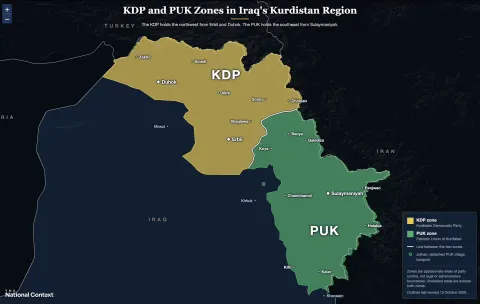
International media outlets, including the Associated Press and Al-Monitor, have reported that the Patriotic Union’s withdrawal is a sign of the collapse of the power-sharing agreement between the two parties and a threat to the region’s political stability. At the same time, analysts warn about the possibility of the administrative separation of Erbil and Dohuk from Sulaymaniyah and Halabja becoming formal; a scenario that, while not necessarily leading to civil war, could undermine the political and economic unity of Iraqi Kurdistan.
This position indicates that the Patriotic Union is no longer pursuing the differences simply through negotiations over its share in the cabinet, but has raised the possibility of returning to a two-department structure as a political option. However, no formal decision has yet been announced on the formation of a separate federal region or an independent government in Sulaymaniyah.
The crisis escalated when the regional parliament convened on November 4, after a nearly two-year hiatus, with 52 members in attendance, and Wala Farid, a representative of the Democratic Party, was elected as speaker.
Meanwhile, reports have been published about the possibility of Tom Barrack, the US special envoy for Syria and Iraq and Washington's ambassador to Turkey, traveling to Sulaymaniyah and meeting with Bafel Talabani. If the meeting is intended to mediate, it could indicate Washington's concern about the consequences of weakening the region's political unity. Over the past years, the United States has supported the integrity of Kurdistan's government and security institutions and has considered the differences between the two parties an obstacle to stability and security cooperation.
The main issue now is whether the two parties are willing to move beyond parallel power structures and form a joint government, or whether Iraqi Kurdistan will move toward formalizing two administrative systems, a path that could undermine the region's political gains since its federal status was recognized in the Iraqi constitution.

User comments