
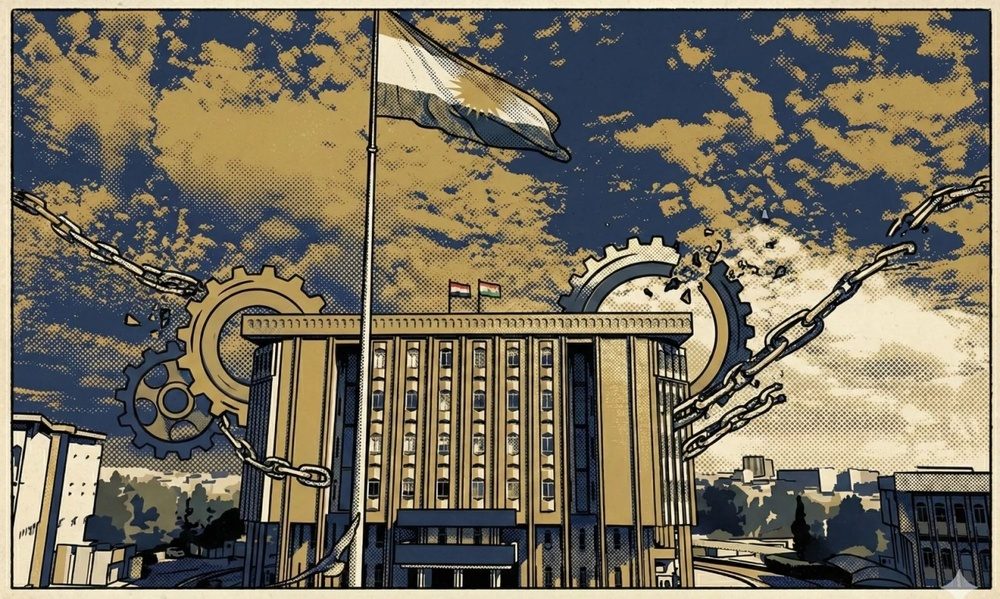
The future of the Kurdistan Region depends on ending the political deadlock and integrating the security forces
According to a report by KurdPress, following the four-year paralysis of the regional parliament - including two years of extending the parliamentary term and two years after the elections in which the parliament was inactive - along with the continued activities of the transitional government and the existence of a constitutional vacuum, the region is practically at risk of collapse.
The report emphasizes that the legal duality and the lack of a constitution in the region have given the parties in Baghdad the greatest leverage to question the legitimacy of the institutions of the Kurdistan Region.The Contradiction of the Constitution; Demanding Rights in Baghdad and Forgetting Duties at Home The report says that the Kurds cannot demand adherence to the constitution in Baghdad, but internally, they have not implemented Article 120 of the same constitution for nearly 21 years.
The report states: “This political and legal duality is the main factor weakening the Kurds’ position in intensive negotiations with the federal government; because more than two decades after the adoption of the Iraqi constitution in 2005, the region still does not have its own constitution.
This situation has caused nationalist and centralist currents in Baghdad to use the region’s internal legal vacuum as a tool against the legitimacy of Kurdistan’s institutions and question the validity of its legal processes.» The true identity of the forces; are the police for critics or for protecting citizens? This report, referring to security statistics, reveals the old wound of the fragmentation of the security structure and emphasizes that the armed, security and intelligence forces do not belong to a specific party, leader or region.
In this regard, national criteria for the separation of duties of the forces within the framework of civil rule and the law are specified and it is emphasized that the main task of the Peshmerga is to protect the people and the homeland, not to protect the party share or to stabilize the balance of power between different factions.
Regarding the police and internal security forces, it is also stated that the police are a tool for enforcing the law, protecting citizens and civil rights, not a tool for detaining, monitoring and controlling the voices of critics and political opponents.Regarding the security forces, it is also emphasized that these forces should be a national institution to combat terrorism and crime and provide security, not a tool to protect areas of political influence and divide the region's geography based on party lines.
Regarding the intelligence service, the report believes that the message and mission of this service should be solely to protect the existence of the region and identify external threats, not to collect political files, spy, and exert pressure on domestic opponents in favor of parties.
Regarding the existence of two parallel chains of command and two separate security and intelligence services under a single name, the report says: "This situation shows that previous reforms were purely administrative and not operational, because the forces still do not have a national perspective.» Shared Responsibility; The Region is a Public Trust, Not a Party Treasure In another important section of the report, the concept of protecting the homeland is removed from the limited partisan framework and emphasized in a warning tone: “This entity is a national trust. The responsibility to protect it is not only the responsibility of the Peshmerga or political parties, but it is a public and shared responsibility that falls on the shoulders of all segments of society; that is, protecting the region is the responsibility of institutions, officials, members of parliament, judges, journalists, teachers, civil activists, and every citizen who believes in law and legitimacy.”
The report also warns that silence in the face of the paralysis of parliament, the continuation of the caretaker government without end, and the end of the legal term of the oversight institutions will cause the region’s existence to gradually be emptied of its democratic content.The report states that the greatest internal threat to the region’s future will arise when citizens lose confidence in the ballot box and see parties changing the law for their short-term interests. The report emphasizes: “Creating a constitution and nationalizing the forces is the only way to save the Kurdistan Region from the administrative collapse it is currently facing.”
Responsibility of the federal government Another section of the report is dedicated to the Iraqi government, which says that the federal government has a legal responsibility to protect Iraq’s federal and democratic system.
According to the report, Baghdad should not exploit the region’s internal weaknesses to reduce constitutional rights, return to centralization, or use rights and budgets as tools to pressure citizens.In turn, the regional government should also make its data and revenues transparent, implement financial obligations, and resolve disputes through the constitution and laws.
The report emphasizes that relations between Erbil and Baghdad should be based on federal partnership, mutual rights and obligations, transparency, and long-term agreements, not pressure and temporary agreements. Limiting the powers of the transitional government Another part of the report emphasizes that the laws and constitutional mechanisms require the transitional government to strictly observe the limits of its powers.
Accordingly, until a new cabinet is formed, the government should not sign long-term strategic contracts, appoint high-level positions for long periods, take out large loans, or change the structure of independent institutions without a clear national necessity.Any extraordinary decision taken at this stage must also be made public, with its reasons, legal basis and financial data, in a transparent manner. At the same time, the organization of the financial system and national security must be prioritized, so that no ministry, region, institution or party has the right to collect public revenues outside the single state treasury. To this end, a treasury account, a customs system, a tax registration system and a salary payment system must be established.
On the other hand, the government is required to submit periodic reports to parliament on the size of the armed forces, the command structure, the budget, weapons and stores, the progress of the integration process and all complaints and violations of the law. Sensitive details can be discussed in closed sessions, but they must still remain under legal supervision.



User comments