
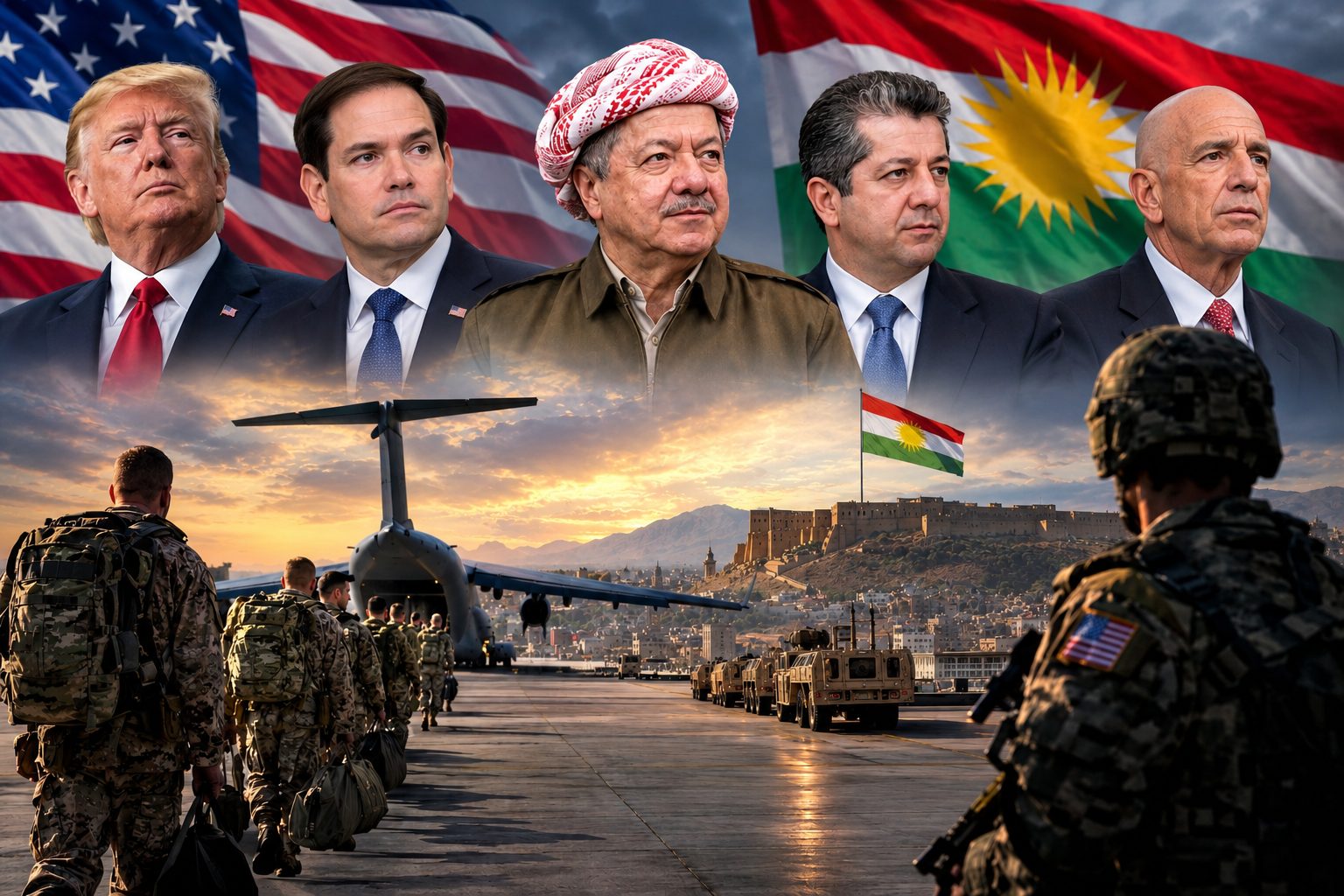
Has the Kurdistan Region lost its military backer?
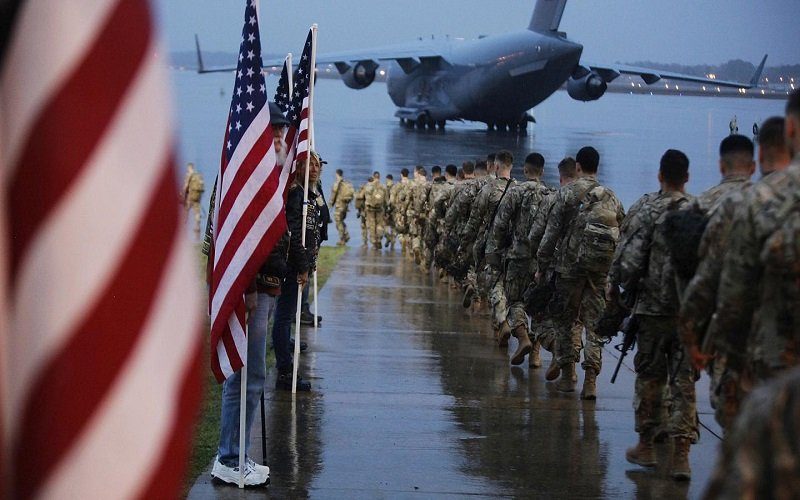
According to Kurdistan Press, the complete withdrawal of American forces from Iraq and the end of the international coalition's military mission on September 30, 2026, has a meaning for the Kurdistan Region beyond the closure of the last American military base in Erbil; because simultaneously with the withdrawal of American forces, the air defense systems deployed to protect coalition forces have also been withdrawn from the region, and the direct responsibility for ensuring security, controlling the skies, and confronting the threats of ISIS and armed groups has fallen more than ever on Baghdad and the Peshmerga forces. However, statements by Donald Trump, Tom Barak, Massoud Barzani, and Masrour Barzani, as well as coverage by reputable American and European media, show that the end of the American military presence does not necessarily mean the end of Washington's security relationship with Erbil.What happened at the end of September, at least according to media reports and statements by relevant officials, was the formal “end of the US military mission” in Iraq, not the complete cessation of all forms of US security cooperation with the country and the Kurdistan Region. The US Department of Defense announced that coalition forces and equipment had withdrawn from the Erbil air base and that Operation “Resolute Resolve” in Iraq had ended. At the same time, Washington announced that Iraqi security forces, including the Peshmerga and other security forces of the Kurdistan Region, would henceforth play the main role in securing Iraq and containing the remnants of ISIS, and that the US would continue to provide targeted training and intelligence support.
But in the case of the region, the difference between “end of mission” and “end of support” becomes crucial.The Kurdistan Region enjoyed direct US military, intelligence, logistical, drone and especially air defense support before the US withdrawal. The Ministry of Peshmerga Affairs of the region announced on September 28 that the US withdrawal was taking place in a situation where more than a thousand drone and missile attacks had been carried out on the region in recent months and no replacement air defense system had been created at the same time as the US withdrawal. The ministry emphasized that the region’s skies are part of Iraqi airspace and the primary responsibility for protecting them lies with the federal government.For this reason, in terms of the Kurds’ enjoyment of direct US military and security facilities, such as direct military presence, bases, combat forces, direct operational intelligence, defensive equipment, and the protective umbrella resulting from the deployment of US forces, this part of US support ended on September 30. However, if we consider the security and strategic relationship, such a relationship has not ended, and even US officials and regional leaders have emphasized its continuation.
Reuters has examined the US withdrawal mainly from the perspective of changing the balance of power in Iraq, warning that the withdrawal of American forces could create more space for foreign influence and armed groups, while at the same time providing a new opportunity for ISIS to rebuild its networks. The news agency reported, quoting Sirwan Barzani, a commander of the Peshmerga force, that the lack of intelligence, logistical support and American drones could reduce the ability to confront ISIS remnants, and that he spoke of an increase in the mobility of ISIS sleeper cells in the weeks leading up to the withdrawal.
The Associated Press and the Washington Post, in contrast to their more general reporting on Iraq, have paid particular attention to Kurdish concerns. The joint report in the Washington Post says the Kurdistan Region is particularly concerned about the US withdrawal, with the most significant issue being the withdrawal of US air defense systems from around Erbil. The report also says the region has faced more than a thousand drone and missile attacks during the recent US-Iran war. This is a figure announced by the Ministry of Peshmerga Affairs.
The New York Times has also identified the Kurdistan Region as one of the most vulnerable parts of Iraq’s new security order. The newspaper writes that the Kurdistan Region, which has been one of America’s closest security partners in the region, has been the target of multiple missile and drone attacks this year. Kifah Mahmoud, an advisor to Massoud Barzani, leader of the Kurdistan Democratic Party of Iraq, also said in the report that neither the region nor Iraq has an adequate air defense system, which has led to a sense of anxiety and uncertainty.
The Financial Times also published the strongest warning from Masrour Barzani before the withdrawal. The newspaper quoted the regional prime minister as saying that the US withdrawal without a proper defense system was “shameful” and that it left the region vulnerable to Iranian attacks. Masrour Barzani’s office later said that the Financial Times report did not reflect his statements in full and word for word, and that he meant that the withdrawal was “a cause for concern.” The Financial Times has retained its original headline, and this discrepancy has remained in the media narrative.
The BBC and European media have also described the withdrawal of American and British forces from Erbil as the end of the military phase of the coalition in Iraq. The British government has stated in its official statement that the Iraqi security forces and the Peshmerga are now in a position to assume primary responsibility for ensuring the country's security, but London will continue to cooperate with Iraq in the form of a bilateral defense relationship.
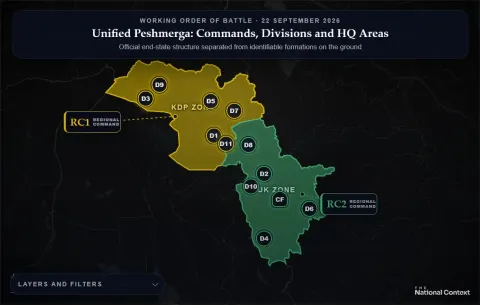
From the perspective of the region, another issue that gained more importance in September was the announcement of the unification of the Peshmerga forces. The Ministry of Peshmerga Affairs announced in September that the process of unification and reorganization of the forces under the ministry had been completed, and that this transformation had been carried out with the direct support of the US-led coalition. At the unification ceremony, Masrour Barzani also praised the US and coalition support for reforming the Peshmerga structure. Thus, just on the eve of the US withdrawal, the region has attempted to transfer one of its most important remaining capabilities from party affiliation to the formal structure of the Ministry of Peshmerga Affairs.
And perhaps the most accurate description of the new situation in the Kurdistan Region is that the US has left Erbil, but the US issue is not over for Erbil; the main question now is whether Washington's new relationship with Baghdad and Erbil can compensate for some of the lost security capabilities, especially in the areas of air defense, intelligence, and deterrence, in a different format and without a physical military presence. This part still does not have a definitive answer, and the American and European media themselves have not spoken about it with certainty in the reports of the last two days.
User comments