
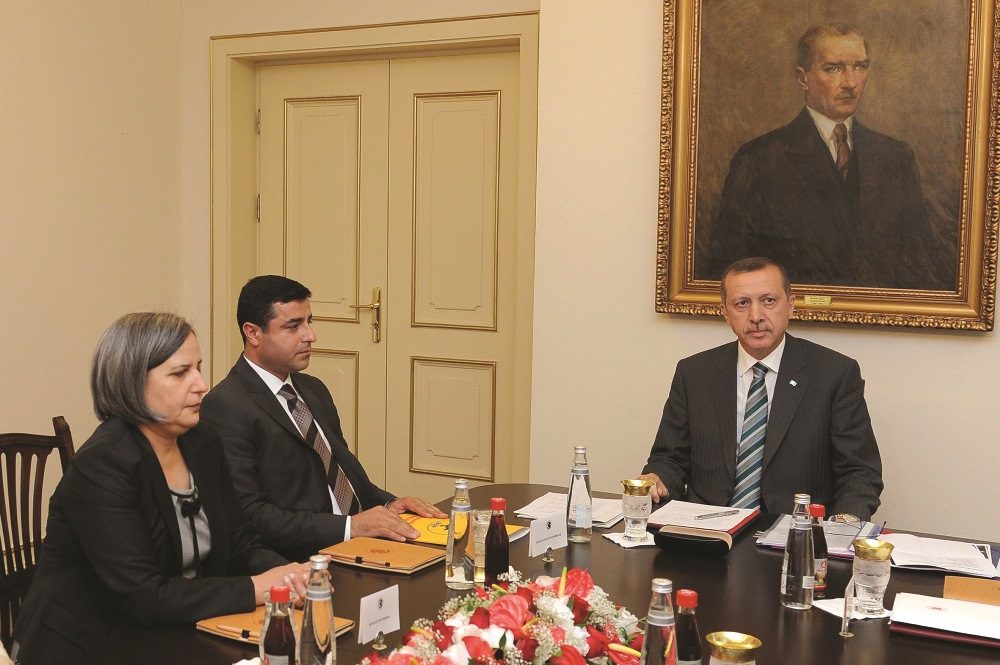
The connection between the Kurdish issue in Turkey and regional equations
According to KurdPress, Thomas James Phillips, a law professor at the American University of Cyprus, in an article in the Cyprus Mail newspaper, examining the new peace process between the Turkish government and the Kurdish political movement, considered this process a limited but important opportunity to move the Kurdish issue from the military field to the political and democratic arena; however, he warns that this process could become a costly deal for the Kurds in the absence of political reforms in Turkey.In this note, Phillips, using an idea from Fyodor Dostoevsky about the necessity of taking small steps to achieve big changes, likens the current state of the Kurdish movement in Turkey to an attempt to take a “five-inch step.” In his opinion, Kurdish leaders, despite their ambitious goals of democracy, ethnic and religious pluralism, cultural rights, women’s empowerment, and the creation of a model beyond nation-states, are now forced to set aside some of these ambitions and enter a more limited but practical phase.
The author believes that regional conditions have also led the Kurds to adopt such an approach.As US support for Kurdish forces in northern Syria wanes and the regional and global environment changes, Kurdish political leaders have accepted the call of the Nationalist Movement Party (MHP) leader Devlet Bahçeli to disarm, a move that Phillips sees as an unexpected sign of the Kurds’ readiness to enter a political phase.
If this process can lead to meaningful political participation for Kurds, guaranteed cultural rights, education in the Kurdish mother tongue, an end to violence, and some transitional justice mechanisms, these concessions could be worth such a “small step,” Phillips writes. In his view, shifting the Kurdish issue from a military to a political and democratic path could also pave the way for deeper changes in Turkey’s political structure in the future and reduce the intensity of nationalism in the country.However, the author stresses the dangers of this process, and the most important issue is its political timing. He believes that the peace process is being pursued at a time when Turkish President Recep Tayyip Erdogan needs Kurdish votes for possible elections in April 2028. In Phillips’s view, this raises concerns that the peace process could become a tool for Erdogan’s political interests rather than part of a democratic transition.
Phillips goes on to argue that there is no clear sign in Turkish politics that the government is moving towards a broad democratic transition. He points to measures such as the dismissal of elected mayors, the political use of the judiciary, and the imprisonment of opponents, and believes that the methods that were first used against the Kurds are now being used on a wider scale against political opponents.To describe this situation, the law professor cites an analysis by Erugurl Korkecco in the American journal Jacobin, who sees the so-called “terrorism-free Turkey” process not as a sign of the beginning of a democratic transformation, but as a limited agreement to reduce conflict within the framework of the continuation of authoritarianism in Turkey.
In another part of his note, Phillips discusses the connection between the Kurdish issue and Cyprus, referring to the famous phrase of the Cypriot journalist and activist Theophilos Georgiadis, who said that “the freedom of Cyprus passes through the mountains of Kurdistan.” He explains that he first heard this phrase during a meeting of the EU-Turkey Civil Service Commission in the European Parliament and has since considered it to have a clear political meaning.He believes that the connection between the Kurdish issue and Cyprus is important because both issues concern the interaction with a single regional power, namely Turkey, which, according to the author, has the second largest army in NATO. However, Phillips emphasizes that Cyprus’ support for the Kurds should not be transactional in nature and that the Kurds’ efforts to abandon the military path and enter the political arena, independent of the short-term interests of other actors, deserve support.
At the same time, he expresses doubts about the fate of this process, asking whether this “five-inch step” can ultimately lead to a more moderate, flexible and peaceful Turkey.In Phillips’s view, there is another possibility that this process could turn into a kind of “Faustian bargain”; in the sense that the Kurds would give up some of their basic freedoms in exchange for peace, and in return, the authoritarian structure of the Turkish state would be strengthened.
The author also sees another scenario as dangerous: that the Turkish government would be unable or unwilling to seize the opportunity to advance political reform and abandon the peace process after its political and security considerations had been exhausted. To warn against this possibility, Phillips points to the failure of a previous peace attempt in 2015, which, he says, had bloody consequences.
In the author’s view, therefore, the fate of the current process is still unclear, and it is not possible to say with certainty whether the relationship between the Kurdish issue and Turkey’s democratic future will reach a lasting conclusion.However, he believes that in the current situation there is no option but hope.
In concluding his note, Phillips writes that it is still too early to say whether “the freedom of Cyprus will pass through the mountains of Kurdistan,” but the current trend shows that developments related to the Kurdish issue could have consequences for regional equations, including Cyprus, beyond Turkey’s borders.

User comments