
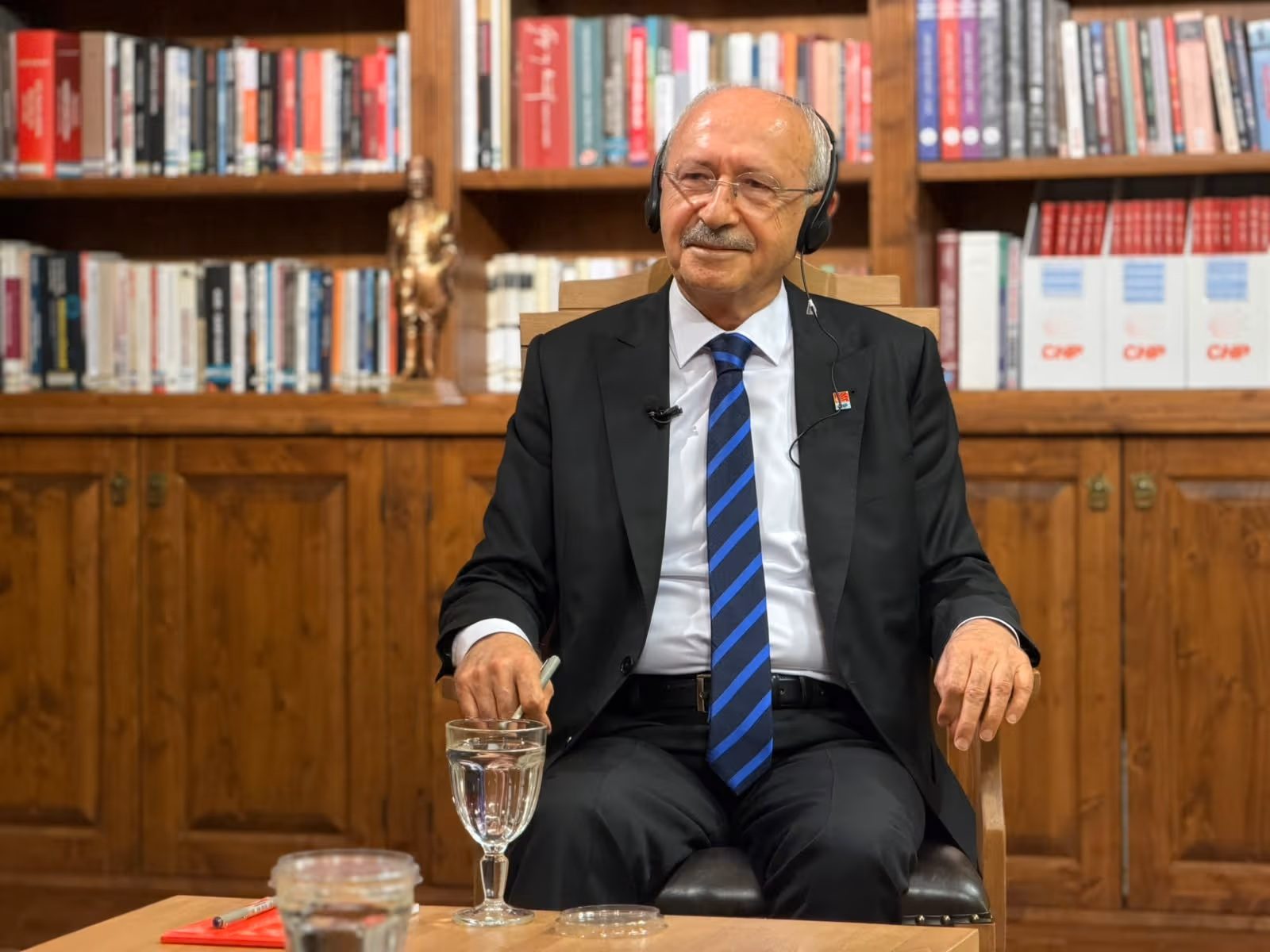
Kilicdaroglu: I fully believe in the peace process with the Kurds
According to KurdPress, Kemal Kilicdaroglu, chairman of the Republican People's Party of Turkey, in an interview with the "Amarci" magazine, supported the new peace process between the Turkish government and the Kurdistan Workers' Party and emphasized the need to end political pressures against the Kurds, but in response to questions about the specific rights of the Kurds and legal reforms, he mainly relied on concepts such as democracy, human rights and equality of citizens.
In this interview, Kilicdaroglu described the ongoing peace process between the Turkish government and the Kurdistan Workers' Party as a real and important step and said that he personally "fully believes" in the success of this process.He said, referring to the role of Devlet Bahçeli, the leader of the National Movement Party, in starting the new peace process: “We have always defended peace.” According to Kilicdaroğlu, the role of Bahçeli in convincing his party’s nationalist base to support a solution to one of Turkey’s fundamental problems is of great importance.
The CHP leader added that his party had also supported the “Framework Law” in this process and believed that the Kurdish issue should be resolved through a political and peaceful path.
However, an important part of Kilicdaroğlu’s statements on the Kurdish issue were related to cultural and linguistic rights, and he refrained from making specific proposals on constitutional amendments or laws on Kurdish political representation.
In response to a question about the rights of Kurdish people in Turkey, he said: “Kurdish citizens exist and of course they should be able to freely use their traditions, customs and language.»
Kılıçdaroğlu, referring to the existence of Kurdish television channels in Turkey, said that some of these cultural rights still exist, but his remarks about Kurdish rights were based more on the concept of equal citizenship than on the recognition of collective rights or Kurdish identity.
He said that the CHP prefers to focus on democracy and human rights rather than on politics based on identities. In this context, Kılıçdaroğlu stated: “We are a party that believes that politics about democracy and human rights is much more correct than politics about identities.”
This approach, in fact, also reflects the CHP’s traditional framework for dealing with the Kurdish issue; an approach that attempts to define the Kurdish issue in terms of equal citizenship rights and general democracy, rather than as a set of political and national rights specific to an ethnic group.Kılıçdaroğlu also emphasized the social ties between Kurds and Turks, saying that family ties between the two communities are so extensive that “there is a Kurdish bride or groom in almost every house.” He also spoke about the oral culture of the Kurds, especially the Dangbegs, and stressed that this cultural tradition must be preserved.
He considered the Dangbegs to be part of the important cultural heritage of the Kurds, saying that each Dangbeg actually tells a story, sometimes sad, sometimes beautiful, and sometimes comforting.
In another part of the interview, Kılıçdaroğlu also touched on one of his most controversial political decisions regarding the Kurdish issue, which was the Republican People’s Party’s decision in 2016 to support a constitutional amendment to lift the judicial immunity of members of parliament.The amendment was passed after the Kurdish Peoples’ Democratic Party (HDP) entered parliament in the June 2015 elections with about 13 percent of the vote and 78 seats, knocking the Justice and Development Party (AKP) out of the majority. After the collapse of the peace process between the Turkish government and the Kurdistan Workers’ Party (PKK) in 2015, pressure on the HDP increased, with the government accusing the party of having links to the PKK.
The amendment to lift the immunity of MPs was passed in May 2016 with 376 votes, lifting the immunity of 138 MPs, including 50 out of the 59 HDP MPs. A few months later, HDP co-leaders Selahattin Demirtaş and Figen Yüksekdağ were arrested.
In an interview with Amarci, Kilicdaroğlu defended his decision and that of his party.He said the AKP could have voted to lift Demirtaş’s or any other MP’s immunity if it wanted to, adding that the ruling party was trying to expose the CHP by proposing the amendment to the charge of supporting a terrorist organization.
“We voted within that framework to dispel this perception,” he said.
Kilicdaroglu also tried to deny the connection between his party’s vote on the amendment and Demirtaş’s imprisonment, saying Demirtaş’s immunity could have been lifted by the AKP’s votes alone.
However, while defending the 2016 decision, he called Demirtaş’s imprisonment unfair, saying a politician should not be imprisoned for his views.
He clarified: “Mr. Demirtaş is in prison unjustly. A politician cannot be imprisoned for his thoughts.If a politician, journalist or writer is imprisoned for his thoughts, there is no democracy there.”
Kilicdaroglu also said that he had visited Demirtaş in prison several times and would visit him again if the right conditions were created.
In the same context, he also criticized the current state of the Turkish political system, saying that the weakening of the independence of the judiciary and the restriction of media freedom had directly affected the situation of Kurds and other opposition groups.
Referring to Demirtaş and Can Atalay, a representative of the Turkish Workers’ Party who is still in prison despite winning the election, he said that one cannot talk about democracy in a situation where a person whose eligibility to run for office has been confirmed by the Supreme Election Council and who has entered parliament after winning cannot be released from prison.
Kilicdaroglu continued: “Democracy means the rule of law.If politicians rule, not the law, there is no democracy.”
He considered the independence of the judiciary to be one of the main foundations for solving Turkey’s political problems, and said that if judges are elected based on political loyalty, the law and state institutions will suffer.
In another part of the interview, the Republican People’s Party (CHP) leader emphasized that Turkey needs to return to democracy first and foremost to solve its Kurdish issue and other political crises. He said that the constitution should be completely rewritten based on democratic principles and that every Turkish citizen should be able to say, “This is my constitution.”However, Kilicdaroglu did not go into detail in the interview about the reforms needed for the Kurdish issue, and did not specify whether he supports explicitly recognizing Kurdish linguistic and cultural rights in the constitution, changing the laws on political parties and elections, or guaranteeing the political rights of Kurdish representatives.
Thus, Kilicdaroglu’s position on the new peace process is clearer than his plan for resolving the Kurdish issue: he supports negotiations and peace, considers the imprisonment of Kurdish politicians unjust, and considers the freedom of Kurdish language and culture to be the right of Kurdish citizens, but does not offer specific legal and political solutions to guarantee these rights.
Kilicdaroglu, who himself is an Alevis from Dersim, also stressed that his identity should not be considered a factor in his defeat in the 2023 presidential election. He said that winning 48.5% of the vote showed that almost half of Turkish society supported him, and he attributed his defeat not to his Alevi and Sunni identity, but to Recep Tayyip Erdogan's election campaign and the release of fake videos against him.
He said that Erdogan had released fake videos during the election about his collaboration with Qandil, and these materials were also widely republished by media outlets close to the Justice and Development Party.
Kilicdaroglu emphasized that he had never hidden his Alevi identity and that he did not consider the Alevi-Sunni divide to be a deep and rooted division in Turkish society.

User comments