
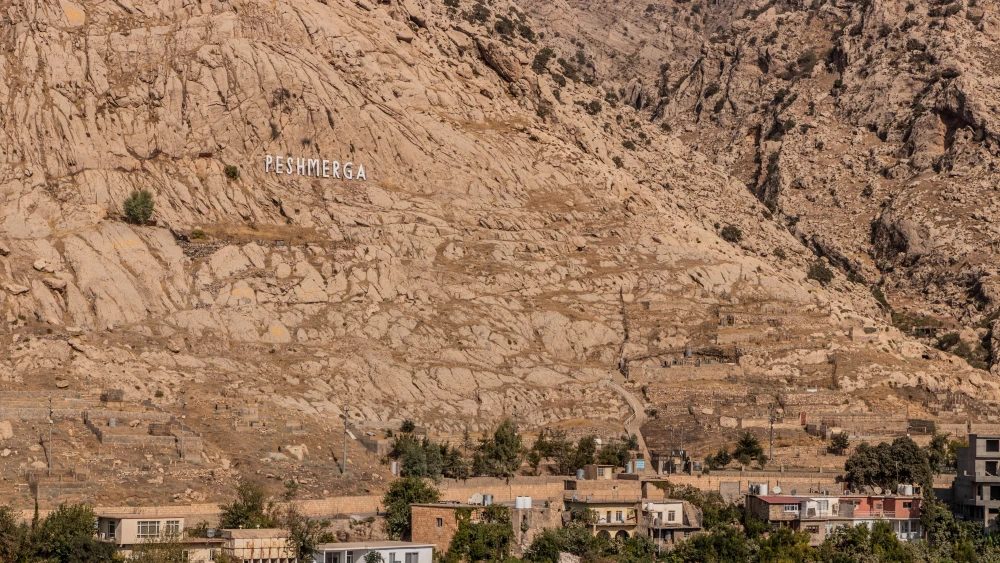
Kurdistan Region’s Unified Military Force; From Dream to Reality
According to KurdPress, the Middle East Forum considers the recent announcement by the Kurdistan Region’s Ministry of Peshmerga Affairs about the integration of the military forces affiliated with the Kurdistan Democratic Party and the Patriotic Union of Kurdistan more of an administrative and political move than the actual realization of a unified military force. According to this analysis, although the new structure has been defined with unified names and under the command of the Ministry of Peshmerga Affairs, control of the forces still remains in the hands of the two main parties in the region.The Kurdistan Regional Government’s Ministry of Peshmerga Affairs announced on September 10, 2026, that the process of integrating the armed forces affiliated with the region’s two ruling parties has been completed. At first glance, this development could be considered an end to decades of duality in the region’s military structure; however, an examination of the new structure shows that this integration is still more of a reorganization of existing forces than the creation of a single army.
Since the formation of the Kurdistan Regional Government in 1991, the Peshmerga forces have remained divided between the Kurdistan Democratic Party and the Patriotic Union of Kurdistan. Although the Ministry of Peshmerga Affairs was established a year later, simultaneously with the formation of the first regional government, the forces of the two parties were not only not integrated into a single structure, but also faced each other in a civil war in the early years of the region’s formation; a war that left thousands dead.Despite the formal recognition of the Kurdistan Region in the Iraqi constitution in 2005, this development has failed to eliminate the region’s dual military structure.
The United States has tried in recent years to place the Peshmerga forces under the command of the Ministry of Peshmerga Affairs. During the war against ISIS, the Peshmerga forces played a significant role in the US-led coalition operations against the group. Despite significant financial and military assistance from Washington, efforts to force the region’s two main parties to fully integrate their forces have failed.
In the previous structure, the forces known as “Forces 80” were controlled by the Democratic Party and the “Forces 70” were affiliated with the Patriotic Union. However, under the new structure, Forces 80 has been renamed “Region One” and Forces 70 has been renamed “Region Two.”In these two regions, 11 divisions will operate under the Ministry of Peshmerga Affairs.
However, in the view of the Middle East Forum’s analysis author, the name change and organizational reorganization do not necessarily mean the end of party control. The Democratic Party still controls six odd-numbered divisions and the Patriotic Union controls five others. So what the regional authorities call “reforms” and “integration” could in fact be a continuation of the same old structure in a new format.
The timing of the announcement is also of particular importance. The decision comes just weeks before the September 30 deadline for the withdrawal of US troops from Iraq, after which the US military will reportedly stop providing assistance to the Peshmerga.From this perspective, the announcement of the integration of the Peshmerga forces could be a message to Washington that the US’s multi-year efforts to reform the region’s military structure have not been in vain and that US financial and military support for the Peshmerga should continue even after the end of its military presence in Iraq.
However, the political stalemate in the Kurdistan Region has also increased doubts about the actual realization of military integration. The region’s two main parties have not been able to reach an agreement on the formation of a new government since the October 2024 parliamentary elections, and the continuation of this stalemate has disrupted a significant part of the region’s political institutions. From the institute’s perspective, if the Democratic Party and the Patriotic Union are still unable to agree on the formation of a government after nearly two years, it also seems difficult for them to reach a real and lasting agreement in the military field.For both parties, control of the Peshmerga is not just a military issue, but also one of the most important tools for exercising political power in the region. Therefore, it is unlikely that either party will easily relinquish control of the forces under its influence. Maintaining these forces as a lever to consolidate the political, security, and geographical spheres of influence of the two parties has been part of the power structure in the region for decades.
This issue becomes even more important in a situation where the Kurdistan Region is facing increasing pressures on its status and authority. The author believes that Baghdad and neighboring countries have increasingly moved to limit the scope of the region’s autonomy, but instead of creating a common political and military front to counter these pressures, the two main parties remain engaged in competition over their power and spheres of influence.According to this analysis, the main issue for the Peshmerga is not simply the name, number, or administrative structure of the divisions, but rather the issue of command and political loyalty. As long as the region’s military forces ultimately remain under the influence of the two main parties, the announcement of unification alone cannot mean the formation of a single, independent military force.
In conclusion, the Middle East Forum emphasizes that political and security developments in the region show that the Democratic Party and the Patriotic Union continue to focus more on preserving their spheres of influence than on protecting regional autonomy. From this perspective, the recent announcement of the unification of the Peshmerga can be seen more than anything as an attempt to demonstrate to Washington the progress of reforms and to pave the way for continued US financial and military support. This is while the transformation of the Peshmerga into a truly unified military force is still a long way from reality.

User comments