
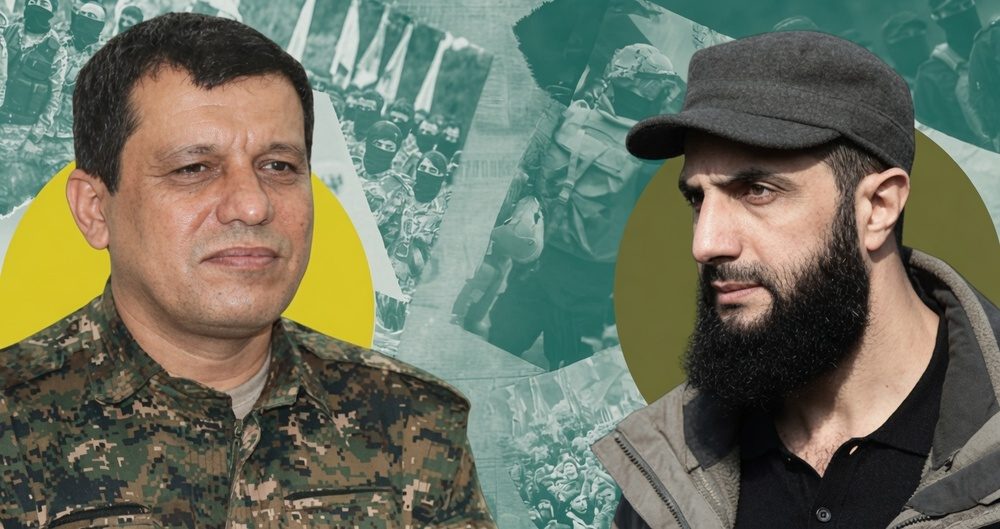
Al-Sharaa and Kobani's Strategy to Prevent a New War in Syria
According to KurdPress, the American magazine New Lines wrote about the reason for the cessation of the conflict between Al-Sharaa and Mazloum Kobani forces. The process of integrating Kurdish forces into the structure of the Syrian government has entered its final stage with the dissolution of the Syrian Democratic Forces (SDF); a process that, according to New Lines, has so far prevented a widespread war in northeastern Syria despite the deep differences between Damascus and the Kurds.By containing extremist forces on both sides of the conflict, Syrian interim president Ahmed al-Sharaa and commander-in-chief of the Syrian Democratic Forces, Mazloum Abdi, have managed to find a political solution for a region that was on the verge of becoming a battlefield for civil war and confrontation with foreign powers.
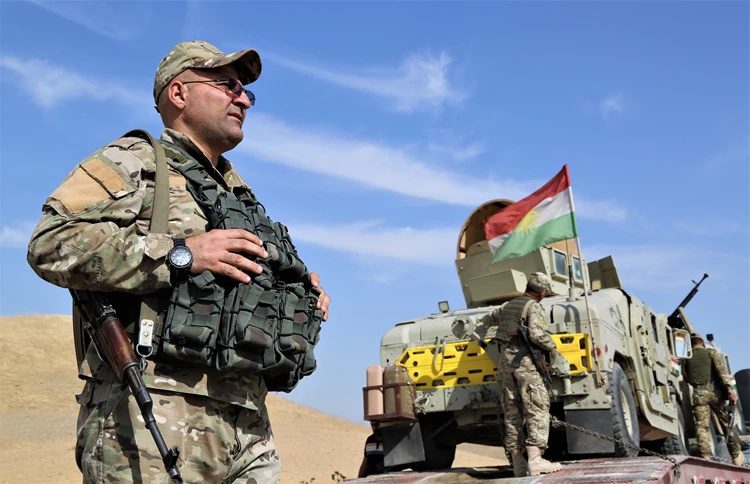
Mazloum Abdi announced on August 25 that the Syrian Democratic Forces had been disbanded. The decision was made as part of the process of integrating the group’s forces into the Syrian Ministry of Defense. Under the new arrangements, three entirely Kurdish brigades of the Syrian Army are stationed in Hasakah and Qamishli, and another brigade is present in Kobani. Thus, at least at the local level, the Kurdish areas of Syria will be administered by Kurdish forces for security and military purposes, not by foreign forces or armed groups affiliated with other parties.
Abdi has also been appointed as an advisor to the Syrian presidency.This agreement is a compromise for both sides. The dissolution of the Syrian Democratic Forces coincides with the end of the autonomous administration structure in northern and eastern Syria and the experience known as “Rojava,” a development that some Arabs and other residents of northeastern Syria see as the end of a rule they considered oppressive. In contrast, many Kurds see the end of the autonomous experiment as the loss of one of their most important political and security achievements and are concerned about the future of their rights in Syria.
On the other hand, a number of Syrian Arabs are also concerned about the continued existence of some local structures under the management of people who until recently were running an independent political project. However, the most important result of the current process is that northeastern Syria has not once again become a battlefield and disputes are mainly being resolved through negotiations.However, this situation seemed highly unlikely in late 2024.
In late November and early December 2024, as the forces of the Tahrir al-Sham Front led by Ahmed al-Sharaa advanced in western Syrian cities and the Bashar al-Assad regime collapsed, the so-called Syrian National Army, supported by Turkey, attacked areas controlled by the Syrian Democratic Forces in the northeast.
With the support of the Turkish air force, the Syrian National Army liberated Tel Rifaat and Manbij from the control of the Syrian Democratic Forces. In Manbij, according to the author, some of the group’s fighters and Arab residents drove Kurds out of their homes and looted their property.
The Syrian National Army forces, some of whom had been driven out of eastern Syria during the war with ISIS and had not been able to return to their homes, had strong incentives to continue the fight.At the same time, there were signs of readiness on the part of the Arab population of northern and eastern Syria to enter a wider conflict.
The conditions were ripe for a full-scale war. Both sides could also count on the support of regional powers: Turkey supported Damascus, and Israel supported the Syrian Democratic Forces. The Syrian Democratic Forces were unwilling to compromise with their long-standing enemies, and the Syrian National Army forces were ready to continue the war.
At this point, the role of Ahmed al-Shara and Mazloum Abdi became decisive.
Al-Shara prevented the Turkish-backed forces from advancing further and, rather than resorting to military action, entered into negotiations with Abdi. The result of these negotiations was the March 10, 2025 agreement to integrate northeastern Syria into the structure of the central government; an agreement that was supported by the United States but had serious opposition among hardliners on both sides.Despite the two sides having different understandings of the agreement's terms and its implementation repeatedly coming close to failure, al-Sharaa and Abdi attempted to rein in their extremist forces and field commanders.
The March 2025 agreement also came at a time when the al-Sharaa government was facing serious problems. A few days earlier, rebels affiliated with the former government had launched an uprising in the coastal areas, and then pro-government forces targeted large numbers of Alawites in sectarian massacres.
In such circumstances, some Kurds believed that by agreeing with al-Sharaa, Abdi had actually given him a chance to escape a political and international crisis. But on the other hand, Abdi may have chosen the right time to negotiate, when Damascus’ ability to govern Syria without the consent of minorities was seriously questioned.
However, Ahmed al-Sharaa also made a miscalculation at some point.
In July 2025, the Syrian government sent its forces to Sweida to intervene in the conflict between armed Druze groups and Bedouin tribes.Damascus aimed to establish a state monopoly on the use of force, but the government faced serious setbacks by choosing a quick military solution over political negotiations.
The Druze, who had previously been divided, united against the attack of foreign forces. Pro-government forces were once again accused of sectarian massacres, and some villages were burned down. Israel also attacked Syrian government forces.
As a result, Damascus not only failed to increase its control over Sweida, but the area became further away from the center after the fighting.
The defeat of Sweida, in turn, strengthened the position of opponents of compromise with Damascus within the Syrian Democratic Forces. Kurdish forces began mobilization operations, tunnel construction, and other preparations for war in northeastern Syria.
But once again, realistic calculations overcame the tendency to war.For Ahmed al-Shara, the defeat of Sweida showed that relying on military power and overconfidence in the government’s ability could come at a high cost. For Mazloum Abdi, it was also clear that the continuation of the SDF structure in the long term was not strategically feasible.
The most important change in the Kurds’ situation was the decline in the SDF’s role as the ground force of the international coalition against ISIS. Damascus was gradually taking over this role, and the United States had also shown its willingness to withdraw its forces from Syria. Washington was no longer willing to play the role of the SDF’s main supporter as it had in the past.
France intervened to some extent in support of the Kurds, but this support did not mean opposing Syrian sovereignty over the northeast.
On the other hand, Turkey continued to maintain its army on the borders of the Kurdish areas of Syria.At the same time, the Turkish parliament had approved a peace process with Abdullah Ocalan, the imprisoned leader of the Kurdistan Workers’ Party, the organization from which the SDF has its roots.
In such circumstances, both the threat of Turkish military action on the one hand and the peace process with Ocalan on the other became factors encouraging the SDF to compromise with Damascus.
However, a final resolution of the differences was not possible without another round of fighting.
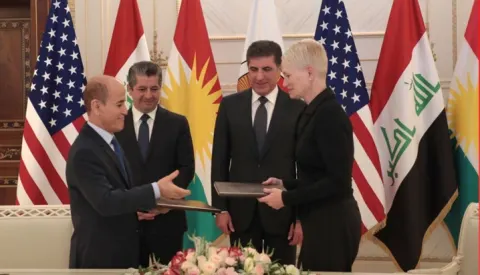
In January 2026, Syrian government forces first pushed the SDF back from the city of Aleppo and then engaged in a battle to remove them from the areas around the Euphrates Dam. At this point, the Arab forces of the SDF largely separated from the group, and government forces and groups of armed civilians pushed the Kurdish forces back towards Kurdish areas.During the fighting, there were reports of abuses and violence on both sides, but the scale was much smaller than in Sweida. Intensive negotiations continued during the fighting, with US envoy Tom Barak traveling back and forth between Erbil and Damascus.
A new agreement was eventually reached to implement the March 10, 2025 agreement. Under the agreement, border crossings and oil fields were returned to the central government, the SDF was integrated into the national army, and full citizenship rights, along with cultural and linguistic rights, were recognized for Syrian Kurds.
However, the end of the SDF military structure does not mean the end of the conflict between the Kurds and Damascus.Kurds who previously lacked official registration are now recognized as Syrian citizens, but because the official title of the “Syrian Arab Republic” remains, they are faced with the title of “Syrian Arab” in the official registration process.
In Hasakah, protesters have repeatedly pulled down government signs that were not written in Kurdish. Arab tribes have also set up “war tents” to show their dissatisfaction with the continued presence of SDF cadres at checkpoints.
The future of the Women’s Defense Units, the female wing of the SDF, is also still a matter of dispute. The situation of Kurdish language teaching in schools has also not been fully resolved.
Despite these disputes, there is one fundamental difference from the past: the conflicts in northeastern Syria have not once again escalated into armed conflict.Political negotiations, social dialogue, and even social media debates have replaced armed conflict. Northeast Syria has not yet descended into a new civil war, nor has it become a direct battlefield for international powers.

User comments