
The Kurdish issue in Turkey cannot be solved by changing governments
According to KurdPress, the new process of political dialogue in Turkey has once again put the Kurdish issue and the future of the relationship between the state and Kurdish society at the center of attention; but a sustainable solution to this issue is not possible only with an agreement between the government and Kurdish representatives. The main issue goes back to the political, legal and social structures of the Turkish state and the definition that has been presented for more than a century of citizenship, national identity, language and belonging to the republic.From this perspective, the fact that the Kurdish political movement is negotiating with the current government does not mean that its historical conflict with a specific party or state has ended. Governments change and political parties come and go, but the state structures and nationalist narratives that have limited or suppressed Kurdish identity for decades are more enduring.
For this reason, the most important question about the current process is not why Kurdish representatives are negotiating with a specific government, but whether these negotiations can lead to changes in the political and social structures that have underpinned the Kurdish question in the first place.Indeed, if the Kurdish movement is to negotiate only with a government that is ideologically aligned with its demands, what kind of government should it expect? A Kemalist, socialist, communist, or some other political coalition? Such an expectation fundamentally ignores the nature of the Kurdish issue. The main party in this dispute is not a specific political party, but the state structure and the dominant definition of identity and citizenship in Turkey.
The Kurdish political movement has followed a long and tumultuous path over the past century, from rebellions and uprisings to participation in socialist movements, armed struggle, civic activism, and representation in parliament. Along the way, demands that were once impossible to raise publicly have now become the subject of formal political debate.Language rights, recognition of Kurdish identity, equal citizenship, and increased powers for local governments remain among the most important demands of Kurdish political movements. The fact that Kurdish representatives can now speak about and negotiate these issues in parliament is the result of decades of political and social struggle.
However, reaching a political agreement between a few politicians alone is not enough to solve the problem. The Republic of Turkey has been based on a Turkic-centric definition of national identity for a large part of its history. Within such a framework, Kurdish language and identity have been limited or denied, and Kurdish political demands have often been defined through a security lens and with concepts such as terrorism and separatism.
This view has not only remained within the structure of the state, but has also been transmitted to society through the educational system, media, popular culture, literature, and political discourse.For this reason, a change in attitude towards the Kurds cannot happen overnight.
The persistence of some anti-Kurdish clashes, nationalist tensions, hostility towards Kurdish seasonal workers and waves of insults against Kurds on social media show that the issue is not limited to the government's decision alone. To reach a lasting agreement, the legacy of this historical view must also be faced at the social and cultural level.
In addition to demands for national and political rights, the Kurdish political movement has also made developments in the area of women's participation. The co-presidency system, gender quotas and efforts to achieve a broad presence of women in parliaments and local bodies have been important features of a large part of the Kurdish political movement in Turkey. This experience, especially in a society with a deep patriarchal history, is considered one of the significant achievements of the movement.However, the social and political achievements of the Kurdish movement are often overlooked due to stereotypes. Even among some socialist and progressive currents in Turkey, Kurdish demands are sometimes viewed with nationalist assumptions or opposition to identity politics.
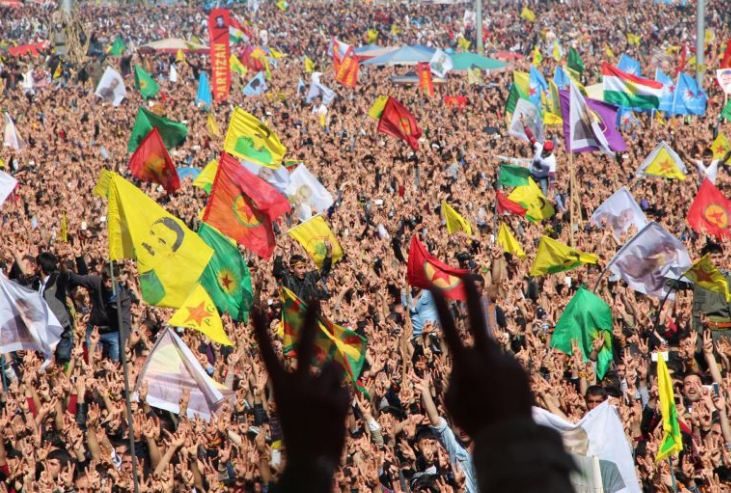
A clear example of this view is the Peoples’ Democratic Party’s general congress in Ankara in 2018. The hall had a capacity of about 17,000 people and was packed, with thousands more outside. Among the participants were teachers, public sector workers, hospital workers and people who had been laid off during the government’s emergency decrees.
However, after the congress, a university professor asked whether the party had really gathered elderly people from eastern Turkey and brought them to the congress by bus.This experience shows how much stereotypes about the Kurdish movement can obscure the social reality and the extent of its support.
Of course, the Kurdish political movement, like any other political movement, has its mistakes and contradictions and must be subject to criticism and democratic oversight. But criticism is different from denying its achievements.
Therefore, one of the important points in the current process is that Turkish society should not be divided into two completely integrated sides, "Turks" and "Kurds". On both sides of this equation, there are different political movements, interests and perceptions about the future of Turkey.Toncer Bakrhan, co-chair of the Peoples’ Democratic Party, has raised an important issue in response to a question about the achievements of the Kurdish movement: Why is the political and social transformation that the Kurds have brought about less often recognized as a revolutionary or progressive transformation, and why is progressive change only credible when led by Turkish socialists or communists?
This question ultimately goes back to the root of the issue. The Kurdish movement may be negotiating with a specific government today, but its historical struggle has not been solely against a government. The main issue is the structure of the state, the definition of citizenship, and the place of Kurdish identity in the Turkish Republic.Therefore, the success of the peace process depends not only on a political agreement between the government and Kurdish representatives, but also on Turkey’s ability to redefine equal citizenship, recognize the Kurdish language and identity, and create a democratic space for political participation and local governance. A real solution to the Kurdish issue will be possible only when change goes beyond the negotiating table and reaches political structures, state institutions, and society’s attitude towards Kurdish identity.
Amarci Magazine

User comments