
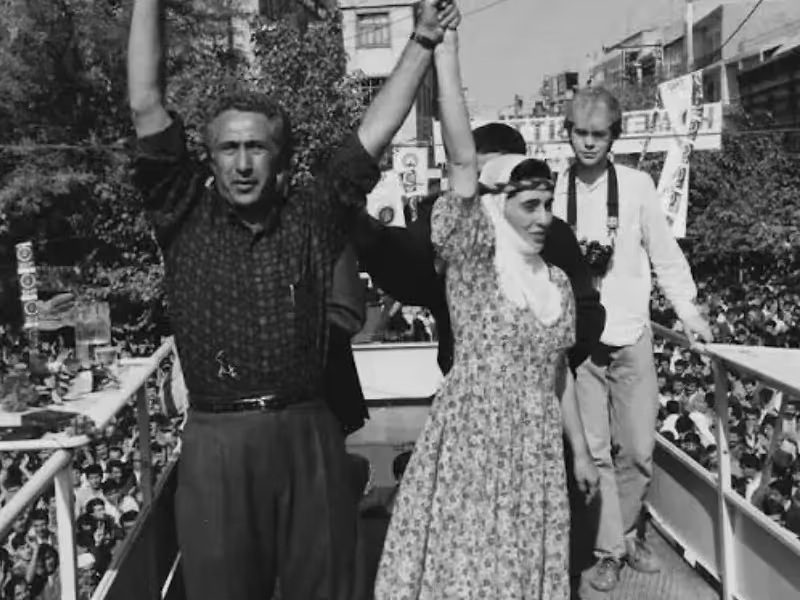
Mehdi and Leyla Zana; Two enduring names in the Turkish Kurdish political scene
According to KurdPress, Mehdi Zana, one of the prominent figures in the contemporary history of the Kurdish political movement in Turkey, died on August 29, 2026 at the age of 85. His political life began in the 1960s and continued over the next four decades, from his activities in the Turkish left and the Diyarbakir municipality to imprisonment, torture and exile.
Mehdi Zana was from a generation of Kurdish politicians who, during a difficult period, made the issue of Kurdish identity, language and political rights one of the most important issues in the Turkish public arena. According to a report published by the Amarci Institute on the occasion of his death, Zana's political experience began in his childhood; when in his home in Diyarbakir, he would hear the screams of people being tortured in the police station located below the house. This experience, he said, drew his attention to the suffering and oppression of the Kurds from his childhood.Zana later explained in an interview with Amy Goodman on the New Democracy program that these scenes, as well as the stories she heard in the tailor shop where she worked about Kurdish uprisings, the burning of villages, and the killing of people, had a profound impact on her and made her ask herself what she could do for her people.
From tailoring to politics
Mehdi Zana, a tailor by trade, began her political career on the Turkish left. In 1963, she joined the Turkish Workers' Party, participated in the founding of the Silvan branch of the party, and later rose to the national leadership of the party. At the same time, she was also involved in the activities of the "Revolutionary Cultural Centers of the East." This organization was an important platform for raising the issue of Kurdish identity and rights in Turkey. Her political activities soon faced government repression. Mehdi Zana was imprisoned after the military coup of 1971 and, according to her own account, spent 38 months in prison.After his release, he continued his political activities and a few years later entered one of the most important periods of his life.
Independent Mayor of Diyarbakir
In December 1977, Mehdi Zana ran as an independent in the Diyarbakir municipal elections and won the mayoralty of the city with about 54 percent of the vote. His victory in Turkey's largest Kurdish city, despite operating outside the country's main parties, was a major political event. Zana's mayoral tenure was short, however. The military coup of September 12, 1980 changed the course of his life once again. He was arrested just 12 days after the coup and sent to Diyarbakir Military Prison. This prison became one of the most well-known symbols of torture and political repression in Turkey in the 1980s. Diyarbakir Prison and the Years of Torture Mehdi Zana's life was tied to prison and torture.In her various accounts, she spoke of the physical and psychological torture she endured in Diyarbakir prison, and later published the details of this period in her memoirs titled “Wait for Me, Diyarbakir.”
The Kurdish Studies Center’s report on Zana also devoted an important part of her life to this experience. According to this report, in 1991, the magazine “Nekte” used Zana’s memoirs and psychological research on torture victims in a case about torture in Turkey. In these memoirs, Zana explained that due to the torture, she had reached a point where she was unable to move her body, and the only times she could open her hands were during torture, and the tortures had no specific time or duration. She also spoke of numerous interrogation sessions that began with beatings and ended with electric shocks.In her accounts, she spoke of stripping prisoners, tying them up, and applying electric shocks until they were unconscious. Zana’s memoirs were not just a prisoner’s personal accounts; these testimonies later became part of the documentation of the structure of torture in Turkish prisons.
The Kurdish Studies Center reports that in 1991, “Nekte” published Zana’s memoirs alongside the results of a study on the psychological consequences of torture. The study was conducted on 35 torture victims. The results indicated anxiety, panic attacks, flashbacks of torture memories, sleep and concentration disorders, and fear of the future among the victims. Zana’s testimony alongside the exposure of torture in Turkey The Kurdish Studies Center report also places Zana’s life in the broader context of the exposure of torture in Turkey.In January 1986, a police officer named Sedat Caner contacted the magazine "Nekte" and confessed to having participated in the torture of about 200 people. The publication of these confessions became one of the most controversial cases of torture in Turkey, and the debate over the responsibility of the security forces was brought to the attention of the press, parliament and the judiciary.
According to the report, torture in Diyarbakir prison was not an isolated case, but became one of the main topics of human rights debate in Turkey in the years after the 1980 coup. Amnesty International also published a comprehensive report on testimonies of torture in Turkey in 1985. Zana spent more than a decade in prison in this atmosphere of repression. According to Amarci, the total prison terms she served at different stages of her political life amounted to about 16 years.After his release in 1991, his case was not closed, and in 1994 he was imprisoned again for his statements on the Kurdish issue, including his testimony in the European Parliament. Amnesty International has at various times described him as a "prisoner of conscience."
Mehdi and Leyla Zana
Mehdi Zana's name is also linked to Leyla Zana in the political history of the Kurds in Turkey. Leyla Zana, his wife, later became one of the most famous Kurdish politicians in Turkey. According to Amarci's report, Leyla Zana married Mehdi Zana, her cousin and about 20 years older than her, at the age of 14; a marriage that, according to the same report, took place against her will. Mehdi Zana spent many years in prison, and this situation paved the way for Leyla to pursue an independent political path. In her narrative, Mehdi Zana said that three months after her release from prison, elections were held and people asked Leyla to run for office.Leyla Zana entered the Turkish parliament in the 1991 elections and became one of the most recognizable symbols of the Kurdish parliamentary struggle in Turkey. Exile and Return Security and judicial pressures eventually drove Mehdi Zana into exile. She spent years in Sweden and returned to Turkey in 2004. However, even after her return, her life was inseparable from the history of the Kurdish political struggle in Turkey. Zana had also changed her last name from “Biliçi” to “Zana,” the Kurdish equivalent of her Turkish last name. This name change itself carried a political message about Kurdish identity and language.
A Generation’s Legacy
Mehdi Zana entered politics at a time when Kurdish political activity in Turkey was severely restricted, and even openly expressing a Kurdish identity could have legal and security implications.He first approached the Kurdish issue from within the Turkish left, then became a prominent figure in Kurdish politics, and finally transformed his personal experience of imprisonment and torture into a political testimony about the oppression of the Kurds in Turkey.
The Kurdish Studies Center report shows that Zana’s prison memories were used years later to examine the structure of torture and its psychological consequences. Her testimonies are part of the documented memory of the period when Diyarbakir prison became a symbol of political violence and torture in Turkey. Mehdi Zana ultimately spent a large part of his life between politics, imprisonment, torture, and exile; but the demand he emphasized from his youth to the end of his life did not change: the Kurds’ enjoyment of identity, dignity, and political rights.In a statement on Kurdish rights in 1998, he summarized this demand as follows: “We want to live as complete human beings; with respect for our dignity, personality, and identity.” His death on August 29, 2026, marked the end of one of the figures of a generation that shaped an important part of the contemporary history of the Kurdish issue in Turkey; a generation that began with leftist activities and cultural organizations in the 1960s, stood up to the coup and repression of the 1980s, and, despite years of imprisonment and exile, made the issue of Kurdish identity and rights an enduring part of Turkish politics.

User comments