
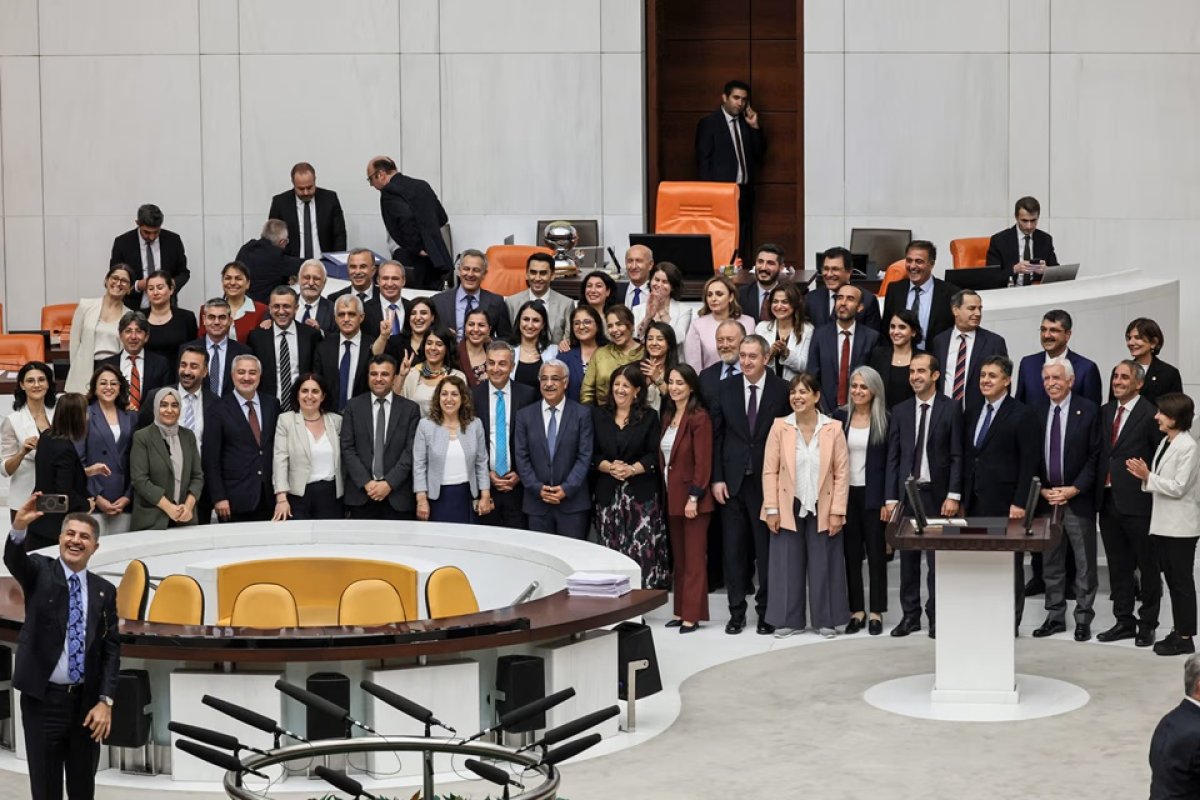
Kurdish rights in Turkey; the missing link in some democratic demands
According to KurdPress, peace talks between the Turkish government and the Kurdistan Workers' Party of Turkey (PKK) are continuing in a situation where some of the liberal and leftist movements in Turkey, citing democratic restrictions, suppression of opponents, and weakening of the rule of law, consider the realization of democracy a prerequisite for any peace agreement.However, Kurdish researcher Yaşim Yapırak Yıldız believes that this approach, if it ignores the historical suffering of the Kurds and the responsibility of Turkish society in the continuation of the violence, will lead to the postponement of Kurdish rights and the continuation of the status quo. According to him and the two researchers who responded to his analysis, ending the armed conflict, guaranteeing Kurdish rights, and Turkey’s democratic transformation should be pursued as related and complementary processes.
In an analysis published in the journal İşmetleri, Yaşim Yapırak Yıldız argues that the Kurdish issue cannot be seen simply as a dispute between the government and an armed movement, examining the political and social reactions to the ongoing negotiations between the Turkish government and the Kurdistan Workers’ Party.In his view, decades of violence, discrimination and denial of Kurdish identity have created a network of political and social responsibilities that encompass not only the direct perpetrators of violence, but also institutions and sectors of society. Therefore, achieving lasting peace requires that Turkish society, in addition to demanding democratic reforms, also examine its role in shaping and perpetuating this situation.
This analysis is based on discussions raised at a workshop entitled “An Unnamed Process: Fighting and Negotiating Peace in Kurdistan” held on June 8-9 at the Free University of Brussels, in collaboration with Jan Yasin Sonja and Joost Jungearden. Pinar Dinç, Associate Professor of Political Science at Lund University, and Joost Jungearden, Associate Professor of Rural Sociology at Wageningen University in the Netherlands, also responded to the analysis, emphasizing the link between resolving the Kurdish conflict, confronting structural violence and realizing democracy.One of the main themes of this discussion is the criticism of the position of groups within the liberal and leftist currents in Turkey who, citing the political situation in the country, consider peace talks inappropriate in the current circumstances. These groups point to the arrest of opposition members, government interference in the administration of elected municipalities, restrictions on freedom of expression, the weakness of the rule of law, and the suppression of political activity, and believe that until democratic institutions are restored, there can be no real peace.
Yesim Yapırak Yıldız emphasizes that an important part of this criticism stems from defensible principles, and the Kurdish movement has also fought for the realization of these same demands for decades.However, in his view, the problem arises when critics make democracy a precondition for starting or continuing negotiations, without explaining why such a condition was not raised with the same seriousness during periods when the Kurds were facing the most severe forms of violence.
As Yeşim Yapırak Yıldız writes, since the late 1980s, police violence against protesters, mass arrests, enforced disappearances, political assassinations and forced displacement have been part of the daily experience of Kurdish areas in Turkey. However, at key political junctures, from elections to political crises and protests related to the Susurluk case, the issue of Kurdish rights has often been sidelined and political and economic corruption has taken precedence.According to the researcher, this history shows that the demand for democracy, when violence was mainly directed at the Kurds, was not always pursued with the same criteria.
Accordingly, Yaşim Yapırak Yıldız does not see an inevitable conflict between criticizing the authoritarian state of Turkey and supporting the continuation of peace talks. In his view, one can simultaneously call for the release of political prisoners, respect for the rule of law, the lifting of political restrictions and an end to the armed conflict. The end of the war is an important step in reducing human suffering and creating the necessary political space for democratic coalitions, which will be more difficult to form in conditions of continued violence and armed conflict.
In this context, the issue is not only the responsibility of the government and the forces involved in the war, but also the role of society in normalizing or confronting violence.By distinguishing between direct participation in violence and participation in the structures that support it, Yaşim Yapırak Yıldız explains that not everyone is equally responsible. Officials who have been involved in issuing harsh sentences without credible evidence, judges who have refused to investigate cases of violence, medical staff who have not reported torture, and individuals who have directly participated in violence against civilians have a different responsibility than citizens who have remained silent out of fear, despair, or a sense of powerlessness.
However, public silence and social indifference can also contribute to the perpetuation of conditions that make violence possible. According to Yaşim Yapırak Yıldız, the lack of public pressure to resolve the conflict, the failure to address past crimes, and the indifference to everyday discrimination against Kurds are among the factors that maintain unequal boundaries between citizens.In such a situation, even using the Kurdish language, singing a song, choosing a Kurdish name, or expressing cultural identity can be met with suspicion, discomfort, or hostility.
To explain this situation, he points to the concept of the “engaged subject” in Michael Rothberg’s thought, a concept that allows for examining the role of individuals in historical structures of violence without holding everyone equally responsible. In this approach, individuals may benefit from the existing order without directly committing violence, remain silent about its consequences, or contribute to the survival of unequal structures by ignoring discrimination. Yaşim Yapırak Yıldız also, citing the perspective of Iris Marion Young, sees collective responsibility not only as directed towards the past, but also as related to the future consequences of the behaviors and structures that society helps to maintain or change.In response to this analysis, Pinar Dinç emphasizes that violence against Kurds should not be limited to the periods of the 1990s and 2015 and 2016. She considers the 2011 Ruboski massacre as a prime example of the continuity of violence and the impunity of its perpetrators. According to Pinar Dinç, the historical experience of the Kurds has led many of them to see violence not as a series of isolated events, but as a continuous process that has continued over generations.
Pinar Dinç also reminds us that the Kurdish issue is not limited to Turkey's borders. The Kurds have faced various forms of violence, repression and displacement over the past decades. In Syria, Kurdish areas have repeatedly been targeted by Turkish military operations and attacks by groups it supports after their uprising, and civilian infrastructure has also been damaged.He also points to the allegations made about the use of chemical weapons against Kurdistan Workers' Party forces in the Iraqi Kurdistan Region in 2022, saying that these allegations did not lead to a military or international investigation, but rather that some of the individuals who made them faced charges of terrorist propaganda and spreading disinformation.
User comments