
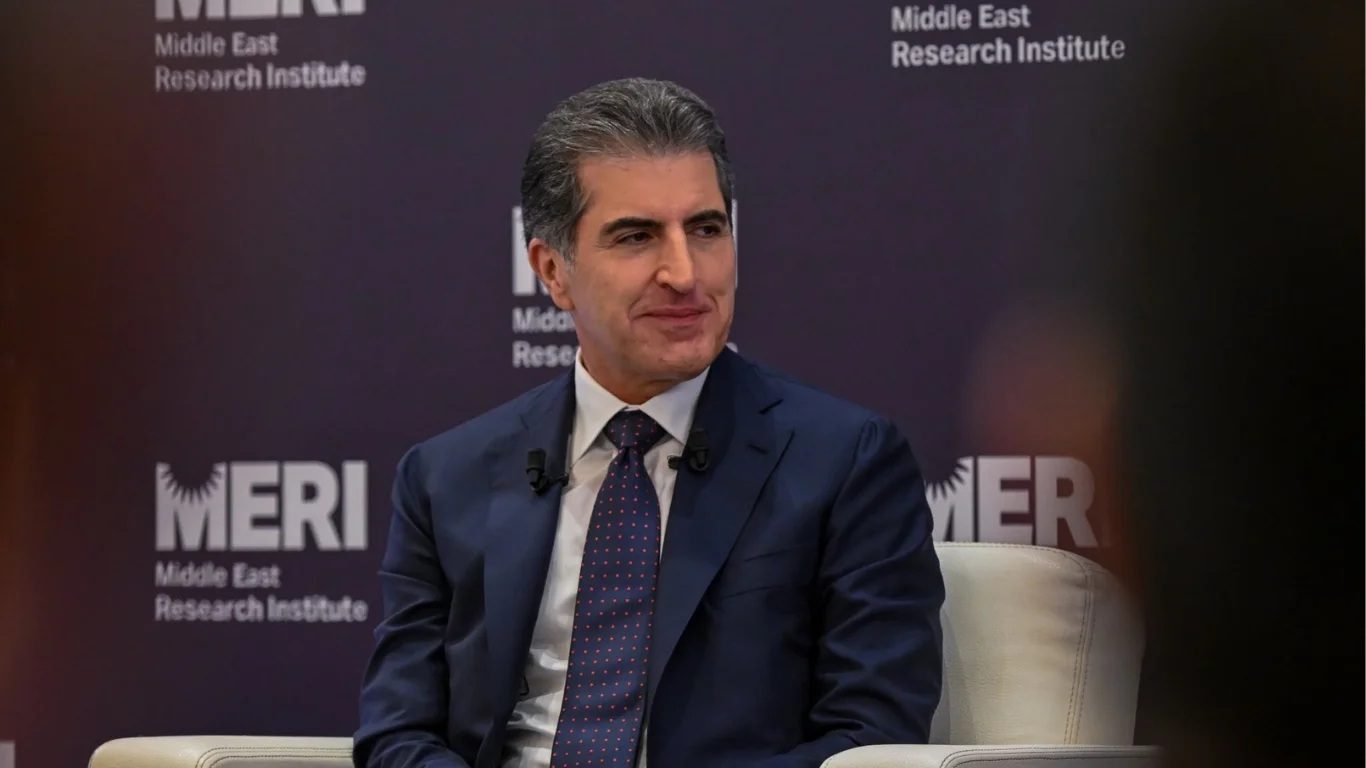
Nechirvan Barzani's political approach from the perspective of the Kurdish Studies Center in Germany
According to KurdPress, in an article examining Nechirvan Barzani's positions at the Middle East Studies Institute meeting in Erbil, Tariq Hammo presents a picture of a political leadership that sets its priorities based on the balance of power and regional developments.In his opinion, efforts to bring the conflicting parties closer together, avoiding confrontational slogans, and separating the priority of peace from political differences are among the main features of Nechirvan Barzani’s approach to the Kurdish issue.
By emphasizing political solutions, expanding relations with regional governments, and supporting peace processes in Turkey and Syria, Nechirvan Barzani, the president of the Kurdistan Region, is pursuing an approach whose main goal is to increase the Kurds’ power of political maneuver and prevent them from becoming victims of regional rivalries. This approach can be seen as an attempt to shift Kurdish politics from a reactive position reliant on military balances to the realm of diplomacy, participation in decision-making, and influence on power structures.Nechirvan Barzani’s presence at the Middle East Research Institute meeting in Erbil, alongside Mazloum Abdi, an advisor to the Syrian presidency, and Tuncer Bakrhan, co-chair of the Peoples’ Equality and Democracy Party in Turkey, was not just a symbolic event. The importance of this presence, especially in a situation where the Kurdish issue has entered a sensitive phase in several countries in the region, is evident in Nechirvan Barzani’s political positions and assessments of the future of these developments.
As the Middle East faces changing balances of power, intensifying security competitions, and regional actors trying to consolidate or expand their influence, the main issue for the Kurds is how to preserve political gains, protect national identity, and prevent the costs of power competition from being imposed on Kurdish communities.In this regard, supporting dialogue and a political solution should not be seen as a mere tactical choice or a reaction to temporary circumstances; rather, this approach can be part of a long-term strategy to consolidate the Kurds’ position in the regional political order.
One of the main features of Nechirvan Barzani’s approach is the emphasis on the necessity of direct communication with decision-making centers and efforts to influence the policies of regional governments. This approach is opposed to two tendencies: first, political isolation and limiting communications to aligned actors; second, relying on strategies based on the complete elimination of the other side and the absolute victory of one side over the other.
The experience of regional developments has shown that neither of these two approaches necessarily leads to a lasting guarantee of Kurdish rights.Isolation can reduce the possibility of influencing fundamental decisions, and constant confrontation increases the risk of the Kurdish regions becoming a battlefield for larger powers. Therefore, political engagement, negotiation, and building effective relationships with regional actors can be tools to protect Kurdish interests, provided that these interactions do not lead to ignoring their fundamental rights and demands.
Nechirvan Barzani had previously described Baghdad as the strategic depth of the Kurdistan Region. His speech in Arabic at the Iraqi Sovereignty Day ceremony was also a sign of emphasizing the political and institutional connection with the central government. These positions are based on the premise that the position of the Kurdistan Region is not strengthened by relying solely on domestic capacities, but also on the extent of its participation in Iraqi decision-making and its ability to influence Baghdad’s relations with regional actors.The same logic is also seen in Nechirvan Barzani’s policy towards Turkey and Syria. Engaging with Ankara to influence the peace process and reaching out to Damascus to involve the Kurds in the political structure of Syria are two examples of efforts to expand the political role of the Kurds through diplomacy.
The so-called peace and democratic society process in Turkey is one of the most important developments related to the future of the Kurdish issue. Nechirvan Barzani has supported dialogue between the Turkish government and the Kurdish political movement and has tried to use the potential of his relations with Turkish President Recep Tayyip Erdogan and officials of the Justice and Development Party to strengthen this process.
The importance of this position must be examined in the historical context of the Turkish government’s conflict with the Kurdish movement. Decades of military conflict, security policies, and restrictions on Kurdish identity and rights have created deep distrust between the parties.In such circumstances, achieving a lasting agreement is not limited to stopping the fighting; it also requires changing political calculations, accepting the social and national reality of the Kurds, and creating mechanisms to resolve disputes.
From this perspective, a peace strategy can achieve a lasting result only when it does not become a tool for eliminating Kurdish demands or unilaterally consolidating state power. The goal should be to create a political framework in which security, linguistic and cultural rights, political participation, and the possibility of expressing Kurdish demands are recognized.
In this framework, Nechirvan Barzani emphasizes the need to use existing opportunities to reduce tension and open the path to negotiations. Such an approach does not necessarily mean that all Kurdish movements have the same view on the details of the peace process; rather, it indicates prioritizing the reduction of violence and creating the possibility of a political settlement of disputes.
User comments