
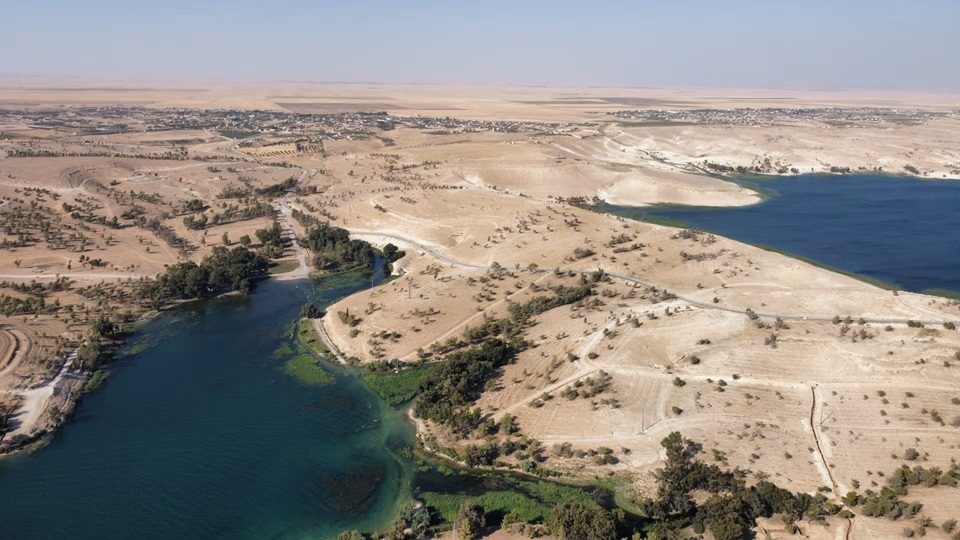
How did the Arab Belt plan change the demographic composition of Syria's Kurdish areas?
Kurds and Arabs demand a resolution to the dispute over confiscated lands in Syria
Nearly five decades after the implementation of the "Arab Belt" plan in the Kurdish areas of northeastern Syria, the dispute over the confiscated lands continues.While Kurdish families are demanding the return of their land, Arab families who were displaced to these areas in the 1970s are also demanding the return of their confiscated properties in Raqqa province or compensation and alternative housing. Existing estimates indicate the vast extent of the land confiscation, and legal experts emphasize that the resolution of this dispute must be pursued within the framework of transitional justice, the realization of the rights of the original owners, and the preservation of the coexistence of Kurds and Arabs.
Shukri Daqori, a resident of Kurdish areas near the Syrian-Turkish border, estimates that as part of the policies of the Baathist government, about 280,000 hectares of land belonging to Kurdish owners in the border strip have been confiscated.Meanwhile, researchers from the Syrians for Truth and Justice Organization have stated that about 335 Kurdish villages have been affected by the consequences of this plan, and dozens of settlements and state farms have been established on confiscated lands.
The organization estimates that about 73,000 hectares of land have been allocated for the construction of settlements for Arab families, and nearly 139,000 hectares of land from Kurdish families have been transferred to state farms. These figures are preliminary estimates and, according to the organization’s researchers, require careful examination and verification.
With the fall of Bashar al-Assad’s regime in December 2024 and the beginning of Syria’s political transition, Kurdish families have become hopeful that they will be able to pursue their property rights.On the other hand, a number of Arab families also emphasize that they were victims of the policies of the previous government and should not be held responsible for the confiscation of Kurdish lands due to their forced relocation to these areas.
After the Baath Party came to power in the coup of March 8, 1963, the Syrian government adopted policies aimed at strengthening Arab identity and limiting Kurdish identity. In 1965, a plan entitled the Arab Belt was developed, which aimed to create strips of Arab settlements in the Jazira region, along the Syrian-Turkish border and in areas with a Kurdish majority.
The implementation of this plan began in the early 1970s. The government of the time confiscated agricultural land and established new villages, settling Arab families in these areas. A number of these families had previously lost their lands and homes following the filling of the Euphrates Dam in Raqqa province.Estimates indicate that around 140,000 Kurdish citizens were displaced from their fertile lands, and Arab families were resettled on some of these lands. This process changed the demographic composition of the region. Despite the halt of the project in 1976, the confiscated lands were not returned to the Kurdish owners.
The issue of ownership of these lands has now become one of the most important issues in Syria’s political transition; a problem whose resolution requires simultaneously examining the rights of Kurdish owners, the situation of displaced Arab families, and the government’s responsibility to compensate for the losses caused by past policies.
Faisal Abboud al-Shwaakh al-Bursan, a 70-year-old man who lives in the village of Bahira, near the city of Amuda, says his family was among the first residents of the village.According to him, his family was moved to the Jazira region on May 1, 1975, after the Baathist government confiscated their land in Raqqa province.
Faisal Abboud al-Shwaakh al-Bursan says: “We came to the Jazira region on the orders of Hafez al-Assad, the then Syrian president, because the government had forcibly evicted us from our land in Raqqa. Our villages and lands were confiscated without compensation. We were put under great pressure, they destroyed mosques and madrasas, and they destroyed the trees in our agricultural lands.”
He emphasizes that his family’s relocation to Kurdish areas was not done with the aim of seizing Kurdish land, but rather as a result of the policies of the government at the time. According to him, government officials told his family when they settled that the land they were transferring belonged to the Syrian Ministry of Defense, and the family was unaware that the land might belong to Kurdish owners.The family has lived in the area for more than 50 years. Faisal Abboud al-Shwaakh al-Bursan says that during this time there have been no problems between his family and the Kurds in the area, and his family does not oppose the return of the land to the original owners.
“We are not against the Kurds or the original owners of the land,” he says. “If they have documents to prove their ownership, they have the right to demand the return of their land.”
Faisal Abboud al-Shwaakh al-Bursan’s family is demanding the return of the confiscated land in Raqqa or fair compensation and alternative housing in that province. He says that they are ready to leave the area if the government provides a fair solution for compensation and the return of his family to their former place of residence.He believes that the dispute should be resolved in a way that both protects the rights of the original Kurdish owners and prevents Arab families who were relocated to the region by the previous government from being punished for policies that they had no role in shaping.
Shukri Daqori, 51, a longtime resident of the Kurdish village of Barifa, says his family has title deeds to their land and wants the return of their lost property and rights instead of receiving financial compensation. He sees the land confiscation as part of a targeted policy to change the demographic composition of Kurdish areas.
According to Shukri Daqori, there are now about 70 hectares of land belonging to the Daqori tribe, which are divided among four lineages of the tribe, with about 30 families sharing in it.He says that another 180 hectares of the tribe’s former lands have been given to Arab families who were resettled in the region as part of the Arab Belt plan.
After the fall of the Baathist regime, a number of Kurdish families entered into talks with Syrian transitional government officials to find a way to reclaim their lands. In this context, a group of families met with Ahmed al-Hilali, deputy governor of Hasakah in the Syrian transitional government, at the regional administration building in Qamishlo to discuss ways to resolve the dispute and prevent social tensions.
Shukri Daqori says that during this meeting, it was agreed that until a solution is reached, the sale and purchase of disputed lands and construction on them will be prevented. According to him, Ahmed al-Hilali had promised that the issue would be resolved within a year, but so far no concrete action has been taken in this regard.Shukri Daqori considers the return of the lands to the original owners to be the final solution, but at the same time emphasizes the need to provide compensation and housing for the Arab families living in these areas. According to him, Kurdish families do not object to growing seasonal crops on the disputed lands in the current situation, but they do not accept the sale of these lands, permanent construction and the implementation of projects that complicate the ownership situation.
He emphasizes that the continuation of the current situation is unacceptable and a solution must be found that restores the rights of the original owners and prevents the creation of a rift between Kurds and Arabs.
Amargi magazine contacted Ahmad al-Hilali to get an explanation about the demands of the Kurdish families and the outcome of the meeting, but the deputy governor of Hasakah stated that he was not authorized to comment on the matter at this time.
User comments