
Syrian Kurds Struggle to Preserve Their Mother Tongue
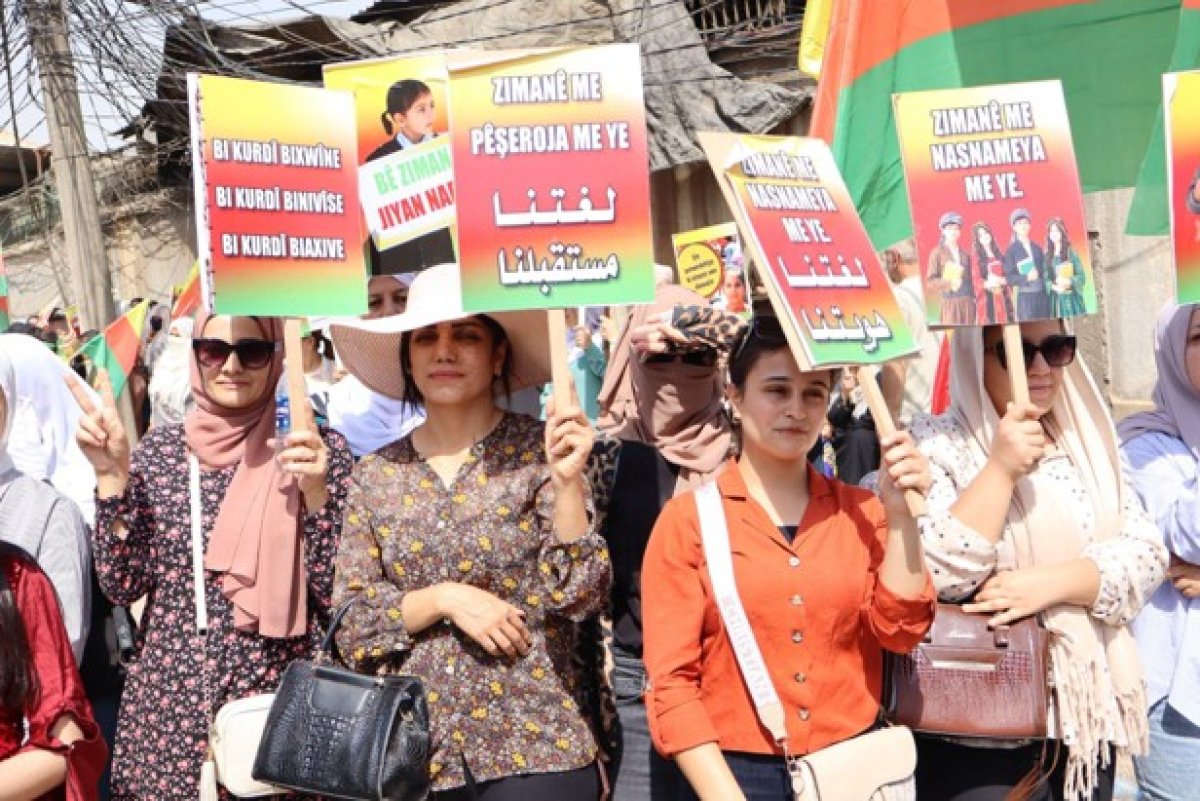
According to KurdPress, the protest by Syrian Kurds against the government's decision to teach some subjects in Arabic in schools in the country's northeast has once again highlighted disagreements over linguistic and cultural rights and how Kurdish regions should be integrated into the central government. According to families and experts, this could lead to students' academic decline and a weakening of Kurdish identity.
According to Syria Direct, hundreds of Syrian Kurds rallied in September in various cities in the country's northeast, including Qamishli, to protest the change in the language of instruction in schools.The protesters demanded that Kurdish remain the main language of instruction in schools in Kurdish-majority areas.
The Syrian government’s new decision to teach some subjects in Arabic comes after Syrian President Ahmed al-Shara issued a decree in January recognizing the linguistic and cultural rights of the Kurds and declaring Kurdish a national language. In March, the Syrian Ministry of Education called on Kurdish experts and teachers to collaborate on developing a Kurdish curriculum. However, the start of the new school year with the government’s decision to teach math and science in Arabic has surprised and worried Kurdish families.
Students and their parents say that many children and adolescents who have studied in Kurdish-speaking schools in recent years do not have sufficient Arabic fluency and may not be able to understand the concepts taught in the curriculum.Miran Suleiman, a 15-year-old Kurdish student, told Syria Direct that teaching math and science in Arabic makes it difficult for him to learn these subjects. He stressed that Kurdish is not only a means of communication but also part of his identity.
Hana Einas, a former teacher in the autonomous administration and a member of the teachers’ union, also warned that some students are skipping classes due to their inability to understand the material and protesting the changes to the curriculum, and may be forced to repeat a grade.
These concerns are rooted in the historical experience of Syrian Kurds. During the rule of Bashar al-Assad, the use of Kurdish in schools and public settings was banned, and the publication of Kurdish publications and some cultural activities, including the Nowruz celebration, were restricted.Hana Einas recalls that Kurdish students were forced to learn their mother tongue in secret, hiding their notebooks under their clothes.
After the Syrian government withdrew from parts of the northeast in 2012, the autonomous administration developed a new curriculum based on the Kurdish language. History, geography and philosophy were also taught in Kurdish, and in the following years, higher education institutions and universities were established in Kurdish-controlled areas.
However, Kurdish education was controversial from the beginning. Some families preferred to send their children to Syrian state schools, as diplomas issued by the autonomous administration were not recognized in many other parts of the country.There are also concerns that Kurdish history and culture will lose their place in textbooks as the central government implements a new curriculum. It is not yet clear who will be involved in developing the curriculum and whether representatives of the Kurdish community will be present.
Despite these differences, many Kurdish families are not opposed to learning Arabic, but want to keep their mother tongue as the main language of education. Hadiya Abdul-Wahhab, a mother of three, said that Kurds, Assyrians, Armenians and Arabs should be able to learn each other's languages, but that most of the lessons for Kurdish students should be taught in Kurdish.Thomas McGee, a Kurdish researcher at the European University Institute, believes that Arabic can play the role of a common language in a unified state, but at the same time the Syrian government must compensate for the consequences of decades of bans and restrictions on the Kurdish language. Benoit Maarten, an expert on education and peacebuilding at the Dutch organization PAX, also warned that ignoring the language and identity of different groups could deepen social divisions. He considered the experience of the Iraqi Kurdistan Region an example of the consequences of limited linguistic contact between the young Kurdish generation and other regions of the country.
This educational gap has intensified in a situation where the process of integrating the Syrian Democratic Forces into the central government structure remains accompanied by distrust and tension.In recent weeks, Kurdish protests against changes to education policy and Arab rallies in Hasakah province in support of expanded central government control have once again exposed the disagreement over the future of the administration of northeastern Syria.
Abdulaziz Ahmadou, a spokesman for the Hasakah provincial education department, announced that promises had been made to return to the autonomous administration’s Kurdish-language curriculum in schools in Kurdish-populated areas. The comments suggest that the government may reconsider its recent decision, but it is not yet clear when and by what mechanism such a change would be implemented.
According to experts, the dispute over the language of instruction is not just an educational dispute, but also related to the issue of the concentration of power and the degree to which the cultural and linguistic rights of different communities have been accepted in Syria since the fall of Bashar al-Assad’s regime.While the central government is emphasizing the need to build a unified structure, Kurds are concerned that integration into state institutions will come at the cost of losing their linguistic and cultural achievements.
Benoit Martin stressed that the Syrian government’s unilateral decision, without considering the demands and concerns of the Kurdish community, will further undermine trust between the two sides, an issue that could also affect the difficult process of political and administrative integration of the northeastern regions of Syria.
User comments