
The role of the urban population in the political fate of the Kurds of Iraq and Syria
According to KurdPress, a study of the map and data of "National Context" about the Kurdish cities of Iraq and Syria shows that the difference between the two Kurdish communities is not limited to the size of the population or geographical area, but there is also a fundamental difference between them in the pattern of urban geographic settlement; a difference that can affect the economic, political and security capacity of the Kurdish areas of the two countries.
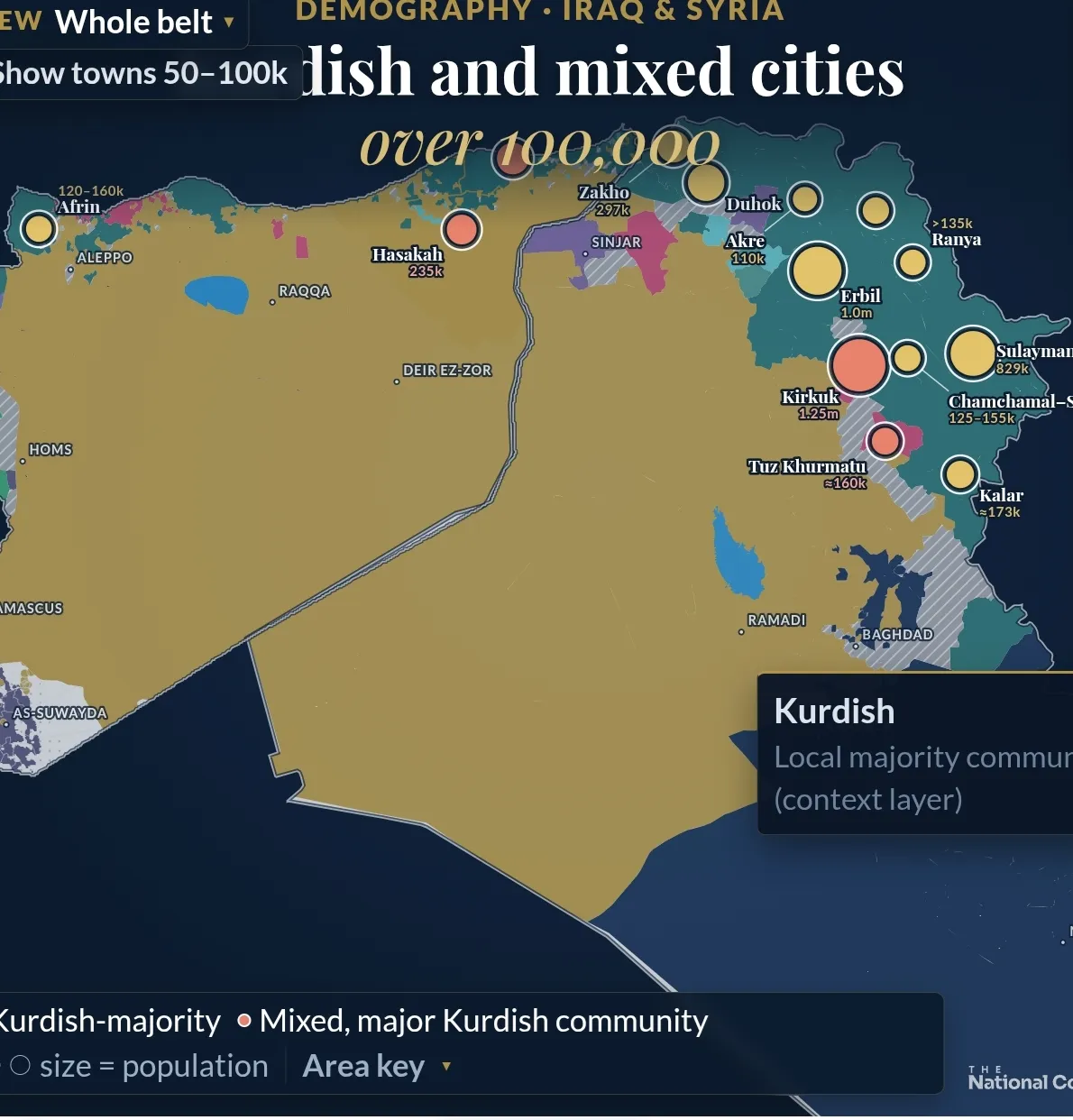
According to this study, Syria has only three cities related to the Kurdish population with a population of more than 100,000 people: Afrin, Qamishlo and Hasakah.Afrin is the only city that National Context classifies as predominantly Kurdish, while Qamishlo and Hasakah are mixed cities with significant Kurdish populations. In contrast, Iraq has at least nine cities with populations of over 100,000 that are predominantly Kurdish, and two mixed cities that fall into this category.
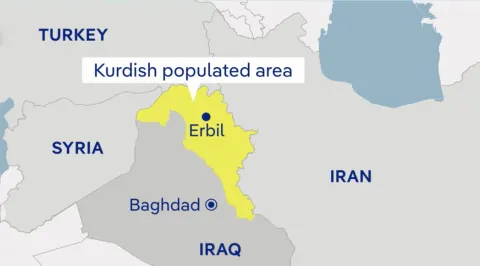
The map published by National Context clearly shows this difference. In the Kurdistan Region of Iraq, cities such as Erbil with about 1 million people, Sulaymaniyah with about 829,000, Zakho with about 297,000, Raniya with more than 135,000, Acre with about 110,000, Kallar with about 173,000, and Chamchamal with a population of about 125,000 to 155,000 form a dense network of Kurdish urban centers. In contrast, Kirkuk with about 1.25 million people and Tuz Khurmatu with about 160,000 are classified as mixed cities with significant Kurdish populations.
In Syria, the picture is different. Hasakah with about 235,000 people and Afrin with a population of about 120,000 to 160,000 are visible on the map, but the main difference lies in the demographic composition around these cities. According to National Context, even cities with a Kurdish majority in Syria are often located in mixed rural areas. For example, in Dirak and Gerak-e-Lage, Kurds are probably more than 70 percent of the population of the cities, but there is a significant Arab population in their surrounding areas.
This situation is even more important in Hasakah and Qamishlo. National Context describes Hasakah as one of the most complex regions in northeastern Syria in terms of population, and writes that the Arab population in the rural areas of the province is very large.In the city of Hasakah, Kurds are also a significant minority, with Arabs and Christians forming the majority overall. In Qamishlo, Kurds are a narrow majority within the city limits, but the surrounding villages, especially to the south of the city, are predominantly Arab.
The gap in the scale of Kurdish cities
The difference becomes even more pronounced when smaller cities are also taken into account. According to National Context, adding cities and towns with populations of 50,000 to 100,000 adds only about six more cities in Syria to the mix, while in Iraq there are more than 26 cities in this population range, most of which are also distinctly Kurdish.
So the difference between Iraq and Syria is not just a matter of having a few large cities. In Iraq, a collection of large and medium-sized cities are located side by side, creating a broader urban and demographic contiguity.In Syria, large Kurdish cities are fewer, smaller, and more geographically dispersed, and many are located in mixed areas.
This difference in urban structure also has economic significance. Larger cities tend to provide more extensive labor markets, services, university education, trade networks, and infrastructure, and thus have a greater capacity to support a regional administrative and political structure. National Context argues that cities form one of the economic and intellectual foundations of any stable political unit.
The security and military implications of demographic differences
The importance of cities is not limited to economics. Urban population density and the presence of large urban centers can increase the cost of a military operation for the central government.The larger the cities and more concentrated the population, the more difficult it is to control simply by seizing a few military points, and military operations can have greater human, economic, and political consequences.
From this perspective, National Context also sees the difference between Iraq and Syria in terms of the possibility of the central government exercising military power as related to urban structure. In Iraq, the concentration of large Kurdish cities in a relatively contiguous area has created conditions different from those in northeastern Syria. In Syria, the geographical dispersion of the Kurdish population and the location of many Kurdish cities in mixed environments have made it more difficult to create a unified territorial unit.
This issue also became important in the experience of administering areas under the control of the Syrian Democratic Forces.According to National Context, the SDF-led administration was not trying to hold Raqqa and Deir Ezzor solely for military or economic reasons, but rather for the greater population and geographic depth of these areas to increase the viability of a political entity. With the loss of these areas and the reduction of SDF-controlled territory to a smaller part of Hasakah province, this capacity was severely reduced.
Iraq; denser urban network, Syria; more dispersed population
In Iraq, cities such as Erbil, Sulaymaniyah, Dohuk, Zakho, Acre, Rania, Kular, and Chamchamal, along with dozens of smaller cities and towns, have created an urban network that concentrates a significant portion of the Kurdish population in urban centers. Even outside the formal boundaries of the Kurdistan Region, cities such as Kirkuk and Tuz Khurmatu have significant Kurdish populations, although their composition is mixed.National Context’s map clearly shows this difference between predominantly Kurdish cores and mixed cities.
In Syria, the three main Kurdish population centers of Afrin, Kobani, and Hasakah are also not geographically connected. National Context has previously argued that this geographic and demographic dispersion, along with the large presence of Arab populations in parts of northern and eastern Syria, has limited the possibility of a unified Kurdish territorial project.
Therefore, the difference between Kurdish political models in Iraq and Syria cannot be attributed solely to differences in parties, ideologies, or the functioning of political forces. Demographic structure, and especially urban structure, is also an important variable in this difference.In Iraq, the presence of a larger number of large and medium-sized Kurdish-majority cities has provided a denser demographic and economic base for regional administration; in Syria, the smaller Kurdish urban network and the mixed nature of a significant portion of the main population centers have further limited the capacity to create and maintain an independent territorial political unit. This conclusion is, of course, the analysis of National Context, and the population classifications of the map are also the analytical estimates of this source, not the results of a single official census for all cities in Iraq and Syria.
The National Context report shows that the main difference between the Kurds of Iraq and Syria lies not only in the “number of Kurdish populations”; but also in the way they are concentrated in cities, the geographical contiguity of these cities, and their relationship to non-Kurdish populations.This urban and demographic difference is one of the important factors that explains the different paths of Kurdish political developments in the two countries.

User comments