
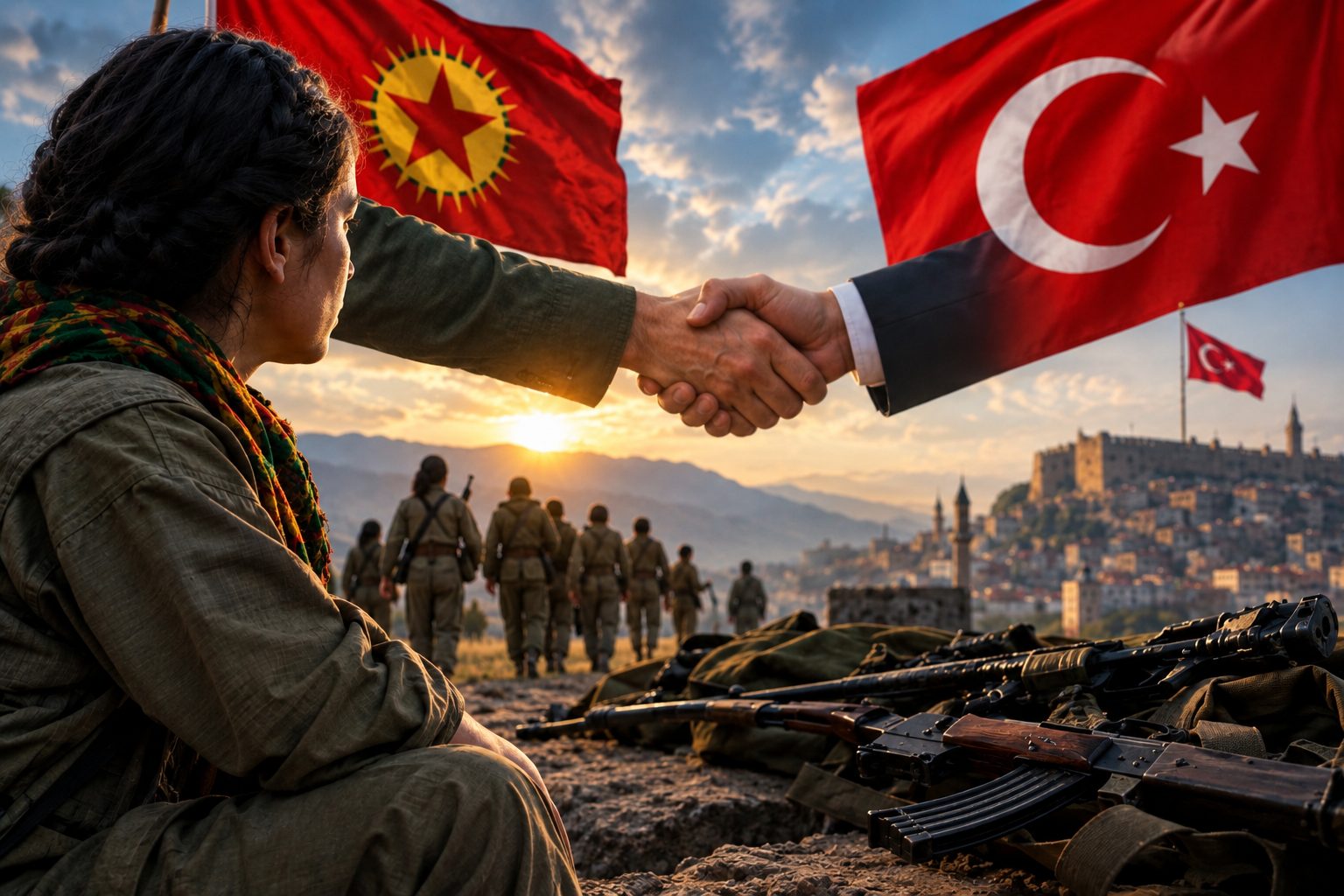
What price have the Kurds paid for peace with Turkey?
According to KurdPress, the Dutch Clingendael Institute's report on the new process of the Kurdish issue in Turkey shows that the process that began in October 2024 has focused on disarmament and dissolution of the PKK rather than moving towards a comprehensive political agreement between the government and the Kurds.According to the institute, the Turkish government has so far taken limited steps to resolve the political, legal and cultural issues of the Kurds, and in turn has used this process to rearrange the domestic political atmosphere and increase pressure on the opposition.
According to the report, the call of the government of Bahçeli, the leader of the National Movement Party, to Abdullah Öcalan in October 2024 was the starting point of the current process, and Öcalan called for an end to the armed struggle and the dissolution of the PKK in February 2025. The PKK also decided to dissolve itself in May 2025, and in July of the same year, the first group of its members symbolically destroyed their weapons in northern Iraq. However, the full implementation of the disarmament was delayed until mid-2026 due to disagreements over legal guarantees and the status of PKK members.
Clingendael believes that the most important feature of the current process is the “imbalance in the leverage” between the government and the Kurdish side. The PKKThe PKK has less military and political power than before, and the possibility of a return to armed conflict has become much more costly for it. In contrast, the Turkish government has more political, security and legal leverage and therefore has less incentive to offer broad concessions.
In this context, the Turkish parliament passed the “Strengthening National Solidarity and Social Integration” law in August 2026. This law provides a mechanism for suspending investigations, trials and the execution of certain sentences of PKK members after the dissolution and disarmament of the organization, but it is not considered a general amnesty and its implementation is subject to the fulfillment of certain conditions. Abdullah Öcalan and a significant part of the old PKK leaders have also been effectively excluded from the benefits of the law.
The report emphasizes that the new law mainly addresses the issue of disarmament and the legal status of PKK members.K and does not address broader issues of the Kurds in Turkey, including constitutional reform, recognition of Kurdish identity, easing political restrictions, the release of political prisoners, and the end of the appointment of state guardians for elected Kurdish municipalities. According to Clingendael, the continued detention of Selahattin Demirtaş and the continuation of the policy of appointing guardians, while not necessarily requiring a new law to remove them, are a sign of the limited agenda of the government.
The institute lists two main goals for the Kurdish side: reducing political repression and creating more space for political and cultural activity. From the perspective of a part of the Kurdish movement, the dissolution of the PKK could pave the way for the separation of Kurdish political activity from the armed struggle and reduce the government’s reliance on the accusation of “links to terrorism.”At the same time, there is disagreement among the Kurds about the future strategy; some continue to pursue the achievement of Kurdish rights within a democratic framework and cooperation with the government opposition, while others see direct engagement with the government as a pragmatic way to achieve specific demands.
Clingendael also examines the current trend in the context of domestic political developments in Turkey and believes that the Kurdish issue could lead to the weakening of the unity of the government opposition. The Peoples’ Democratic Party, Equality and Democracy (HDP) has adopted a more cautious stance towards the government in some cases in order to maintain the negotiation process, while at the same time the opposition parties have disagreed on how to deal with the disarmament process. The passage of the August 2026 law also revealed divisions within the opposition, especially over how to interact with the government and the PKK.
At the regional level, the report says that the dissolution of the PKKThe PKK has raised questions about the future of its affiliated structures in other regions. In Syria, contrary to some initial predictions, the Turkish process did not lead to a broad agreement on Kurdish self-rule, and Kurdish political and military structures were significantly limited and reorganized within the framework of the agreement with Damascus. In Iraq, both main Kurdish parties, the Kurdistan Democratic Party and the Patriotic Union of Kurdistan, support the continuation of the Turkish-PKK process, since a return to conflict could once again turn the territory of the Kurdistan Region into a battlefield. In other regions, it is still unclear to what extent the call for the dissolution of the PKK includes its affiliated structures.
Clingendael believes that the current process in Turkey has so far been a controlled process for the disarmament of the PKK rather than a “peace process” to fundamentally resolve the Kurdish issue.This process could create a limited political space for the Kurds, but this space, if the current path continues, will likely be conditional and dependent on the frameworks set by the government.
According to the institute, the likely outcome of such a process is neither the complete elimination of the Kurds from the Turkish political scene nor a comprehensive solution to the Kurdish issue, but rather a kind of “managed integration”; that is, the presence and political activity of the Kurds within the limits determined by the government. Clingendael sees this situation as part of the process of consolidating authoritarianism in Turkey and believes that until the balance of power between the government and the Kurdish movement changes, it will be difficult to expect a fundamental change in the political and legal agenda of the Kurdish issue.

User comments