
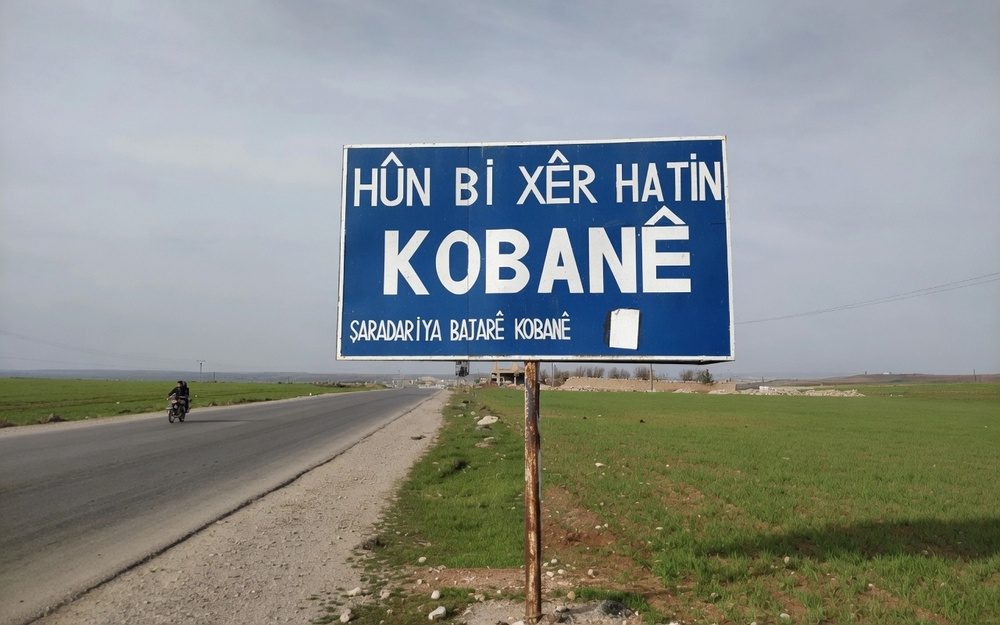
Kobani; 12 years after the ISIS attack
According to KurdPress, on the 12th anniversary of the start of the massive ISIS attack on the city, Kobani once again witnessed clashes, arrests of citizens, the entry of security forces from outside the city, and a fire in the prison; a series of events that, according to Polat Can, a former official of the autonomous administration and an analyst of Syrian Kurdish issues, remind the residents of the city of an era that they thought would never return to after paying heavy human costs.In an article published in Eurasia Review, Polat Can writes that ISIS’s attack on Kobani began on September 15, 2014, using tanks, artillery, and weapons it had captured in Iraq and Syria. The attack displaced tens of thousands of people from surrounding villages and then allowed ISIS forces to enter the city itself. Kobani has since become one of the most symbolic battlegrounds against ISIS, a symbol that has gained importance not only for the Kurds but also internationally.
According to the analyst, the recent events in Kobani began with the kidnapping and killing of Sipan Hazni, a former Kurdish member of the Syrian Democratic Forces. Hazni had joined the Hasakah Brigade of the Syrian Defense Ministry after the merger agreements with Damascus, but was kidnapped by an Arab armed group and killed after being filmed and filmed. The incident was also released.John believes that the way the incident was abducted, filmed, murdered, and released was reminiscent of the methods ISIS used in the past to turn killings into a message against their community.
He emphasizes that the significance of Hazani’s killing for the Kurdish community was not limited to the killing of an individual, because he had previously left an independent Kurdish military structure and joined the Syrian army. From the author’s perspective, this shows the main contradiction of recent events: the Kurdish force that had entered the Syrian government structure in accordance with the Damascus agreements could not remain immune from attacks and killings.
Hazani’s killing led to protests in the Kurdish regions of Syria, and Kobani, which was already facing a series of political and social problems, became one of the centers of protest.Polat Can points to the dispute over the use of the name “Ayn al-Arab” instead of “Kobani” in official Syrian documents, the restrictions on Kurdish language education, and the issue of the return of Kurdish refugees from areas such as Tal Abyad or Garh Sepi. None of these issues alone, he writes, can explain the recent events, but together they raise concerns about the future of the rights and position of Kurds in the new Syrian structure.
According to the article, when the protest rallies were held in Kobani, local internal security forces tried to prevent the conflict from spreading. However, according to information the author claims to have received directly from senior local security officials, a road security officer named “Shahin,” who is from Sarmada in Idlib, entered the city with road security and special operations forces.This action was taken in a situation where local authorities had warned of the possibility of inciting the protesters, writes Jan. After some young protesters threw stones, the security forces retreated towards the security center, and shooting continued at the protesters.
Local security forces intervened to control the situation and arrested about 17 people who were involved in attacking the security forces or causing disorder. However, according to Polat Jan, other public security and special operations forces stationed outside Kobani later entered the city. According to the author, the vehicles of these forces moved through the streets of the city while chants of takbir and provocative and racist slogans could be heard, and a number of citizens were arrested from the streets, parks and restaurants.The author also claims that some detainees were beaten and humiliated.
In the wake of these developments, the issue of transferring the detainees to Aleppo became one of the main points of disagreement. Polat Can introduces Majd al-Din al-Sheikh, known as “Abu Omar,” as one of the main factors in this confrontation and writes that he is responsible for internal security in the Kobani region. The author also claims, citing local security information, that he has a family connection with Jihad Issa al-Sheikh, known as “Abu Ahmad Zakour,” a former senior figure in Hayat Tahrir al-Sham and currently working as an advisor to Ahmad al-Sharaa on tribal affairs.
According to him, after local security forces objected to the method of transferring the detainees, the conflict escalated and eventually 17 prisoners were taken out of Kobani and transferred to Aleppo.Protests by other prisoners over their transfer also led to a prison riot, which resulted in a fire that killed nine prisoners and injured 17 others, some of whom are reported to be in critical condition.
The author emphasizes that the exact responsibility for how the fire started must be investigated, but in his view, the crux of the matter is that these individuals were in custody and nine of them died inside the prison. Therefore, according to Jan, the investigation of the incident cannot be separated from the security decisions regarding the detention, the transfer of prisoners from Kobani, and the ensuing conflict.
Polat Jan examines the recent events in the context of larger developments in Syria, and does not see it as just an uncontrolled protest or an incident in the prison.These events, he writes, occurred just weeks after the commander of the Syrian Democratic Forces, Mazloum Abdi, announced the dissolution of the force and the autonomous administration and their integration into the institutions of the Syrian government.
According to the analyst, the Syrian Kurds had created a set of military, security, and administrative institutions over more than a decade, through which they governed parts of northern and eastern Syria and defended those areas against ISIS. He believes that the dissolution of these structures has created a historic change in the level of bargaining power of the Kurds.
Polatcan further argues that, based on the expectation formed by the agreement with Damascus, the dissolution of the independent military and administrative structures of the Kurds was supposed to be accompanied by their meaningful participation in the new structure of Syria and the recognition of their identity, language, local rights, and political participation.However, in the author’s view, recent developments have raised concerns that Damascus may see “integration” primarily as a means of dismantling Kurdish institutional power and postpone the issue of Kurdish rights to a later stage.
Accordingly, he sees the dispute over the name of Kobani, Kurdish language training, the deployment of security forces outside the city, and the transfer of prisoners as issues that go beyond ad hoc security disputes. In John’s view, the sum of these developments could indicate a process in which Kurdish institutions are first weakened or dissolved, and then Kurdish political and cultural rights are negotiated; at a time when, he argues, the Kurds’ bargaining power has diminished compared to the past.
The killing of Sipan Hazni has a special place in this analysis because he continued to be targeted after joining the Syrian army and leaving the independent Kurdish military structure.John raises the question of how much confidence other Syrian Kurds can have that abandoning their remaining institutions will provide them with greater security if the integration of a Kurdish force into the Syrian army cannot guarantee their security.
In another part of the article, he refers to Turkey’s role in the developments in Syria, writing that Ankara has long assessed the military and administrative structures of the Kurds in Syria in the context of its conflict with the Kurdistan Workers’ Party and has welcomed their dissolution. According to him, this situation, along with Turkey’s influence over the new authorities in Damascus, could affect the course of developments in the Kurdish regions of Syria.The analyst also distinguishes between two approaches to the process of disarmament and Kurdish developments: on the one hand, an approach that emphasizes the dissolution of armed structures and the end of the presence of Kurdish armed forces, and on the other, an approach that links disarmament to political and democratic developments and the resolution of the Kurdish question. According to John, until this difference in approach is resolved, the Kurdish areas of Syria could continue to be exposed to pressures from the broader Kurdish conflict.
Kobani, in this regard, has a place beyond an ordinary city. The city became a symbol of resistance against ISIS in 2014, and its battle was one of the most important symbols of the cooperation of Kurdish forces with the US-led coalition against ISIS. According to John, this battle played an important role in the formation of the subsequent military and political structure, including the Syrian Democratic Forces and the Autonomous Administration.Therefore, the presence of security forces outside the city in the current situation, from the author’s perspective, has a meaning beyond a local security dispute.
In another part of the article, Polat Can refers to the background of some figures associated with the new Syrian security structure and writes that the experience of Kobani residents with jihadist groups, including ISIS and the Nusra Front, has made them sensitive to changing the names of institutions and uniforms. He clarifies, of course, that this does not mean that all current Syrian government institutions are identical with ISIS, but he believes that changing the organizational structure or official title of a group alone cannot eliminate the memories, records of individuals, and the experiences of victims.
According to this analyst, for the people of Kobani, the recent events are not simply a series of clashes, arrests, and the killing of a few people, but carry a broader message about the type of power exercised in the city.In his view, the entry of armed forces from outside Kobani, the arrest and beating of some citizens, and the subsequent death of prisoners in a fire, in a city where the memory of the ISIS attack is still fresh, creates much greater sensitivity.
At the end of the article, Polat Can recalls the 12th anniversary of the ISIS attack on Kobani and writes that the city has once again faced the presence of armed forces from outside the city, the transfer of detainees, and the killing of prisoners. In his opinion, for the residents of Kobani, changing the flag and uniform alone is not enough to change their perception of the behavior of the armed forces, and public trust is formed when government institutions can guarantee the security of citizens and treat them according to the law.Polat Jan, the author of this article, is a PhD researcher in International Relations at the University of St Andrews, and studies and researches in the fields of international relations, conflict, war, governance, regional politics and security.





User comments