
The Kurds and Washington's Relationship in US State Department Documents
According to Kurdpress, the relationship between Iraqi Kurdish leaders and the US government between 1962 and 1975, according to official US State Department documents, began with requests for political and humanitarian support, then progressed to requests for financial and military aid, and finally, in 1972, led to secret cooperation and the transfer of money, weapons, and intelligence to the forces of Mullah Mustafa Barzani. However, this cooperation was ended by the US following the Iran-Iraq agreement in March 1975.This collection of documents was extracted from the archives of the US Department of State’s “Office of Historical Records of Foreign Relations,” which collects and makes publicly available historical documents of Washington’s foreign policy. The documents used in this file mainly relate to correspondence, diplomatic reports, internal memos, and confidential documents that have been declassified after many years and are now available in their original text or images in the official archives of the US Department of State.
These documents record some of the contacts and correspondence between representatives of the Iraqi Kurds, especially those close to and representing Mullah Mustafa Barzani, and American officials from the early 1960s to the mid-1970s.The documents cover a process that begins with political and humanitarian appeals and efforts to gain Washington’s support, and then moves on to discussions of financial, arms, and covert U.S. support for the Iraqi Kurdish movement. Along with the Kurdish side’s requests and proposals, these documents also record the positions, considerations, and responses of U.S. officials at various points.
What follows is a documented account of this process that relies solely on the content of these historical documents and follows the course of the contacts, requests, decisions, and actions recorded in them without adding analysis or judgment. For each section, a link to the original document in the official archives of the U.S. Department of State is provided.
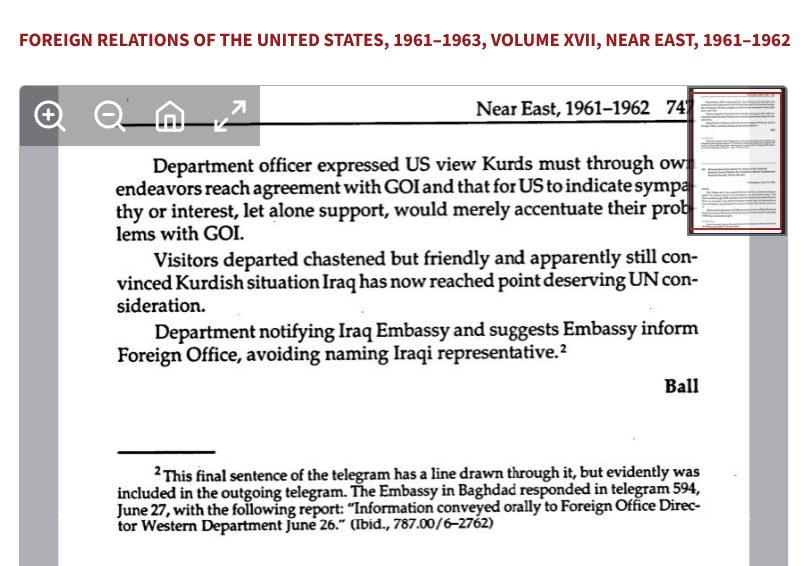
The first contacts recorded in this series date back to June 1962.On June 20 of that year, Kamran Badr Khan and Jamal Abdullah, who introduced themselves as representatives of Mullah Mustafa Barzani, met with US State Department officials. Barzani's representatives asked Washington to pay attention to the issue of the Iraqi Kurds, raise the issue of the Kurds at the United Nations, provide moral and humanitarian support to the Kurds affected by the Iraqi army's attacks, and at least not oppose raising the issue of the Kurds at the United Nations. The US response was that Washington could not stand by the Kurdish movement or provide political support for their demand for autonomy. US officials believed that the Kurds should resolve their issue through an agreement with the Iraqi government and that US intervention or even official sympathy could make their situation more difficult.
User comments