
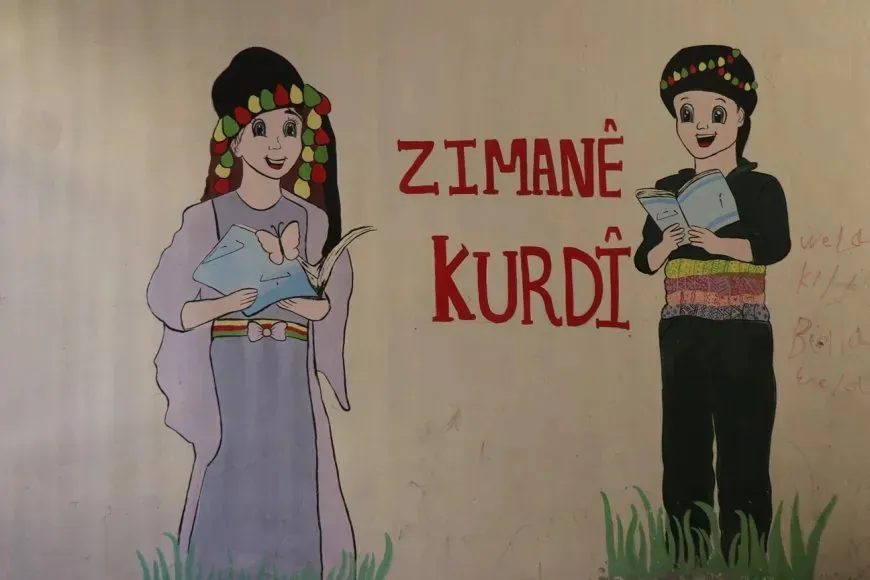
The fate of Kurdish teachers and students in Aleppo and Afrin remains uncertain
According to KurdPress, despite the issue of merging the institutions of the Syrian Interim Government and the Autonomous Administration and the emphasis that the employees of these institutions will not be dismissed, a clear decision has not yet been announced regarding the status of Kurdish teachers, students, educational programs and educational institutions in Sheikh Maqsoud and Ashrafiya regions of Aleppo and the Afrin region.This issue has become one of the important files in the negotiations between the Syrian interim government and the autonomous administration as the new school year is about to begin.
According to the Hawar news agency, during the period of the autonomous administration's activity, three languages, Kurdish, Arabic and Syriac, were used as the main languages of education in schools, and each community could receive education in its own language. In the Kurdish-populated areas of Afrin and the Sheikh Maqsoud and Ashrafiya neighborhoods of Aleppo, schools, teacher training centers and universities with the Kurdish language of instruction were also established.
However, in the process of integrating the autonomous administration institutions with the structure of the Syrian interim government, the status of the educational staff in these areas has not yet been determined. According to the statistics provided, the number of teachers and educational staff associated with these centers reaches 4,265 people.In the two neighborhoods of Sheikh Maqsoud and Ashrafiya in Aleppo, 13 schools were operating, three of which were directly under the supervision of the autonomous administration and 10 schools were jointly managed by the autonomous administration and the Syrian interim government. About 25,000 students studied in these schools in primary, middle and high school. The “Martyr Zouzan Yousef” Teacher Training Center also played an important role in the education and training of teachers.
Before the recent attacks on these two neighborhoods, more than 400 teachers, most of whom worked under the supervision of the autonomous administration’s education and training institution, taught in these schools. With the beginning of the attacks at the beginning of this year and the displacement of some residents, the educational process was also stopped.
After the refugees returned to their homes within the framework of the agreement between the Syrian Democratic Forces and the interim government, a delegation of teachers from the two neighborhoods approached the Aleppo Education and Training Administration to follow up on their situation.According to the teachers, they did not meet directly with Anis Qassem, the director of education in Aleppo, but rather shared their situation with Hassan Shaker and Safia Talja, officials in his office at the Aleppo Education and Administrative Development Department. However, the answers they received were not clear and specific, according to the teachers.
The teachers also stated that Safia Talja asked them to resubmit their files in Excel format so that the Aleppo administration could send them to Damascus. This request has caused concern for the teachers, as they say they had already submitted their files about four months ago and it is not clear why they have to submit their documents again.
How did Kurdish language education begin in Aleppo?
Kurdish language education in Aleppo has a history of several decades, dating back to years before the July 19 uprising.In the 1980s and 1990s, Kurdish language teaching was conducted clandestinely and in homes.
In 2012, the Kurdish Language Institute was opened in the western part of Sheikh Maqsood, and four generations of students were educated there under the supervision of six expert teachers. Seven months later, the education process was suspended following attacks on two neighborhoods, but in 2013, Kurdish language education resumed, and in 2014, Kurdish language was included in the school curriculum.
In 2016, with the resumption of attacks on Sheikh Maqsood and Ashrafiyeh, Kurdish language classes were held in the basements of buildings. After that, educational activities continued under the supervision of the Education and Democratic Society Committee.
After the displacement of Afrin residents due to the attacks of Turkey and its affiliated forces in 2018 and the transfer of a large number of them to Aleppo, a building in the western part of Sheikh Maqsood was designated for Kurdish language education.The building was designated as a school in 2020 and named after the "Hero of Afrin". The school's curriculum was based on the educational program of the Autonomous Administration.
With the increase in the number of students, the "Avasin Demhat" and "Cudi Amanus" schools were also opened in 2022. A year later, the "Zuzan Yusuf" Teacher Training Center also began its activities.
The situation of education in Afrin before the occupation
In the Afrin region, before the occupation of this region by Turkey, the first schools, teacher training centers and universities where education was taught in Kurdish were established.
On January 6, 2011, the first Kurdish language school in the Syrian Kurdistan region was opened in the village of "Deir Qaliya". This school began its activities under the name "Shahid Fawzi", and after that, 318 schools were established in the region at the primary, middle and high school levels.About 50,000 students studied in these schools, and the number of teachers and teaching staff reached 3,712. In addition to public schools, dozens of private schools were also operating.
In 2014, the “Vian Amara” Teacher Training Center was opened with 11 majors. About 500 students studied in this center, and their education was provided by 82 teachers and dozens of staff.
In August 2015, Afrin University was opened with faculties of medicine, electromechanical engineering, communications, economics, agriculture, and Kurdish literature. Before the attacks began, 469 students were studying at this university, with 51 professors and nearly 20 staff responsible for its education and administrative affairs.
With the start of the attacks by Turkey and its affiliated forces, the education process in Afrin was stopped and educational centers were looted or destroyed.Some of these centers were also turned into military bases by Turkish forces and its affiliated groups.
According to information provided to this media by the Afrin-Syria Human Rights Organization, 65 Kurdish language teachers were kidnapped during these developments.
In the current situation and with the start of the new academic year approaching, the fate of this educational infrastructure, and especially the situation of teachers, students, and the continuation of Kurdish language education in Aleppo and Afrin, remains one of the unresolved issues in the negotiations between the autonomous administration and the Syrian interim government.
User comments