
Why is Syria's political geography nothing like Iraq's?
According to Kurdistan Press, comparisons between Syria and Iraq are usually based on the assumption that both countries face a similar problem: a weak central government struggling to hold together a society made up of large ethnic and religious groups. However, the demographic and geographical structures of the two countries are fundamentally different, and these differences explain why federalism, power-sharing based on social components, and territorial autonomy have been able to gain ground in Iraq, but Syrian minorities are in a much weaker position to negotiate the country’s future political structure.
Iraq; Three Major Demographic and Geographical Blocs
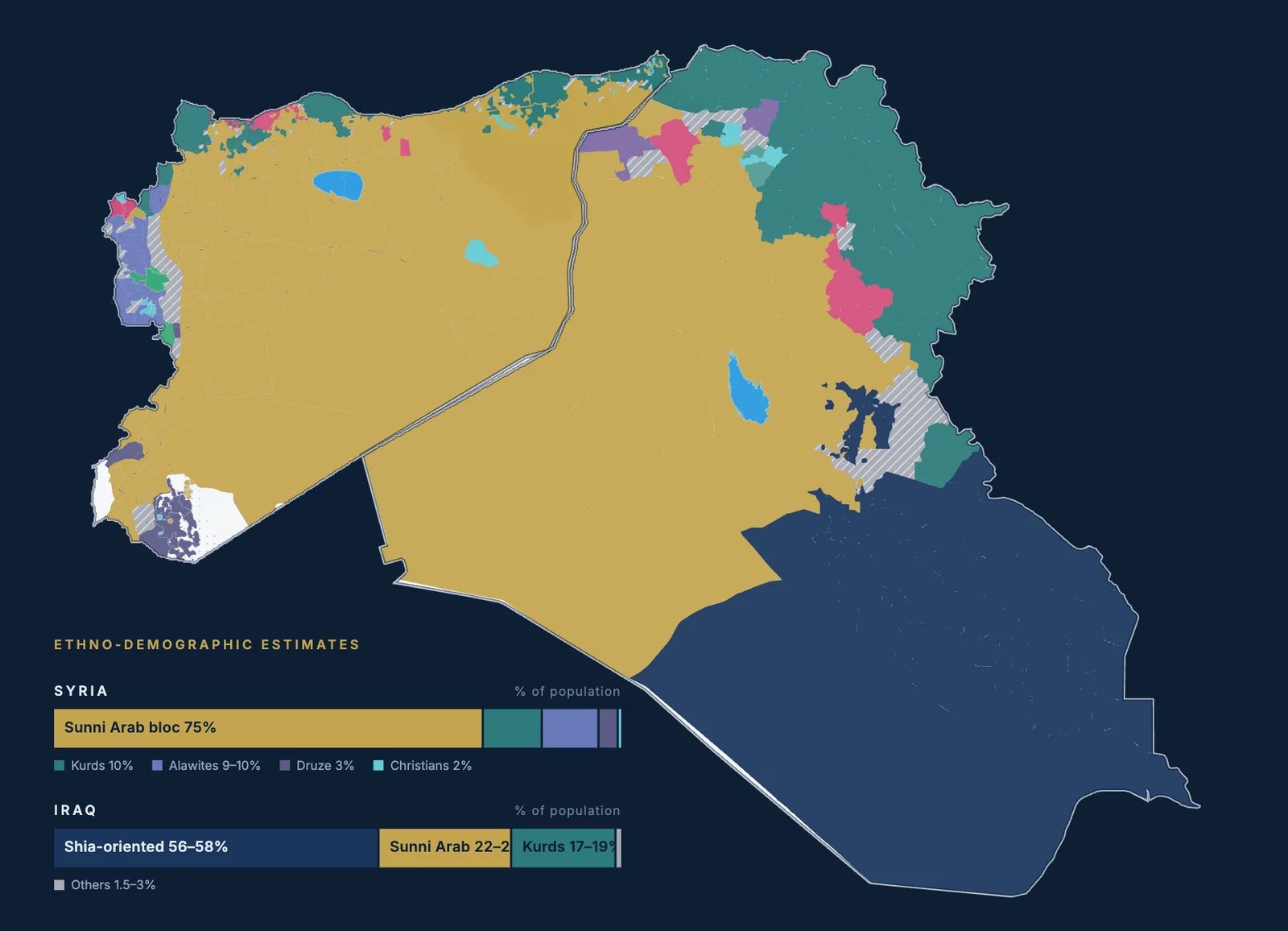
In Iraq, Shiites make up just over half of the population; that is, they have a demographic majority, but this majority is not large enough to dominate the political structure without considering the other major groups in the country.Based on estimates derived from the provinces’ share of parliamentary seats, Shiites make up about 56 to 58 percent of Iraq’s population, and are concentrated mainly in the southern regions of the country.
In contrast, Sunni Arabs make up about 22 to 24 percent of Iraq’s population and have a relatively contiguous geographical area. Kurds make up about 18 percent of Iraq’s population and have the Kurdistan Regional Government.
This situation has created a kind of territorial pluralism; in the sense that the largest community in the country has a majority, but this majority is not large enough to overcome the other groups on its own. On the other hand, the other two blocs make up about 40 percent of the country’s population, and each has its own large and relatively contiguous geographical areas, major cities, and political organizations.For this reason, the political structure of Iraq has moved towards a form of power sharing among the main components of society; a structure of which federalism and the autonomy of the Kurdistan Region are among its most important manifestations.
Syria: a large majority and several small minorities
The structure of Syria is completely different. Sunni Arabs make up about 75 percent of the Syrian population, and smaller Sunni groups such as Turkmen and Circassians are also usually included in the same spectrum in political calculations.
In contrast, other groups have a much smaller share. Kurds and Alawites each make up about 10 percent of the Syrian population, Druze about 3 percent, and Christians about 2 percent.
As a result, none of the Syrian minorities alone exceeds even 10 percent of the country's population.This is a fundamental difference from Iraq, where the two main communities after the Shiites, Sunni Arabs and Kurds, each have a significant population weight, while in Syria the minorities are much smaller in terms of population.
Difference in the geographical distribution of Kurds
Another important difference between the two countries concerns the distribution of minorities.
In Iraq, the Kurdistan Regional Government is predominantly Kurdish, with more than 70 percent of the country's Kurds living there. This population constitutes about 14 percent of the total population of Iraq, and it has a defined geographical area, important cities, and political and administrative institutions.But in Syria, the areas that were under the control of Kurdish-led forces before the dissolution of the Syrian Democratic Forces (SDF) in August 2026 were home to only about 40 percent of Syrian Kurds, a population equivalent to about 4 percent of the total Syrian population.
Syrian Kurds are therefore in a much weaker demographic and geographical position than Iraqi Kurds in any negotiations about the future political structure of the country.
Syrian Minorities and the Lack of a Coherent Region
Another important difference is that Iraq’s major communities each have a distinct and relatively coherent region. The structure of Iraq can be largely defined by three large, geographical components, each with its own region, cities, and political organizations.
Syrian minorities, however, do not have such a position.They are more dispersed, and even in areas where one group is more concentrated, the situation is not comparable to Iraq.
For example, the Alawites are mainly concentrated in the coastal areas of Syria, but unlike the Kurdistan Region of Iraq, this region lacks a large, dominant city with a clear Alawite majority that could serve as the political and urban center of a territorial project.
The role of cities in the political structure
The pattern of urban settlement also shows the same difference. Cities are of particular importance in any territorial project, since the existence of large urban centers belonging to a specific community is one of the main foundations for the formation of a regional political structure.
In Iraq, Baghdad has a mix of different populations, with an estimated two-thirds Shiite and one-third Sunni; the capital is therefore still a mixed city. But in other large cities, demographic demarcation becomes more pronounced.Mosul is predominantly Sunni Arab, Basra is predominantly Shia, Erbil is predominantly Kurdish, and Najaf is predominantly Shia. Thus, Iraq’s geographical framework is reflected in the major cities as well as in the rural areas.
In Syria, the situation is almost the opposite. Damascus, the country’s largest city, is probably about 80 percent Sunni Arab. Aleppo, Homs, and Hama are also predominantly Sunni.
Syria’s fifth largest city, Latakia, is the only example where there is no Sunni majority. In this city, the Alawite and Sunni shares are closer together, estimated at about 50 percent to 40 percent.
As a result, Syria lacks a single major city in which one of the country’s major minorities has a clear majority.The country also lacks the equivalent of cities like Erbil or Basra, a major national urban center that is clearly dominated by one of the major minorities.
The impact of demographic differences on political coalitions
These demographic and geographical differences directly affect the coalition politics of the two countries.
In Iraq, the Shiite majority is large enough to play a major role in national politics, but not so large that it can ignore the other two blocs. Sunni Arabs and Kurds together make up about 40 percent of the country’s population, and both have distinct geographic areas, major cities, and political organizations.
In Syria, about a quarter of the country’s population, made up of various minorities, cannot function as a single political bloc.These groups are geographically separated from each other, and therefore their political priorities differ.
In other words, the 56-58 percent Shiite majority in Iraq faces two communities of about 23 percent and 18 percent; but the nearly 75 percent majority in Syria faces several smaller minorities, none of which come close to the demographic weight of the Sunni Arabs or the Iraqi Kurds.
Two Different Patterns for the Political Future
Finally, the main Iraqi communities are largely complete and relatively coherent units politically and geographically; each of these groups has a significant population, a defined territory, important cities, and political structures.
But Syria is made up of a large, dominant core population that includes the Sunni Arabs, with several smaller, scattered minorities around it.Therefore, the model that led to federalism, power-sharing, and territorial autonomy in Iraq is not necessarily transferable to Syria. Differences in the size of minority populations, their degree of geographic concentration, their access to large cities, and the presence or absence of autonomous regions make the bargaining power of different groups in the two countries significantly different.
Accordingly, any discussion of the future of Syria’s political structure must take into account the fundamental difference between that country and Iraq, because the mere existence of ethnic and religious divisions does not mean that the different groups have the same demographic and geographical weight. In Syria, it is this structural difference that makes the position of minorities, including the Kurds, much more complex and difficult in negotiations over the form of government and the distribution of power.
Source: National Context
User comments