Have the Syrian Kurds achieved their rights in exchange for integration?
According to KurdPress, the process of integrating the Syrian Democratic Forces and the Autonomous Administration into the structures of the central government of Syria, despite progress in the field of military integration and the presence of some Kurdish figures in government institutions, is still facing serious disputes over the right to teach and educate in the Kurdish language, political participation, local authority, and security in Kurdish areas.A review of the implementation of the Damascus-SDF agreement shows that the central government has made progress in restoring its authority over northern and eastern Syria, but no clear guarantees have yet been provided for preserving the political and social gains of the Kurds.
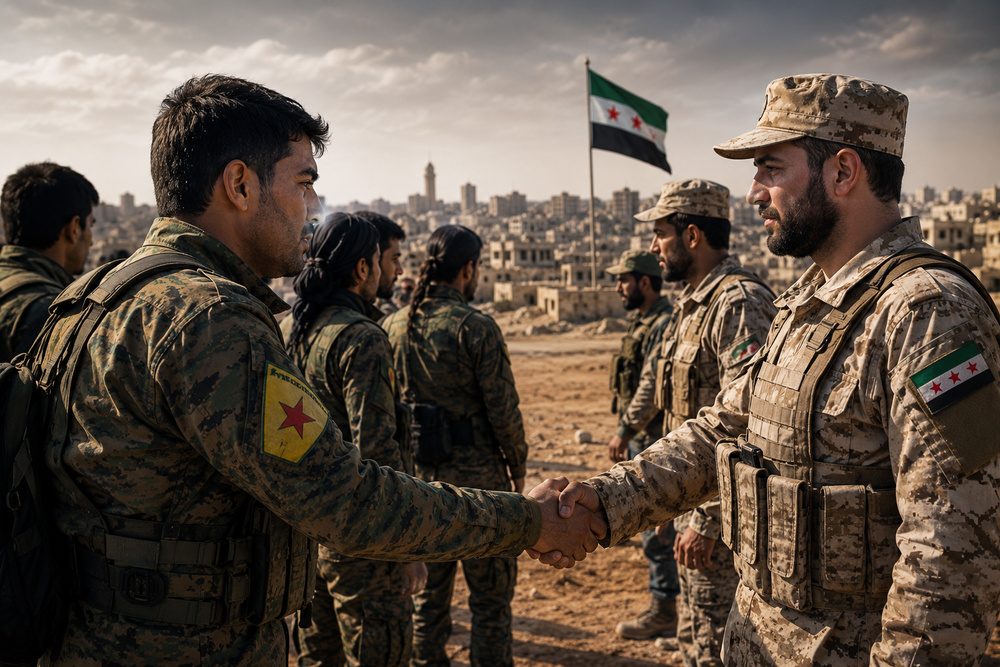
In a report published on October 22, Yves Morris Gray, a writer for the journal Amagi, pointed out that the integration process, despite some achievements, is still at a difficult stage. According to Ilham Ahmed, a senior Syrian Kurdish diplomat, the parties have made progress on this path, but important commitments have not yet been implemented. Disagreements over the status of Kurdish military forces, educational and linguistic rights, the manner of political participation, and the extent of local authority are among the most important obstacles to completing this process.One of the most important developments in this process was the formal dissolution of the Syrian Democratic Forces as an independent military force on August 25, 2026. Before that, about 5,200 men from this group had joined the Syrian army in the form of four brigades. After completing military training in the Damascus suburbs, these forces were deployed in their local areas and took on responsibilities in the field of border defense. However, the integration of these forces does not in itself mean the resolution of disputes over military command, local security powers, and the participation of the Kurds in Syria's defense structures.
The status of the Women's Defense Units also remains unclear. The units announced on October 20 that negotiations on the details of their integration were ongoing.Two months earlier, representatives of the group had discussed with the Syrian transitional government’s Interior Ministry the possibility of merging the Women’s Defense Units as a distinct and organized force, but no final agreement has been reached. Damascus’s opposition to women’s participation in the army has complicated the prospects for integrating these forces.
The dispute goes beyond a military issue and concerns the future of women’s rights in Syria. The autonomous administration has made equal participation of women in political and military structures one of its core principles in recent years, but the central government’s approach to this issue is different. Recent decisions by Damascus to exclude women from studying in some universities and academic fields have also raised concerns about the restrictions on women’s rights during the transitional period.Therefore, the fate of the Women’s Defense Units could become a yardstick for measuring the extent to which the social achievements of the autonomous administration are preserved in the new Syrian structure.
In the area of cultural and linguistic rights, the Syrian Presidential Decree No. 13, which recognized Kurdish identity, culture, and language, is one of the foundations of the integration agreement. However, many Kurds believe that recognizing their rights in official documents without the practical implementation of these rights in schools, universities, and administrative institutions will have limited impact.
Decision No. 493 of the Syrian Ministry of Education, which allocates three sessions a week to teaching Kurdish in schools, has been met with protests from Kurdish students, teachers, families, and political representatives. This decision was made in a situation where students in the autonomous areas had been receiving education in their mother tongue for the past 14 years.Protests and classroom boycotts show that the dispute over Kurdish language teaching has become one of the main challenges to implementing the agreement.
The status of universities established during the self-rule period also remains unclear. In July, Syrian Higher Education Minister Marwan al-Halabi visited the University of Rojava in Qamishlo and said the ministry was considering merging it with the Hasakah branch of Euphrates University. However, negotiations are ongoing on the details of the plan, with Rojava University seeking to retain some of its institutional autonomy and continue teaching in Kurdish. How this dispute is resolved could affect the future of higher education in Kurdish-populated areas and the extent to which institutions established during the self-rule period will be preserved.
The Syrian transitional government has also begun steps to grant citizenship to Kurds who were stripped of their citizenship in the 1962 Hasakah census.This has been a long-standing demand of Syrian Kurds, and the start of the citizenship process is a positive step. However, Kurds living outside Syria still do not have a clear path to apply for citizenship, a limitation that limits the scope of the measure.
Kurdish political participation in the new Syrian structure also faces serious questions. The Syrian transitional parliament began its work in 2026, but Kurdish representatives have expressed concerns about the adequacy of the mechanisms envisaged to represent their communities. Actors associated with the autonomous administration did not participate in the elections, although Ilham Ahmed later became a member of parliament with the appointment of Damascus.These developments come as Syria’s political transition remains highly centralized, with the limits of regional authority and the extent to which residents will participate in decisions about their future unclear.
The appointment of Mazloum Abdi, commander of the Syrian Democratic Forces, as presidential adviser on Kurdish affairs could also provide a way to channel Kurdish demands to central institutions, but the extent of his practical influence over government decision-making remains unclear. From the perspective of Kurdish representatives, presence in formal institutions can lead to effective political participation only when it is accompanied by genuine political competition, reliable representation mechanisms, and clear mandates for local governance.
In addition to these differences, social tensions and security concerns have also made the implementation of the agreement difficult.In the Ghuwayran neighborhood of Hasakah, a number of Arab residents gathered to protest what they saw as a lack of central government control over the area. At the same time, the public desecration of Kurdish flags and symbols at some of the protests raised concerns about the possibility of escalating tensions between the different communities. Noureddine Ahmed, the Kurdish governor of Hasakah, accused forces opposed to the merger agreement of fueling tensions in the city.
User comments