
Can the Swiss experience solve the Kurdish issue in Turkey and Syria?
According to KurdPress, the Swiss experience in recognizing linguistic and cultural diversity, the division of power between the central government and local units, and the direct participation of citizens in decision-making can be a model for reviewing the relations between the governments of Turkey and Syria with the Kurds.In an analysis examining the views of politicians, lawyers and federalism experts, Swissinfo emphasizes that the Swiss model does not necessarily mean the formation of an independent Kurdish state, but can be a way to guarantee the rights of Kurds and their equal participation in the political structure of the countries where they live.
According to Swissinfo, the issue of the Kurds in Turkey and Syria is no longer limited to the expansion of minority rights, but also concerns how political power is organized, different identities are recognized and democratic governance structures are created. In this context, the Swiss experience shows that maintaining the political unity of a country does not necessarily mean imposing a single language, a single national identity and a centralized administrative structure.With its multiple official languages, extensive cantonal powers in areas such as education and health, and mechanisms for direct citizen participation, Switzerland has been able to manage cultural and linguistic diversity within the framework of a common political system. Some Kurdish activists and intellectuals living in the country believe that this experience could also be inspiring for resolving the Kurdish issue in Turkey and Syria; although the historical, political, and social differences of these countries make it difficult to directly transfer the Swiss model.
Hasni Yilmaz, a lawyer and chairman of the board of trustees of the Mesopotamian Justice Observatory Foundation in Geneva, considers coexistence to be one of the most important features of the Swiss system.He believes that constitutional guarantees for different languages and cultures, the participation of different groups in the administration of the country, and the broad powers of cantons and municipalities have made it possible to solve local problems without complete dependence on the central government. In some parts of Switzerland, education, public administration, and the judicial system are also provided in several languages.
He believes that the realization of a similar model in Turkey will not be limited to administrative reforms and will require a new constitution and a fundamental revision of the concept of a centralized state. Ozcan Yilmaz, a historian at the University of Geneva, also emphasizes that Turkey and Syria are still influenced by a centralized understanding of the nation-state and a single national identity; a situation that is far from the principles of linguistic pluralism, equal citizenship, and local self-government.In Turkey, the debate is linked to long-standing Kurdish demands for mother-tongue education, political participation and the empowerment of local institutions. Kurdish politician and lawyer Ferat Anli believes that one of the most important lessons from the Swiss experience is the link between direct democracy and local self-government. In this model, citizens participate in decision-making not only through elections but also through referendums and popular initiatives, and local institutions have greater authority to run affairs.
Anli says that the Kurdish political movement has been emphasizing the strengthening of local governance for years, but achieving inclusive democracy in Turkey requires the recognition of the right to mother-tongue education, respect for the rule of law, full implementation of international human rights standards and increased powers for local institutions.In his view, local self-government is not simply an administrative reform, but a mechanism to ensure political representation and strengthen citizens’ sense of belonging to the country’s political structure.
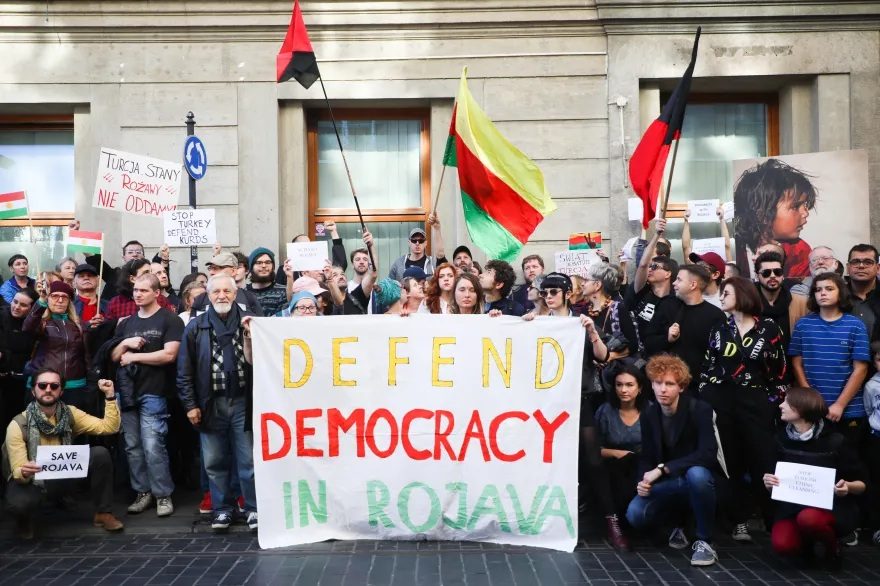
This discussion is also of particular importance in Syria, where the experience of governing the Kurdish regions of the north and northeast of the country, despite relying on local participation, cultural pluralism, and the presence of citizens in management structures, has been exposed to pressures resulting from the return of central government authority. According to Swissinfo, the experience of governing these regions, which was inspired by some principles of local democracy and citizen participation, is comparable in some aspects to the Swiss cantonal system; although the differences in the political and security conditions of the two countries limit the possibility of direct modeling.The main issue in Syria is therefore not simply to preserve or change the administrative structures of the Kurdish regions, but how to guarantee the linguistic and cultural rights of the Kurds, their participation in the administration of the country and prevent the monopoly of power in the central government. The Swiss experience can be a basis for asking whether the reconstruction of the Syrian political structure can be based on the distribution of power and the recognition of social diversity, or whether it will once again lead to the concentration of authority in Damascus.
Fatma Şik, former co-mayor of the Sur district in Diyarbakir, also emphasizes the importance of direct democracy and equal participation of women and men. She believes that the Kurdish women's movement has created experiences in areas such as the co-chairmanship system, equal gender representation and independent women's organization that can even be instructive for European democracies.According to her, the participation of women in decision-making structures, in addition to increasing their political representation, has helped to share power and change traditional patriarchal practices.
However, Eva Maria Belzer, a professor at the University of Fribourg and an expert in the field of federalism, warns that the realization of such a model requires political will and social consensus. She emphasizes that federalism is not simply an administrative issue and that its acceptance by the majority of society will not be easy, especially in countries where a single national identity and centralization of power are entrenched.
Belzer believes that the Swiss experience can be an example of the possibility of coexistence of different linguistic, religious and cultural groups within a common political structure, rather than a model for the formation of an independent Kurdish entity.From this perspective, federalism can allow historical minorities to manage their affairs, especially in cultural areas, more independently, while at the same time participating as equal partners in the governance of the country as a whole.
He also suggests that the discussion of federalism in Turkey and other countries in the region should not be framed solely in terms of the Kurdish issue, but should consider the benefits of decentralization for society as a whole. Strengthening the authority of citizens and local institutions, he believes, can help improve governance and reduce conflict between the central government and different social groups.
Overall, the Swiss experience for the Kurds in Turkey and Syria provides a framework for making demands, such as ensuring linguistic and cultural rights, equal participation in power, and strengthening local self-government, rather than being a ready-made recipe for changing the political structure.The realization of such a model, however, will depend on changing the way central governments view identity diversity, reforming political structures, and forming a social consensus on the distribution of power.

User comments