
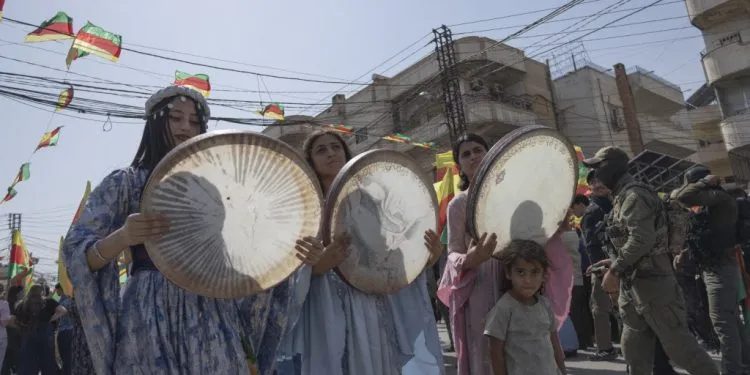
A Historic Opportunity for Syrian Kurds
According to KurdPress, Tariq Hamou, the author of the article and a researcher at the Center for Kurdish Studies in Germany, who holds a PhD in political science and is a lecturer in the Department of Political Science at the Danish Arabic Academy and is also a member of the German Political Science Association, considers the current developments in Syria, and especially those related to the Syrian Kurds, the beginning of a “new stage” for Syrian Kurds; a stage that, according to him, is fundamentally different from previous periods. At this stage, the Kurds are not supposed to remain merely on the margins of the Syrian political structure, but must participate in the administration and building of the state and at the same time preserve their national identity, language and culture.The article was published on September 26, 2026.
One of the important examples mentioned in the article, which was published on the website of the Kurdish Studies Center, is the situation of the Kurds in the central regions of Syria. The author says that in the Kurdish villages of the Hama countryside, a widespread desire to learn the Kurdish language has emerged. According to the initial information provided by the article, more than 50 Kurdish villages in this region have demanded that official government institutions teach Kurdish. The residents of these villages also want to send trained Kurdish teachers and have even suggested that people from among their own children be trained to teach Kurdish.
The author does not see this development as simply an educational demand.In his view, the insistence of the Kurds of the Hama countryside on teaching their mother tongue is a sign of an attempt to reconstruct Kurdish identity and cultural heritage in areas that have been affected by policies of assimilation and language change for decades. To explain this situation, the article compares it with the insistence of the Anatolian Kurds on preserving their language across generations.
The legacy of Baathist policies
An important part of the article is devoted to the past policies of the Syrian government. The author says that the Baathist government presented the Kurds of central Syria as an example of “integration” into Syrian society; but in his view, the real meaning of this integration was the gradual loss of the Kurdish language and identity and its replacement by the dominant Arabic language and identity.
In this context, the article refers to the 1962 census, which, according to the text, deprived hundreds of thousands of Kurds of Syrian citizenship and classified them as “foreign nationals.”The author also considers the “Arab Belt” project between 1965 and 1976 to be part of the Syrian government’s demographic and identity policies, which, according to him, were implemented with the aim of dispersing Kurdish population centers and weakening their social cohesion.
From this perspective, the article distinguishes between two concepts: “integration with identity preservation” and “melting and erasure of identity.” The author believes that the current stage should move towards the former and prevent the repetition of the latter pattern.
Language education; a project beyond school
One of the main proposals of the article is to create an “empowerment phase” or an organized program to restore the Kurdish language and culture to the central regions of Syria.
In the author’s opinion, this plan should not be limited to holding language classes.He suggests the creation of cultural, educational, training and awareness-raising structures and believes that these institutions should be linked to universities and educational institutions in Hasakah and Kobani.
The author highly values the importance of this project and places it alongside some important political goals of the Kurds, including implementing the integration process, consolidating the presence of the Kurds in the state structure and trying to recognize the Kurdish constitution as the second national group in Syria.
Within this framework, the four cities of Qamishlo, Kobani, Afrin and Rukn al-Din are introduced as potential cultural centers that can play a connecting role between Kurdish communities in different parts of Syria.
The responsibility of Kurdish parties
The article does not address the Damascus government alone and places an important part of the responsibility on Kurdish political currents.The author criticizes Kurdish parties for emphasizing “land, people, and language” and symbols such as the Kurdish flag and dress in their programs and campaigns over the past years, but now they must turn these slogans into practical activities.
According to the article’s proposal, these parties should coordinate with each other, send their forces and cadres to central Syria, and help Kurdish communities in these areas to teach the language and preserve their culture.
It has even been suggested that the performance of the parties be periodically evaluated; that is, the slogans that leaders and parties raise in the media and social networks should be compared with their actual actions in Kurdish areas.
Two simultaneous components for integration
One of the key points of the article is that the author does not consider “integration” to be a purely security or administrative process. He defines two main components for it.The first component is “Kurdish identity”; that is, the spread of Kurdish language and culture and the reconnection of hundreds of thousands, and even, as the article puts it, millions of Kurds in the central regions, with their heritage, language, and historical geography.
The second component is “Syrian national identity”; that is, participation in building the Syrian state, strengthening the concept of citizenship, the rule of law, and creating a competitive political life based on elections, political programs, and the interests of citizens.
Therefore, the article argues that preserving Kurdish identity and participating in building the Syrian state should not be seen as two contradictory projects.
The author’s demographic perspective
The article claims in another section that the Syrian Kurds are still in the early stages of their presence in the state structure and that they need to consolidate this process in subsequent stages. The author believes that if this process is successful, the existing picture of the demographic weight of the Kurds in Syria could also change.Here, he writes, the discussion may no longer be limited to estimates of around 10 percent of the Syrian population, and even proportions of 20 or 30 percent may be raised. Of course, these figures are the author's estimates and views, and the text does not provide independent population data for them; therefore, they should not be quoted as definitive statistics on the population of Syrian Kurds.
Opponents of the integration process
The article goes on to mention currents that oppose the participation of Kurds in the administration of the Syrian government and the integration process. The author introduces these opponents as a diverse group and claims that some of them also have problems with the peace and agreement process between the Kurdish movement and the Turkish government; he also mentions the remnants of the Baath, some foreign affiliated networks, and groups that have been involved in looting and seizing property and houses in the past.The author believes that these movements will try to undermine the achievements of the Kurds and disrupt the process of their participation in the administration of the Syrian government. He places this process within the framework of the January 29, 2026 agreement, as well as regulations such as Presidential Decree No. 13 and the decision of the Ministry of Local Government and Environment on increasing the powers of governors.
Opposition within the Kurdish movement
The article also says that opposition to the integration approach does not only come from outside the Kurdish movement. According to the author, some voices in cyberspace accuse the Kurdish forces participating in this process of “betrayal”.
However, the author believes that these movements do not have a decisive influence on the political process due to their limited field role and intellectual isolation.In contrast, he speaks of the approach of participation and integration, supported by the Iraqi Kurdistan Region, the Kurdish movement in Turkey, the Kurdistan Workers' Party, the Peoples' Democracy and Equality Party, as well as some other coalitions of Kurdish political movements.

User comments