
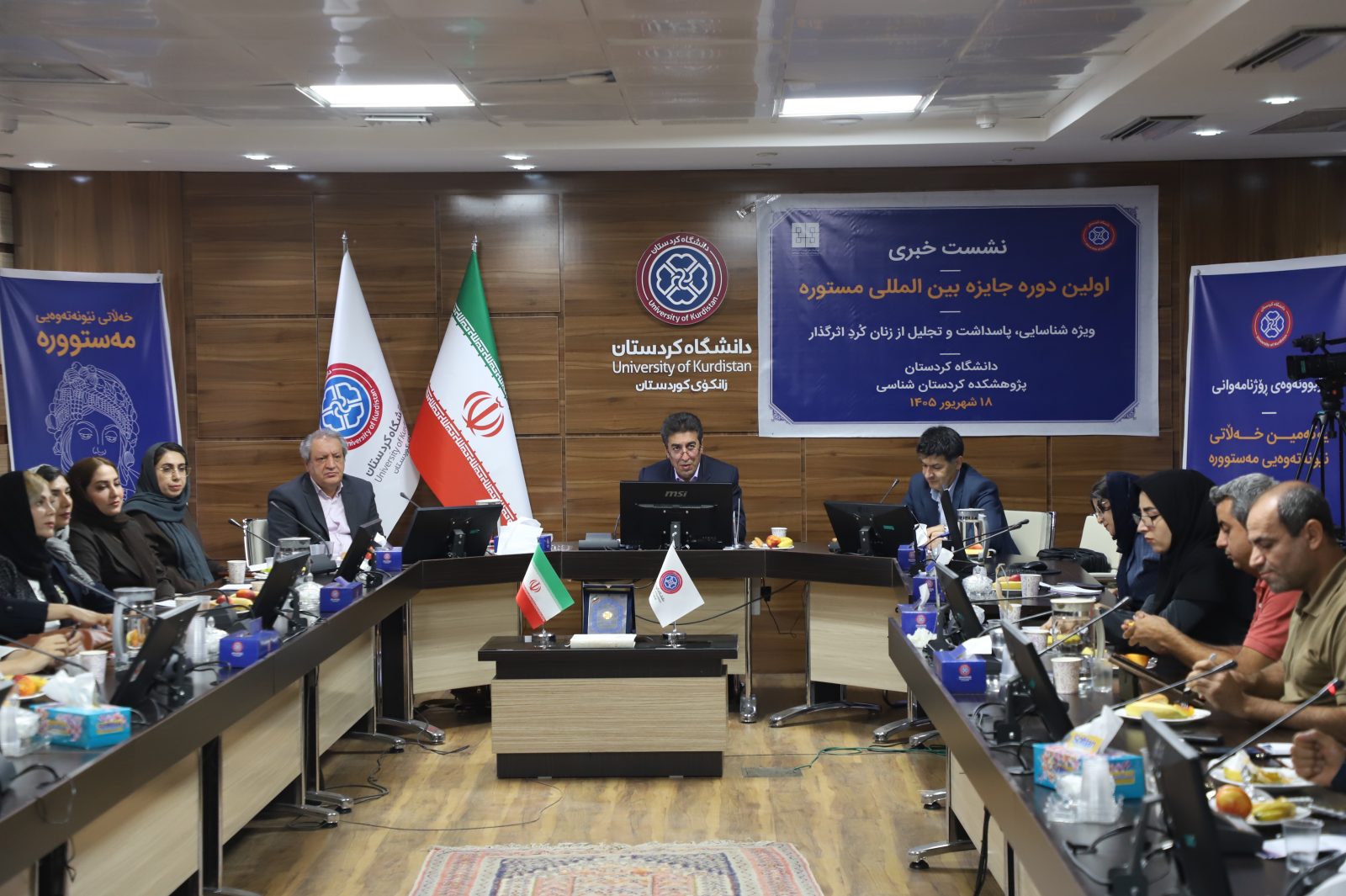
First International Mastoura Award; An Effort to Recognize Influential Kurdish Women
In a press conference, officials from the University of Kurdistan and members associated with the award discussed the objectives and criteria of the Mastoureh Award, the structure of its committees, and the importance of recognizing Kurdish women.
Dr. Yadgar Karimi, head of the Kurdistan Studies Research Center at the University of Kurdistan, while welcoming attendees and journalists, emphasized that the University of Kurdistan is not merely a place for learning and research, but must also, within the framework of a fourth-generation university, be responsive to the needs and issues of its own society.
The Mastoura Award, therefore, is likewise a step within the same framework toward recognizing Kurdish women and their achievements and impact.
Four Categories of the Award
Dr. Bayan Azizi, executive secretary of the Mastoura Award, explained the background and characteristics of the award and noted that the name "Mastoura" is not merely a chosen name, but rather has a cultural and social background behind it.
Bayan Azizi also noted that the selection criteria do not encompass only one dimension, but rather consider various dimensions and the matter of honoring their personality and work.
According to her explanations, the Mastoura Award has been designed in a "selective" manner and covers four categories:
1. Science and specialized sciences, basic sciences including physics, chemistry, mathematics, etc.;
2. Social affairs and job creation;
3. Culture, literature, and art;
4. Mysticism and fields related to women.
At the same time, it was emphasized that the intention is not merely to award well-known names, but rather to discover and recognize influential women; particularly those who have had an impact in their own place and community but are not widely known.
"Famous Women" or "Influential Women"?
One of the distinguishing points of the Mastoura Award is the distinction between "fame" and "influence." At the conference, it was clarified that famous women are to some extent already known, but the main focus of the award is on influential women; those women who have created an impact in society through their work and struggle.
For this purpose, a special media committee has been envisioned for the award so that, through the media, the work and achievements of influential Kurdish women are brought more into the public eye.
Mastoura: The Reason Behind the Award's Name
Jamal Ahmadi Ayin, regarding Mastoura Ardalan, pointed out that Mastoureh was among those women who had scientific education in her time and was able to distinguish herself in several fields.
According to those explanations, Mastoura was not only a "chronicler" but is known as a historian who wrote the history of those before her, and at the end of some of her writings, she also recorded events she witnessed herself.
The discussion also touched on Mastoura's proficiency in Arabic and Persian, and that she had the ability to read sources in Arabic. Her direct influence on the women of her time was one of the important points of the discussion.
From Mastoura to Today's Women
At the conference, it was emphasized that the recognition of Kurdish women should not be limited only to historical and famous figures.
Dr. Bayan Karimi in this regard said that Kurdish women, despite all obstacles, have their own characteristics and capabilities, and recognizing those women can be a task for all those who care about Kurdish history and culture. In the same framework, it was noted that amid the noise of social networks, attention must return to the heart of the community and "our own home," to those who create impact in daily life.
The Charter and Selection Criteria
According to the explanations of the award's officials, a charter has been prepared for the Mastoura Award, and in the process of preparing that charter, various meetings and sessions were held.
Dr. Bayan Karimi, the award's scientific secretary, thanked the policy council, which in a short period was able to prepare a charter covering the different categories of the award.
The Hall of Fame and the Continuity of Recognition
Within the framework of the charter, various events and programs, as well as the establishment of a "Hall of Fame" for Kurdish women, were discussed.
According to the officials of this award, the primary goal of the award is to recognize influential Kurdish women, but the ultimate goal is to showcase their impacts; so that their struggles and achievements become a source of inspiration for the new generation.
Experience of Previous Awards
In response to a question from a KurdPress reporter regarding what the international criterion of the award is, the award's officials noted that this award encompasses all Kurdish women with all dialects, religions, beliefs, and faiths, wherever they may be, and they are honored. They also referred to the experience of the "Hejar Pen" Award and said that the experience of that award, along with its positive and negative points, has been taken into consideration in the process of establishing the Mastoureh Award.
In response to another question from the KurdPress reporter regarding how a woman in an unknown village can introduce herself to this award and reach the nomination process, and whether there is a special system for identifying such individuals, Dr. Serveh Menbari, a member of the award's executive secretariat, announced: "We have tasked a committee specifically with finding these individuals, who in several ways, including visiting villages and seeking assistance from the international advisory council online and by telephone, collect information about these individuals and forward it to the scientific committee of the award."
Dr. Menbari added: "Ultimately, the names of all candidates are submitted to the judges in special forms, taking into account their capabilities and status, and four individuals are recognized as award winners and four others as honorable mentions in the four main categories."
In the continuation of the press conference, efforts to establish the Mastoura Award were discussed, and the role of the University of Kurdistan, the Governorate of Kurdistan, the Ministry of Higher Education, and related institutions in supporting this award was highlighted.
In conclusion, the organizers of the award expressed hope that the Mastoura Award will become a step toward recognizing Kurdish women; not only those whose names are recorded in history and the media, but also those women who, in villages and cities and various fields, without much fame, have had a genuine impact on society.
User comments