
PKK and the Project to Build a Media Ecosystem for the New Era
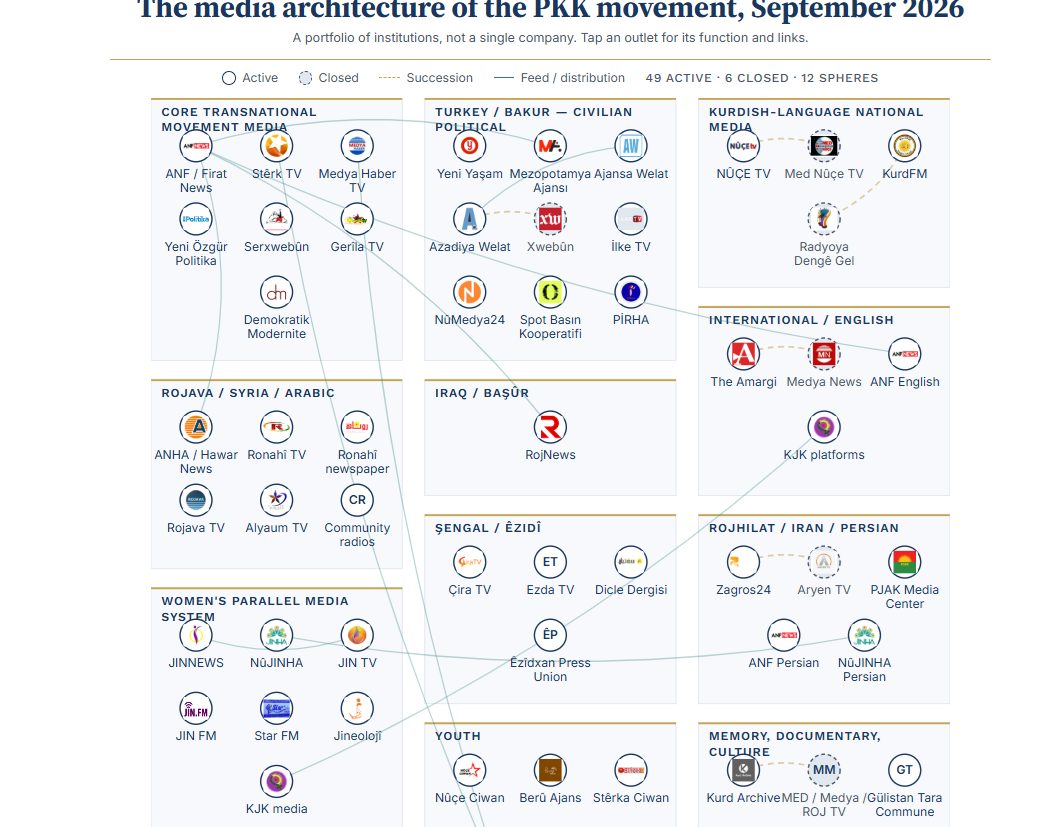
According to KurdPress, citing the National Context magazine, the media network of the PKK and movements close to it has entered a different stage over the past 18 months. At this stage, the media is no longer simply a tool for covering the armed struggle and conveying the movement's political message, but is becoming part of the infrastructure for this movement's presence in the post-war political, social and cultural space.The closure of some long-standing media outlets, the launch of new networks and news agencies, changes in the languages of publication, and attempts to more precisely target audiences in Turkey, Syria, Iraq, and among Kurds outside the region are the main signs of this transformation. The set of these changes indicates that the media structure affiliated with or close to the PKK is moving away from the traditional model of “war media” and moving towards a kind of multilayered and specialized media ecosystem.
This transformation must be examined in the context of the changing political conditions surrounding the PKK. In a situation where the armed struggle can no longer be the main axis of political organization as in the past, issues such as the peace process, politics, rights, culture, language, women, youth, and civil society are gaining more importance. The media must also inevitably redefine its role in line with this change.Within the so-called “free press” movement, there has also been a discussion of reorganizing the media structure. Instead of relying on a centralized organization, the new structure emphasizes the creation of separate departments for news, women, youth, culture, and social issues. The result of this approach is a more diverse network of media outlets, each pursuing its own mission, audience, and language.
One of the clearest signs of this change is the fate of the old media. Media News, the movement’s English-language outlet, closed in June 2025, and at the same time another publication in Germany began operating. The difference between the two media outlets is not just in name and format. The new media is trying to attract audiences such as journalists, academics, researchers, and policymakers whose communication needs differ from those of the traditional war media.In the same year, Anha in northeastern Syria and Rudnews in the Kurdistan Region also stopped broadcasting their Turkish services and focused more on regional languages. On the other hand, when closing the media outlet, the authorities of Dengkegel announced that the peace process had entered a new era and that the media practices of the past were no longer adequate for the new conditions.
The year 2026 brought this process to a new stage. In May, Noche TV began broadcasting from Germany, with offices in the cities of Diyarbakir, Qamishli and Sulaymaniyah. At the same time, Kurdafm was launched as a Kurdish radio station for Kurmanji, Sorani and Kurmanji audiences. A few days later, Zagros 24 began its activities, focusing on Kurdish and Persian-speaking audiences.
What is important here is not simply the increase in the number of media outlets, but the formation of a division of labor between them.Instead of all media outlets repeating the same message in different formats, the new network is trying to define a specific audience and function for each media outlet.
In Turkey, media outlets such as Yeni Yaşam and Mesopotamia News Agency are still the main elements of the news structure, but they are also accompanied by media outlets with different missions. Ağanşa Völat focuses on Kurdish news, Azadıya Völat operates as a press outlet, İlk TV introduces itself as a media outlet for peace and rights, and Nomedia24 deals with culture, podcasts, and lifestyle in addition to politics. Spot Press also targets an intellectual and democratic audience and follows topics such as the peace process, political economy, and reconciliation.
In this way, the concept of “media” in this structure is changing.The media outlet is no longer necessarily the single mouthpiece of an organization; it can be a Kurdish-language outlet for Kurdish audiences, an Arabic outlet for the Arab community, a Persian outlet for Persian speakers, and an English outlet for journalists and policymakers. This shift transforms the media network from a centralized propaganda apparatus to a collection of regional, linguistic, and thematic outlets.
The Kurdish language has a special place in this new architecture. Noche TV has taken over part of the former political function of Sturk TV, while Sturk has focused more on language, culture, and social issues in the various Kurdish dialects. Alongside them, Kurdfm serves as a radio outlet, Ajansa Vlat serves as a news agency, and Azadi Ya Vlat serves as a press outlet.Meanwhile, efforts to preserve and reproduce the media memory of this movement continue. Kurd Archive is creating a media archive by digitizing the legacy of old media outlets such as Mad TV, Media TV, and Rouge TV; a move that shows that the new network is not only thinking about producing everyday content, but also considers preserving its media history as part of a long-term communication project.
Geographical division is also part of this transformation. In Iraq, Rudnews covers topics ranging from the politics of the Kurdistan Democratic Party of Iraq and the Patriotic Union of Kurdistan to Baghdad, Sinjar, Makhmur, and the Turkish operation, while at the same time trying to include an Iraqi Arab audience in its circle of audience.
In northeastern Syria, this division of labor is clearer.ANHA plays the role of a news agency, Ronahi TV plays the role of a television network, and Al-Youm TV plays the role of an Arabic news media outlet. In the Persian-speaking audience, Zagros 24 seeks to create a different media platform with a combination of Kurdish and Persian content.
One of the important features of this new structure is the creation of specialized media outlets for women and youth. Gene News, Nujinha, Gene TV, and Gene FM operate in the field of women, and the Geneology magazine pursues the theoretical and intellectual dimensions of this field. Media outlets such as Estrekejavan, Nochejavan, and Boro are also active for youth.
This division shows that the media in this new structure is not simply responsible for transmitting news. The media has become a tool for producing identity, social organization, redefining the audience, and maintaining cultural ties.From this perspective, the media is part of a larger political and social organization that is trying to adapt to the post-conflict environment.
The chain of media replacements also illustrates this change well. “Media News” has given way to “Amargi”, “Arian TV” has been replaced by “Zagros 24”, “Khoy Bun” has been continued with the re-release of “Azadiya Valat”, and after the closure of “Dangeghel”, new audio media, including “Kardafm”, have been formed. Even the name “Noche”, which has a long history in this network, has been revived once again in the form of a television network.
This pattern shows that the goal is not simply to maintain existing media capacities. It seems that the main effort is to rebuild these capacities with a more professional language, format and identity that is appropriate for the audiences defined in the new political space.
The media transformation of the PKKThe PKK has occurred at the same time as broader changes in the regional political environment. The peace process in Turkey, the movement of the Syrian Democratic Forces towards integration into the Syrian government structure, and the changing political relations in the Kurdistan Region have created conditions very different from the period when the PKK media network was formed mainly to cover the armed struggle and media confrontation with the Turkish government.
In such an environment, the media cannot be based on the logic of war forever. A network that is supposed to be present in the new political and civil space must also speak about elections, rights, culture, language, economy, society, women and youth, and have an appropriate audience and format for each of these areas.
However, the direct organizational relationship between all these media and the PKK must be judged with caution. The official connection of some old media with the PKK media structureThe PKK has a documented history, but for a number of new media outlets, including “Amargi”, “Ilkay TV”, “Nomedia24”, “Spot”, “Zagros 24” and “Al-Youm”, public evidence is more related to the background of the activists, the time of establishment, media links, the way the media is introduced and their political position and does not necessarily prove a direct command relationship with the PKK.
From this perspective, a more accurate description of this development is not the “expansion of PKK media” in the narrow sense, but the formation of a broad media ecosystem around this movement, part of which has a clear organizational history and another part has approached this movement more through a human, intellectual and media network.
Ultimately, what is taking shape can be considered a transition from “media supporting and trained in the struggle” to “media in the post-armed struggle era”.A network that was once built primarily to narrate the war and maintain political cohesion in conflict situations now struggles to be present in multiple political and geographical spaces, with different languages and audiences, and in areas ranging from politics and society to culture, women, and youth.
If this trend continues, its importance will not be limited to the number of newly established networks and news agencies. The main question is whether this new structure can transfer the political narrative of this movement from the battlefield to the public arena, an arena where media credibility, audience diversity, professionalism, and the ability to influence public opinion become as important as conveying the political message.
User comments