
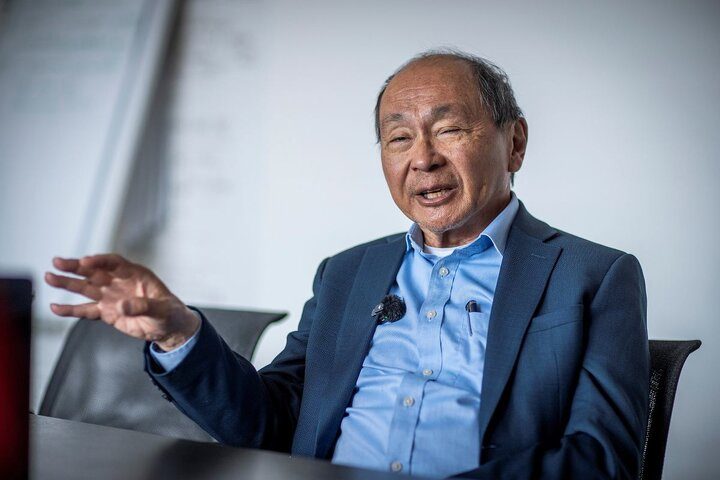
Fukuyama: Rubio seeks to justify Trump's contradictory policies
According to Kurdistan Press, US Secretary of State Marco Rubio's recent trip to three NATO member countries and his controversial speech in Greece have become one of the most controversial diplomatic and media events in recent days. In his speech in front of the historical monument of the Acropolis in Athens, Rubio advanced an anti-Iranian narrative and claimed that the Achaemenid army and Xerxes set fire to the place and destroyed its temples; statements that provoked widespread reactions on social networks.Critics emphasized that the US Secretary of State, by abusing ancient narratives and distorting history, sought to create a psychological foundation and justify aggressive approaches and possible military threats against Iran. Rubio continued his speech by claiming that "Western civilization is in danger of decline" and called on European countries to return to "the values of ancient Greece" to save this civilization and to help the United States on this path. However, the controversial dimensions of this speech were not limited to the distortion of Iranian history; his reckless use of political philosophy terminology also led to a sharp reaction from Western intellectual elites.
Fukuyama enters the fray; Criticizes Rubio's misuse of "thymus"
In the latest reaction, Francis Fukuyama, a philosopher and senior researcher at Stanford University, questioned the US Secretary of State's claims by publishing a frank note.Fukuyama points out that Rubio, on the historic hill of the "Penix" (near the Acropolis), considered the backbone of Western civilization to be the Greek concept of "Thymos" and praised it; a concept that Rubio introduces as simply equivalent to "the search for excellence, competition, ambition and manifestation of great men" in the fields of war, philosophy and statecraft.
Pointing out that he himself redefined the concept of thymos in the book "The End of History and the Last Man" in 1992, Fukuyama clarifies that the US Secretary of State has a very incomplete and superficial understanding of this concept. He explains that "thymos" in ancient psychology and philosophy means "pride, zeal and the inner desire of man to be seen and recognized"; A force that is never a one-sided virtue, but rather a dangerous double-edged sword that has shaped humanity's first bloody battles to impose dominance over others.Two Sides of the Coin: Democratic Egalitarianism vs. Destructive Hegemony
The leading international relations theorist explains that the human desire to be seen falls into two diametrically opposed branches: first, “Isothymia,” or the desire for equality and recognition as equals, which underlies human dignity and the emergence of democracies; and second, “Megalothymia,” which is based on the desire for superiority, the desire to be superior, and the inferiority of others.
While this hegemony has rarely motivated leaders such as George Washington, Abraham Lincoln, and Winston Churchill, Fukuyama warns that at most points in history it has fueled the machine of tyranny and the horrific crimes of the likes of Adolf Hitler, Joseph Stalin, and Pol Pot.Therefore, Rubio’s blind praise of this trait without considering its uncontrollable nature is a strategic and intellectual error.
Fukuyama adds: “Trump wants his face carved on Mount Rushmore, but at the same time he is pursuing lesser honors such as the Nobel Peace Prize. Trump is an example of “unbridled megalomania.” The US president was not satisfied with wealth and sought political power, a path that has led America to an authoritarian state.”
Sacrificing the principles of democracy at Trump’s feet
The senior researcher at Stanford University directs his criticism directly at Donald Trump and the political flattery of his Secretary of State. Fukuyama sees Trump as the perfect and reckless embodiment of “unbridled superiority” that is unable to distinguish between moral virtues and power-seeking vices.Fukuyama asserts that Marco Rubio is distorting the truth and objective facts to maintain his position in Trump's inner circle. He adds that Rubio speaks of the unity of Western values while his boss openly admires authoritarian leaders such as Vladimir Putin and Xi Jinping more than Washington's democratic allies.
The prominent thinker concludes by noting that just as extreme supremacy led the city-state of Athens to the disastrous quagmire of the "Sicilian Massacre" and its collapse in ancient times, relying on these traits in today's world is also destructive; because the true cornerstone of democracy and the charter of the United States is the principle of "inherent equality of human beings," not the strain against the desire of autocratic rulers to dominate the world.
Source: ISNA





User comments